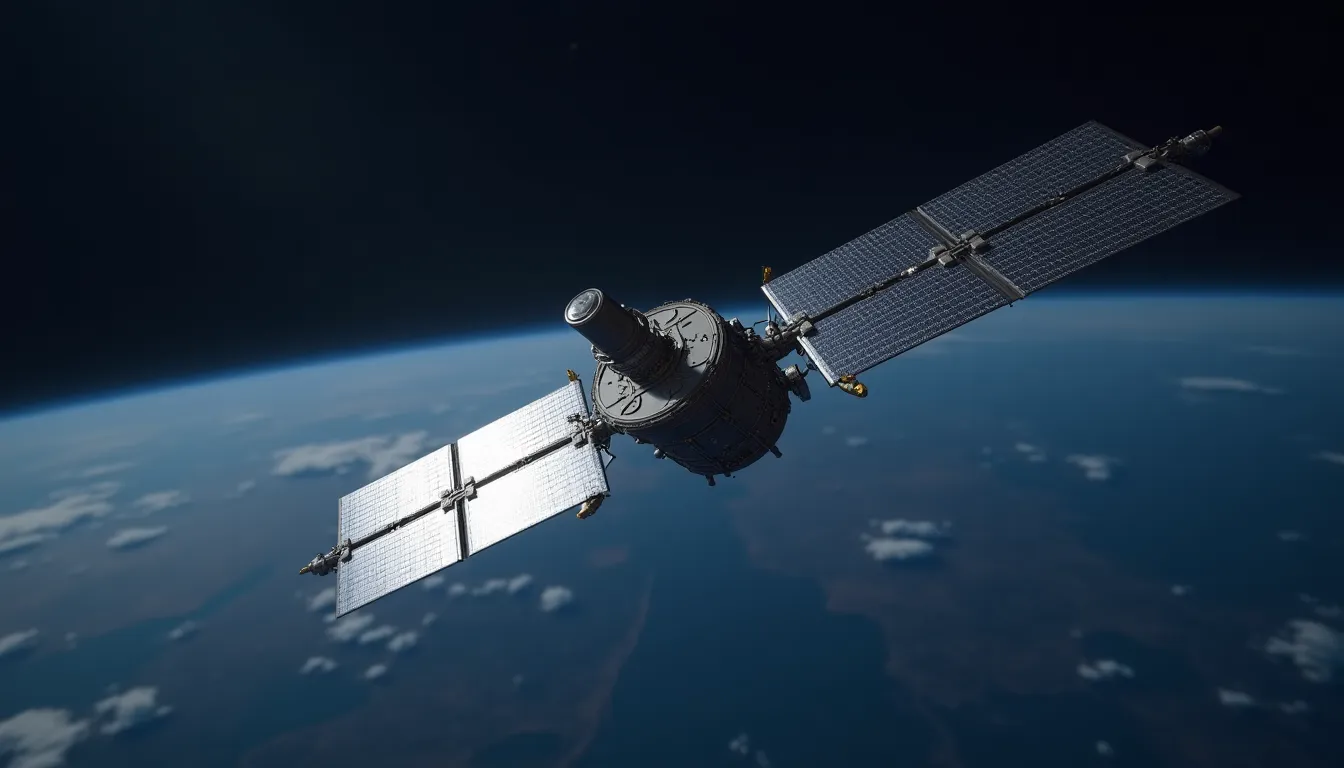
In an era defined by rapid technological advancements, satellite technology stands at the forefront of the aerospace and defense industries. Recent developments emphasize a shift towards low Earth orbit (LEO) constellations, sophisticated missile detection systems, AI-driven analytics, and robust communication networks. These innovations not only enhance strategic defense capabilities but also redefine the landscape of global security.
Key Initiatives in Satellite Technology
Golden Dome Missile Defense Initiative
One of the cornerstone projects driving satellite innovation is the U.S. Department of Defense’s Golden Dome Missile Defense Initiative. Launched in September 2025 with a substantial budget of $24.4-25 billion, this initiative focuses on the deployment of satellites equipped with advanced infrared sensors. These sensors are designed to detect the heat signatures of hypersonic missiles, enabling early warning capabilities and space-based intercepts. According to a Lockheed Martin analyst, this initiative is poised to redefine missile defense, showcasing the critical role satellites play in national security.
Tranche 3 Tracking Layer
Another significant development is the Space Development Agency’s (SDA) Tranche 3 Tracking Layer, which awarded contracts for 72 satellites on December 19, 2025. These satellites will utilize Phoenix infrared sensors alongside advanced 9-DOF MEMS IMU technology for precision fire-control tracking. The Tranche 3 system builds upon its predecessors, enhancing missile warning and defense capabilities across various orbital altitudes, including geostationary (GEO), medium Earth orbit (MEO), and low Earth orbit (LEO).
The Role of AI and Onboard Processing
TacSat Program
The integration of artificial intelligence (AI) and onboard processing represents a transformative shift in satellite capabilities. Lockheed Martin’s TacSat program exemplifies this trend, featuring onboard data processing to minimize reliance on ground relay systems. By processing data directly in space, TacSat can deliver near real-time analytics, significantly enhancing operational efficiency. This program’s advancements are complemented by the Defense Support Program (DSP), which is undergoing upgrades to incorporate AI for improved clutter rejection and hemispheric coverage, thus expanding its operational scope.
Proliferated Constellations and Resilience
The aerospace industry is witnessing a marked transition towards proliferated constellations, with hundreds of small LEO satellites being deployed. This model is driven by the need for lower costs, rapid deployment, and enhanced resilience against potential threats. These constellations, such as those utilizing Very High Throughput Satellites (VHTS), promise terabit-speed data transfer, facilitating Internet of Things (IoT) applications and enabling groundbreaking advancements in quantum encryption and edge computing.
Future Technologies and Applications
The advancements in satellite technology also encompass high-performance systems such as the Advanced Sensor Module, which integrates a 9-DOF MEMS IMU for exceptional motion sensing capabilities. Such technologies are crucial for applications requiring stability and precision, further enhancing the capabilities of modern satellites.
Moreover, the ZQXXSGDSS System, with its high-performance single-tube PIN quadrant detectors, is poised to revolutionize laser beam positioning and tracking applications critical to defense operations. Coupled with the Control System featuring high-performance CMOS imaging, these advancements reflect the industry’s commitment to integrating cutting-edge technologies into satellite operations.
Upcoming Projects and Innovations
In addition to the aforementioned initiatives, several notable projects are on the horizon. The FORGE C2 project aims to establish cyber-secure satellite command and control, with the next phase expected in early 2025. Furthermore, the MACH-TB 2.0 initiative will focus on hypersonics testing, while SDA’s demonstrations of space-to-air optical links continue to pave the way for innovative communication solutions.
Conclusion
The landscape of satellite technology is rapidly evolving, driven by significant investments and innovations from both government and private sectors. The advancements in missile detection, AI integration, and resilient communication networks are set to enhance defense capabilities and redefine military strategy. As we look to the future, the ongoing development of satellite systems will play a crucial role in shaping global security and technological advancement within the aerospace and defense sectors. With the continual push for miniaturization and efficiency, the next generation of satellites will undoubtedly usher in unprecedented opportunities and challenges in national defense and beyond.
References
-
Revolutionizing Defense: Recent Advances in Satellite Technology (orbysa.com) - 4/7/2026 Explore the latest developments in satellite technology that are transforming aerospace and defense, focusing on LEO constellations, …
-
Defense Tech Trends for 2026: Innovation in Action - NSTXL (nstxl.org) - 2/6/2026 Satellite communications are trending toward more resilient and proliferated constellations, with enhanced cybersecurity, lower-latency …
-
Defense Support Program Satellites - Space Force (www.spaceforce.mil) In their 22,300-mile, geosynchronous orbits, DSP satellites help protect the United States and its allies by detecting missile launches, space launches and …
-
Space Development Agency – Increasing Warfighters’ Lethality … (www.sda.mil) - 4/7/2026 The Space Development Agency (SDA) will quickly deliver needed space-based capabilities to the joint warfighter to support terrestrial missions.
-
Reports - BryceTech (brycetech.com) - 3/30/2026 Orbital and Suborbital Launch Sites of the World 2025. Download Report. A BryceTech publication. January 28, 2025. Revised December 22nd, 2025.
-
Aviation, Defense, and Space Market Size Report, 2032 (www.metastatinsight.com) - 2/20/2026 The future of development includes AI-based autonomous operations, better battery life, and increased payload capacity for both defense and …
-
New Technology Trends in Aerospace and Defense Industry [2026] (www.epicflow.com) - 12/29/2025 This is explained by the reduction of prices for satellite launches and the increased demand for geospatial intelligence and satellite imagery.
-
Satellite Tech Solution Providers List 2025 - Aero Defense Outlook (aerodefenseoutlook.com) - 3/12/2025 With the rise of Low Earth Orbit (LEO) satellites, organizations are achieving greater coverage, resilience, and affordability in global communications.
-
Space Technology Trends 2025 | Lockheed Martin (www.lockheedmartin.com) - 12/3/2024 Here are the top 10 space technology trends shaping the future of satellite communications, remote sensing and space exploration.
-
The New Frontier of Satellite Technology | Dassault Systèmes (www.3ds.com) - 4/3/2024 Driven by the need to accelerate innovation, this new frontier helps companies identify opportunities to extend the limit of rocketry and satellite design and …