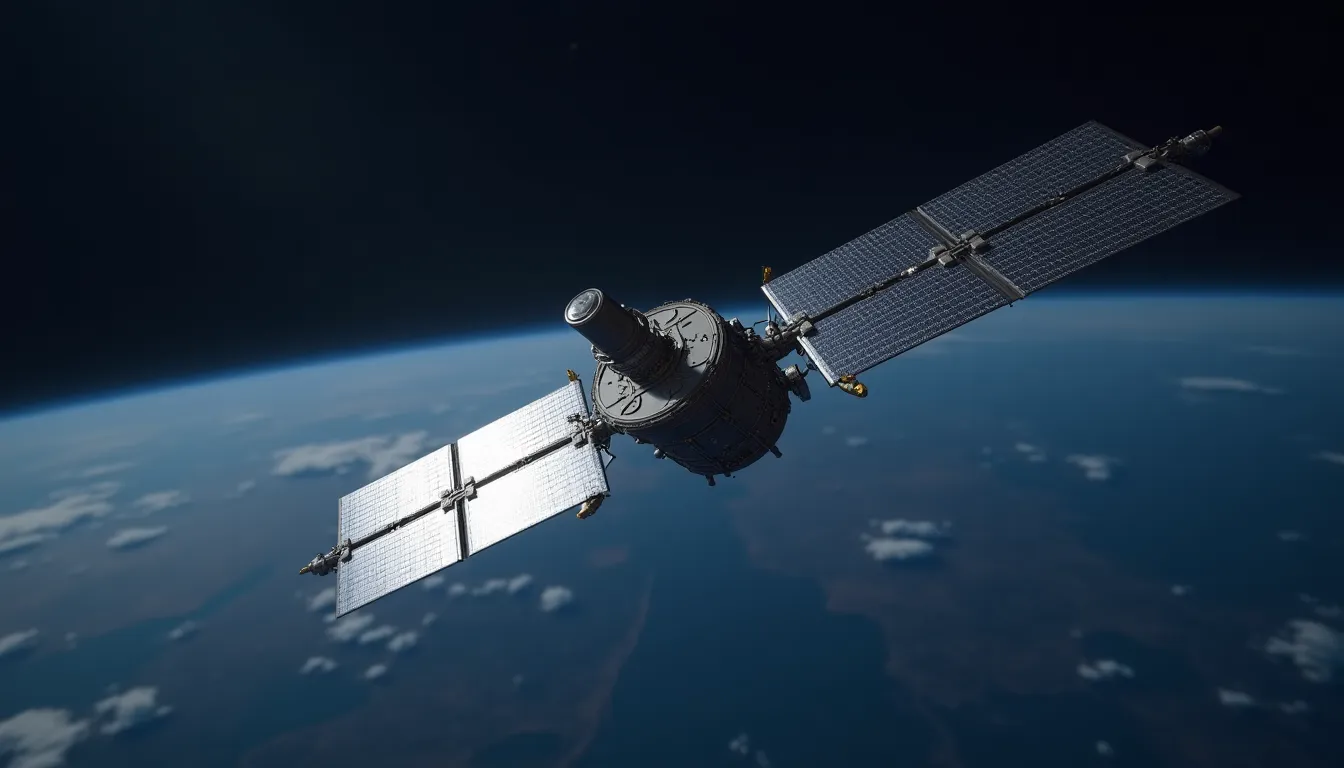
Recent advancements in satellite technology are revolutionizing the aerospace and defense sectors, focusing on low Earth orbit (LEO) constellations, sophisticated infrared sensors for missile detection, and the integration of artificial intelligence (AI). These developments are largely driven by initiatives from the U.S. Space Development Agency (SDA) and innovative commercial entities, marking a pivotal shift in satellite capabilities and applications.
Advancements in Satellite Technology
The SDA has recently made headlines by awarding a significant contract valued at $3.5 billion for the deployment of 72 LEO satellites as part of its Tranche 3 Tracking Layer program. This initiative aims to enhance missile warning and tracking capabilities, specifically against emerging hypersonic threats. Rocket Lab is tasked with launching 18 of these satellites on its Lightning platform, utilizing the Advanced Sensor Module, which integrates a 9-DOF MEMS IMU for precise fire-control tracking. This technological leap builds on previous phases of the Proliferated Warfighter Space Architecture (PWSA) initiative, which is set to redefine the landscape of military space operations.
The transition from traditional geosynchronous systems, such as the Defense Support Program (DSP), to next-generation proliferated architectures is essential for adapting to the rapidly changing threat environment. The DSP satellites, which have been operational for decades at 22,300 miles above Earth, are being phased out in favor of the more responsive Space Based Infrared System (SBIRS), which offers enhanced capabilities for missile and space launch detection.
Enhanced Missile Detection Capabilities
The new LEO satellites equipped with advanced infrared sensors are designed to detect the heat signatures of hypersonic missiles during their ascent phase, offering early warning capabilities that were previously unattainable. Lockheed Martin is also making strides in this field by developing a medium Earth orbit (MEO) missile-tracking satellite. This system aims to provide a broader coverage area closer to the Earth’s surface, effectively complementing the upgrades being made to Northrop Grumman’s GEO-based DSP satellites.
The integration of technologies like the JDWZZ3411 System, a dual-axis MEMS gyroscope, enhances the precision of these satellite systems, ensuring they can accurately track fast-moving objects in space. Such innovations demonstrate the industry’s shift towards using advanced sensor technologies to meet the increasing demands for reliable and responsive defense systems.
Commercial Expansion and European Initiatives
In addition to U.S. advancements, European companies like ICEYE are making significant strides in satellite technology. ICEYE is expanding its satellite fleet to serve as a defense intelligence provider for Europe, focusing on real-time tactical operations. This move not only reduces reliance on U.S. data but also empowers European nations to enhance their autonomous defense capabilities. According to reports, ICEYE’s recent expansion is designed to provide timely synthetic aperture radar (SAR) imaging, which is crucial for battlefield awareness and operational planning.
Emerging Trends in Satellite Technology
As we look towards late 2025 and early 2026, several emerging technology trends are shaping the future of satellite operations. The proliferation of small satellite constellations is proving advantageous due to their resilience, lower costs, and rapid deployment capabilities. Innovations in AI and machine learning (ML) are also being leveraged for onboard data processing. For instance, Lockheed Martin’s TacSat, equipped with the 5G.MIL payload, exemplifies the potential for satellites to process data autonomously, enabling faster decision-making in defense scenarios.
Moreover, the trend towards satellite miniaturization is facilitating enhanced Earth observation capabilities. Very high throughput satellites (VHTS) are emerging as key players in this space, providing terabit-speed data transfer capabilities that dramatically improve communication and data-sharing efficiencies.
Groundbreaking Demonstrations and Future Outlook
The SDA has showcased significant advancements in optical communications, including space-to-air demonstrations conducted on September 2, 2025. These demonstrations highlight the potential for high-speed data transmission between satellites and ground-based systems, which is crucial for future military operations. Alongside these advancements, Lockheed Martin’s establishment of a Small Satellite Processing Center underscores the industry’s commitment to high-volume production for these advanced systems.
Conclusion
The landscape of satellite technology is evolving rapidly, driven by innovations in LEO constellations, missile detection, and AI integration. As the SDA and various commercial entities continue to push the boundaries of what is possible, the future of aerospace and defense appears increasingly interconnected and technologically advanced. With the continued development of systems like the ZQXXSGDSS System for precise laser beam positioning and tracking, the potential for enhanced operational capabilities is vast. As we approach the end of 2025 and beyond, stakeholders across the industry must remain vigilant and adaptable to leverage these advancements for national security and global defense strategies.
References
-
Revolutionizing Aerospace: The Future of Satellite Technology in … (orbysa.com) - 4/8/2026 Explore the latest developments in satellite technology that are transforming aerospace and defense, focusing on LEO constellations, missile …
-
Defense Support Program Satellites - Space Force (www.spaceforce.mil) In their 22,300-mile, geosynchronous orbits, DSP satellites help protect the United States and its allies by detecting missile launches, space launches and …
-
Reports - BryceTech (brycetech.com) - 4/10/2026 Orbital and Suborbital Launch Sites of the World 2025. Download Report. A BryceTech publication. January 28, 2025. Revised December 22nd, 2025.
-
Space Development Agency – Increasing Warfighters’ Lethality … (www.sda.mil) - 4/7/2026 The Space Development Agency (SDA) will quickly deliver needed space-based capabilities to the joint warfighter to support terrestrial missions.
-
New Technology Trends in Aerospace and Defense Industry [2026] (www.epicflow.com) - 12/29/2025 According to the research, some of most prominent satellite technology trends are going to be the following ones: Satellite miniaturization …
-
Military Space Systems - Defense News (www.defensenews.com) - 11/17/2025 Defense News offers premier news and analysis of military space programs and technologies to keep defense and industry decision-makers informed.
-
Satellite Tech Solution Providers List 2025 - Aero Defense Outlook (aerodefenseoutlook.com) - 3/12/2025 With the rise of Low Earth Orbit (LEO) satellites, organizations are achieving greater coverage, resilience, and affordability in global communications.
-
Discover Defense Technology Suppliers on Defense Advancement (www.defenseadvancement.com) - 12/4/2024 Accelerate Defense Modernization through Strategic Sourcing ; Sila Nanotechnologies SteerAI ; Advanced Navigation BAE Systems FalconWorks Wolf Advanced Technology.
-
Space Technology Trends 2025 | Lockheed Martin (www.lockheedmartin.com) - 12/3/2024 Here are the top 10 space technology trends shaping the future of satellite communications, remote sensing and space exploration.
-
The New Frontier of Satellite Technology | Dassault Systèmes (www.3ds.com) - 4/3/2024 Driven by the need to accelerate innovation, this new frontier helps companies identify opportunities to extend the limit of rocketry and satellite design and …