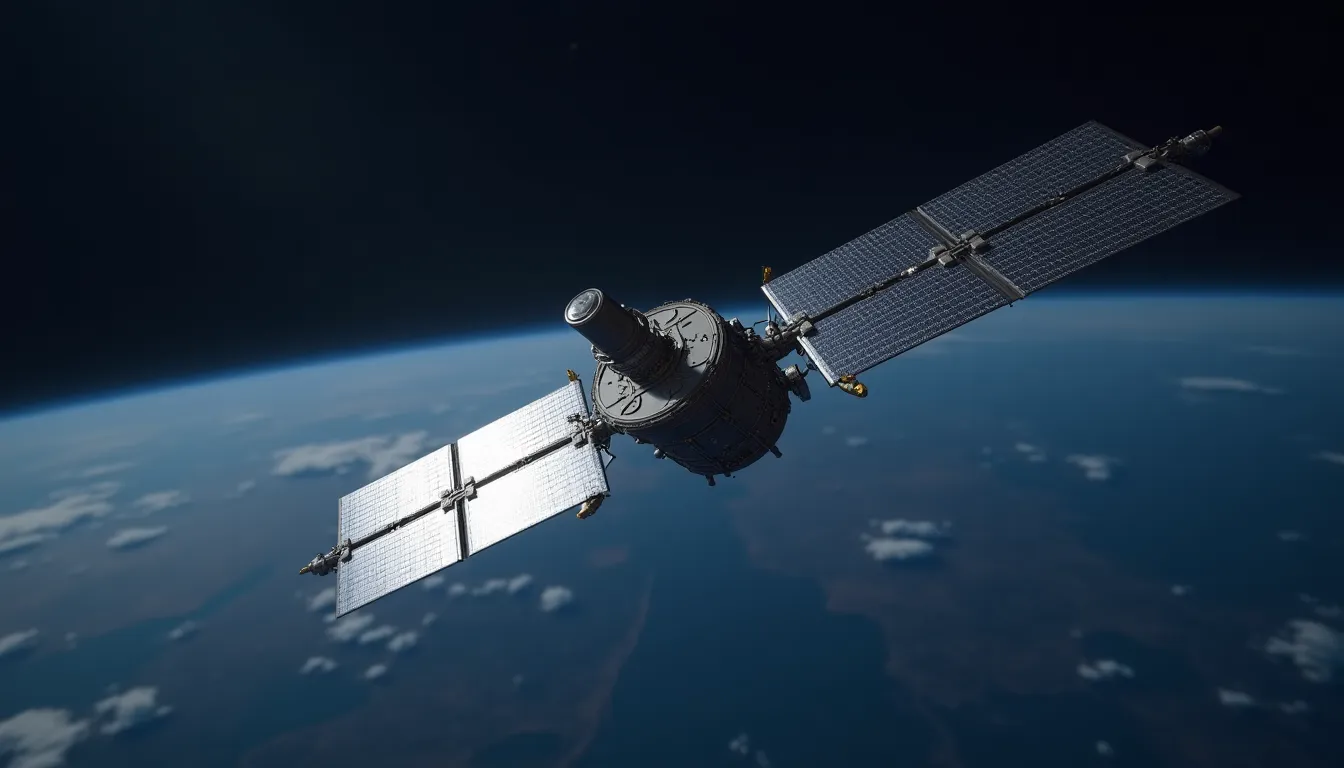
Recent advancements in satellite technology are not only reshaping the aerospace and defense industries but also responding to an evolving geopolitical landscape. The focus on resilient missile detection systems, proliferated low-Earth orbit (LEO) constellations, and dual-use capabilities for civilian and military applications is more critical than ever. This article delves into the key developments in satellite technology, highlighting significant U.S. and European initiatives.
Enhanced Missile Warning and Tracking Systems
In the United States, the Space Development Agency (SDA) is at the forefront of developing advanced missile detection systems. The SDA’s Tranche 3 Tracking Layer is set to significantly enhance missile warning capabilities, with a contract awarded to Lockheed Martin for 18 satellites, as part of a broader $3.5 billion investment covering a total of 72 satellites by late 2025. These satellites will utilize advanced infrared sensors designed to detect hypersonic threats, which have become a priority due to their speed and maneuverability.
Lockheed Martin’s Next-Gen GEO Overhead Persistent Infrared (OPIR) system is another flagship project. Utilizing the LM 2100 bus, these satellites exhibit enhanced cyber hardening, increased power, and improved propulsion systems that allow for effective detection of missile launches from geosynchronous orbits.
Two-Way Optical Communications
The SDA has also demonstrated two-way optical communications between satellites and aircraft, showcasing a leap in secure high-speed networking crucial for the Proliferated Warfighter Space Architecture (PWSA). This capability provides GPS-independent navigation via optical inter-satellite links, marking a significant advancement in military satellite operations.
Dual-Use Satellites: A Global Perspective
Across the Atlantic, the European Space Agency (ESA) has proposed a €1 billion dual-use satellite network that integrates optical and radar sensors with artificial intelligence and edge computing technologies. This initiative is part of a broader €6 billion strategy aimed at enhancing space security and is expected to lay the groundwork for both scientific monitoring and military surveillance through 2035.
The global military and dual-use space budget exceeded $58 billion in 2023, with spending projected to grow as nations increasingly turn to public-private partnerships to bolster their satellite capabilities. The U.S. Department of Defense is notably integrating commercial SATCOM systems to enhance mission resilience and support multi-domain operations.
Agile and Maneuverable Satellite Designs
As threats in space evolve, the need for agile and maneuverable satellite designs becomes paramount. Companies like BAE Systems and Lockheed Martin are investing heavily in demonstration spacecraft that can maneuver on-orbit, enabling dynamic space operations essential for modern space warfare. This includes shadowing adversary satellites and executing networked operations, which are critical for maintaining strategic advantages.
Legacy Technologies and Innovations
The legacy of satellite technology is also being transformed. The U.S. Space Force’s Defense Support Program (DSP) satellites operate in geosynchronous orbits and are designed to detect missile launches using advanced infrared sensors. Enhancements to these satellites focus on improving hemispheric coverage, resolution, and clutter rejection, paving the way for the upcoming Space Based Infrared System (SBIRS).
Additionally, Dassault Systèmes’ 3DEXPERIENCE platform is revolutionizing satellite and rocketry design processes through virtual twins and multi-physics simulations. This innovation allows for faster lifecycle development and reduced risks in satellite deployment, ensuring that new systems are both efficient and effective.
Future Technologies: A Look Ahead
The evolution of satellite technology is intrinsically tied to advancements in various components and systems. For instance, the integration of precision accelerometers and quartz MEMS gyroscopes enhances navigation accuracy and reliability in satellite operations. Furthermore, the development of thermal battery systems for missile technologies ensures that defense platforms can operate effectively in long-range scenarios, maintaining operational readiness in critical moments.
Conclusion
The future of satellite technology is bright, with numerous developments poised to enhance both military capabilities and civilian applications. As nations continue to invest in dual-use satellites and agile designs, the role of satellites in defense strategies will only grow in importance. By leveraging advanced technologies and innovative designs, the aerospace and defense sectors are not just meeting current challenges but are also preparing for the complexities of tomorrow’s operational environment. The integration of sophisticated systems will ultimately redefine our approach to space warfare and security on a global scale.
References
-
Defense Firms Target Next Phase of Space Warfare With Agile … (aiaa.org) - 4/15/2026 Defense Firms Target Next Phase of Space Warfare With Agile Satellite Designs Written 15 April 2026. Home/News …
-
Reports - BryceTech (brycetech.com) - 4/10/2026 Orbital and Suborbital Launch Sites of the World 2025. Download Report. A BryceTech publication. January 28, 2025. Revised December 22nd, 2025.
-
Space Technology Trends Shaping The Future | Lockheed Martin (www.lockheedmartin.com) - 4/8/2026 Explore the latest space technology trends … Extending satellite life and improving reliability across the entire missile defense network.
-
Space Development Agency – Increasing Warfighters’ Lethality … (www.sda.mil) - 4/7/2026 The Space Development Agency (SDA) will quickly deliver needed space-based capabilities to the joint warfighter to support terrestrial missions.
-
Dual-Use Satellites to Reshape Defense Tech Landscape in 2025 (www.marketresearchfuture.com) - 12/4/2025 That same year, the European Space Agency proposed a 1-billion-euro dual-use satellite network featuring optical and radar sensors, onboard artificial …
-
Satellite Solutions for Defense Applications - YouTube (www.youtube.com) - 11/5/2025 The Department of Defense is increasingly looking to commercialized satellite communications (SATCOM) to strengthen mission resilience, …
-
Defense Support Program Satellites - Space Force (www.spaceforce.mil) In their 22,300-mile, geosynchronous orbits, DSP satellites help protect the United States and its allies by detecting missile launches, space launches and …
-
Satellite Tech Edition 2025 | Aerospace Defense Outlook (aerodefenseoutlook.com) - 3/12/2025 Satellite Tech Edition 2025 · Titanium Tech Leap Could Reshape the Future of Flight · When GNSS Can’t Be Trusted: The New Challenge for Modern Avionics · Mission …
-
The New Frontier of Satellite Technology | Dassault Systèmes (www.3ds.com) - 4/3/2024 Driven by the need to accelerate innovation, this new frontier helps companies identify opportunities to extend the limit of rocketry and satellite design and …