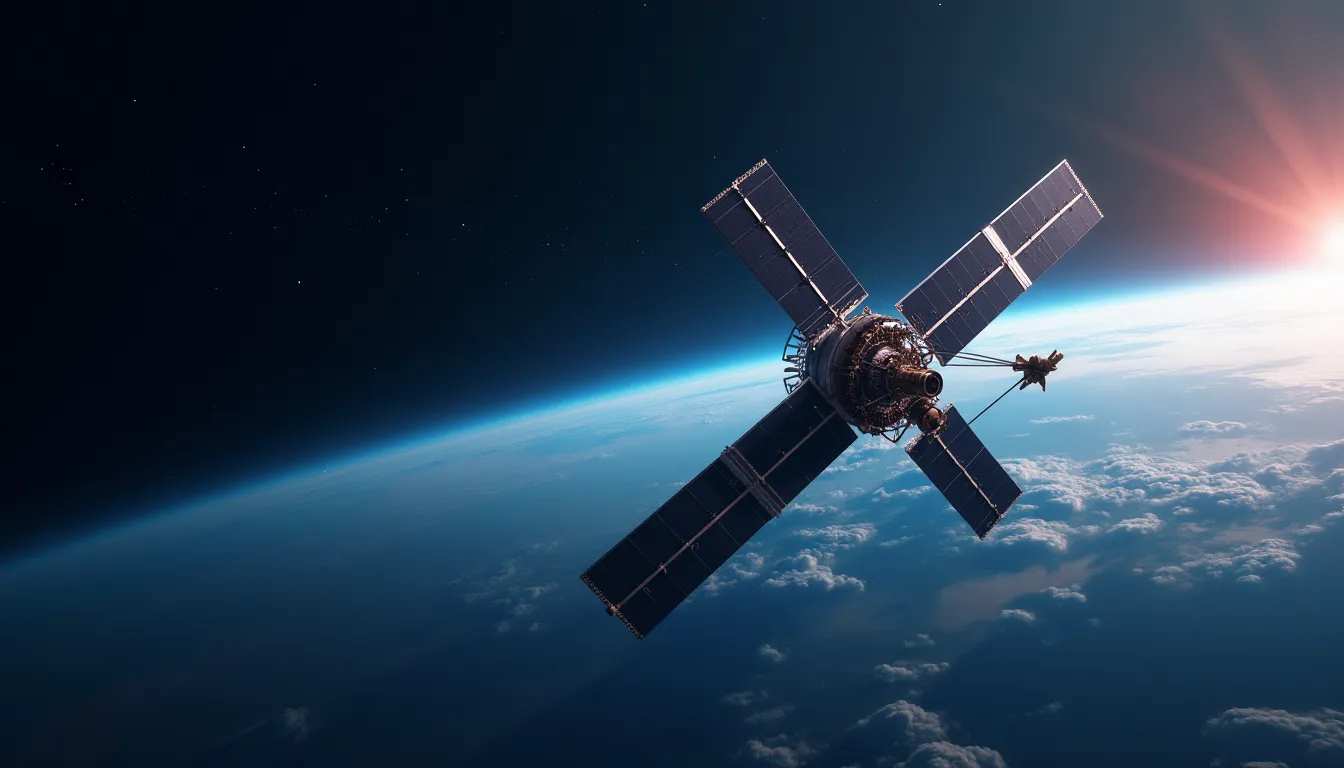
As the aerospace and defense sectors continue to evolve, March 2026 stands out as a pivotal month for satellite technology. With significant advancements driven by industry leaders like SpaceX and innovative emerging companies, the landscape of global connectivity is being redefined. This article delves into the latest developments in satellite launches, AI integrations, and the implications for both commercial and defense applications.
SpaceX’s Starlink Expansion
In March 2026, SpaceX solidified its dominance in the satellite sector with a series of launches that further expanded its Starlink constellation. On March 4, 29 satellites were launched from Cape Canaveral, followed by 25 satellites on March 8 from Vandenberg Space Force Base. Another 29 satellites took to the skies on March 19 from SLC-40 in Florida. This ambitious schedule has pushed the total number of Starlink satellites in orbit beyond 6,700, enhancing global connectivity, particularly in remote, aviation, and maritime sectors.
Each of these satellites is equipped with an Advanced Sensor Module featuring a 9-DOF MEMS Inertial Measurement Unit (IMU). This state-of-the-art technology integrates a three-axis gyroscope, accelerometer, and magnetic sensor, providing exceptional stability and comprehensive motion sensing capabilities, critical for navigation and operational effectiveness.
The Rise of AI and In-Orbit Computing
Emerging companies are also making waves in the satellite industry, particularly through the integration of artificial intelligence. Notably, India’s GalaxEye is preparing to launch its “Mission Drishti,” an OptoSAR satellite set for deployment in 2026. This innovative satellite will leverage both optical and radar imaging capabilities, significantly enhancing earth observation data.
In parallel, Planet is rolling out its “Owl” satellites, which are equipped with Nvidia GPUs for in-orbit computing. This partnership with Google aims to facilitate advanced processing capabilities directly in space, paving the way for more efficient data management and analysis.
Furthermore, IonQ is developing the first-ever space-based Quantum Key Distribution (QKD) network, following its acquisition of Capella Space. This initiative aims to provide quantum-secure communication channels for space-to-space and space-to-ground interactions, a critical step in safeguarding sensitive information in the aerospace domain.
Defense Innovations and Regulatory Changes
The U.S. Space Force continues to play a crucial role in enhancing satellite capabilities for defense applications. Recently, it has begun sharing classified satellite tracking data with commercial firms, fostering public-private partnerships that could lead to enhanced situational awareness and operational readiness.
In the commercial satellite sector, Viasat continues to develop its ViaSat-3 constellation, which aims to double network capacity for government and aviation satellite communications (satcom). Despite facing a setback with one satellite failure, the second satellite is currently in final positioning, and the third is nearing launch. This constellation will utilize high-performance MEMS accelerometers, ensuring superior stability and precision even in demanding environments.
Broader Implications for the Industry
The advancements in satellite technology extend beyond mere connectivity. Companies like xAI are exploring the potential of orbital data centers, while NASA’s ongoing efforts with the International Space Station (ISS) and lunar missions reflect a commitment to data management and exploration. The integration of AI is set to drive over 20 missions, marking a shift towards next-generation capabilities in space.
The implications of these developments are vast, impacting everything from telecommunications to defense strategies and global data management. The advancements in Control System technologies, specifically high-performance CMOS imaging series, are enabling better automatic exposure control and external triggering capabilities, which are essential for high-resolution imaging in various applications.
Conclusion
As we look ahead, the satellite industry is poised for unprecedented growth and transformation. The rapid advancements in technology, driven by both established players like SpaceX and innovative startups, are paving the way for enhanced global connectivity and more secure communications. With the integration of AI, quantum technologies, and advanced navigation systems, the future of satellite operations looks promising, heralding a new era for the aerospace and defense sectors.
The landscape of satellite technology is not just about launching more satellites; it is about creating a more interconnected and secure world. As these technologies continue to develop, they will undoubtedly play a crucial role in the ongoing evolution of global communication and data management.
References
-
Blastoff! SpaceX launches 29 Starlink satellites from Florida, nails … (www.youtube.com) - 3/19/2026 SpaceX launches 29 Starlink satellites from Florida, nails landing | March 19, 2026 … HUGE News: Did NASA Just Replace Boeing With SpaceX?!
-
Satellite Developments in March 2026: A New Era for Global … (orbysa.com) - 3/14/2026 March 2026 witnessed significant advancements in the satellite industry, driven by SpaceX’s Starlink expansions, xAI’s orbital data center …
-
The Rise of AI in Space: 20 Missions & Projects Defining the Next … (orbitaltoday.com) - 3/1/2026 GalaxEye “Mission Drishti”. Timeline: First satellite announced for 2026. What’s it about: India’s OptoSAR mission combines optical and radar …
-
Space Force Opens Secret Tracking Data to Commercial Firms (keeptrack.space) - 3/1/2026 Space Force shares classified tracking data with commercial firms. Falcon 9 reentry linked to upper-atmosphere lithium plume.
-
10 Hottest Companies in Satellite for 2026 (interactive.satellitetoday.com) - 2/23/2026 Via Satellite’s annual 10 Hottest Companies rounds up 10 “must watch” companies in the satellite industry, from constellations, …