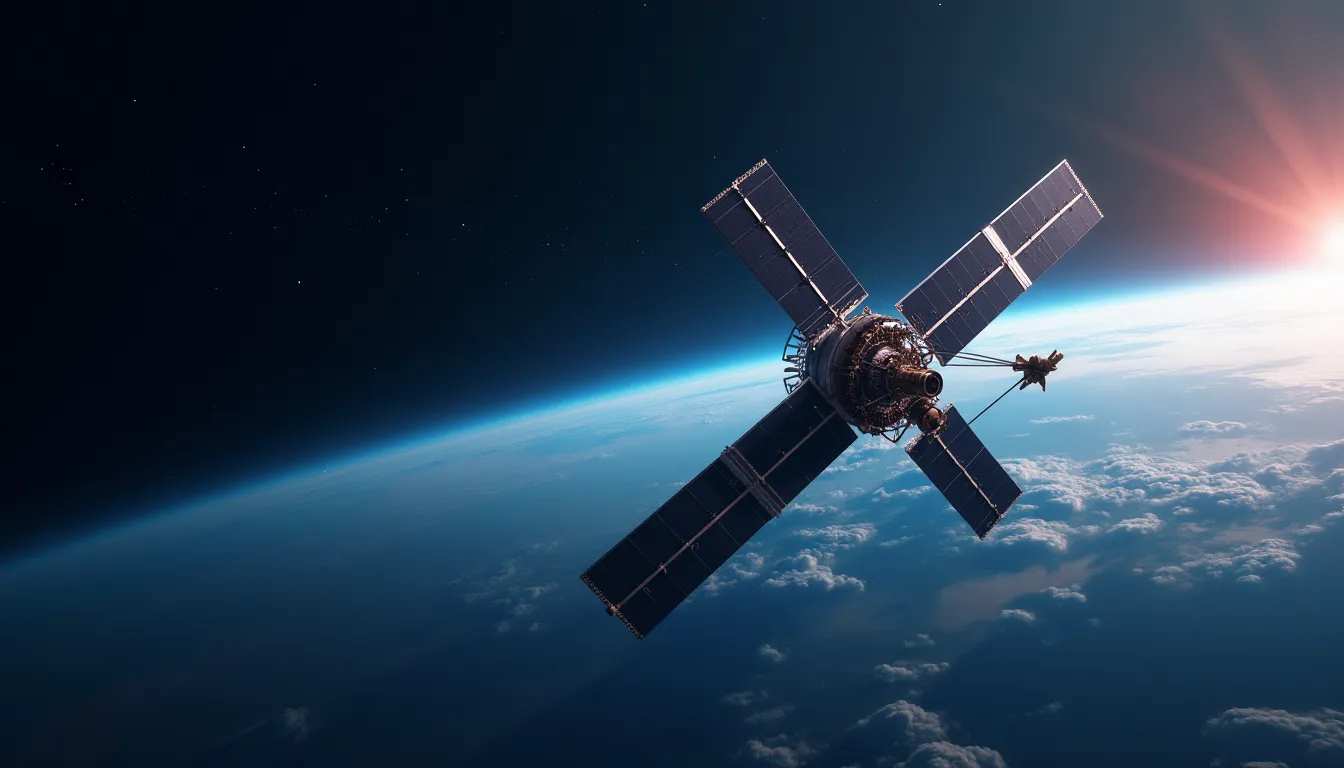
As the aerospace and defense sectors continue to evolve, March 2026 has marked a significant leap forward in satellite technology, driven by innovations from key players such as SpaceX, Planet, Viasat, and IonQ. These advancements not only enhance global connectivity but also emphasize the importance of security and sustainability in a rapidly changing environment.
Starlink Expansions and Connectivity Enhancements
In a major push to expand satellite internet access, SpaceX launched a total of 83 Starlink satellites throughout March, including 29 from Cape Canaveral on March 4, 25 from Vandenberg Space Force Base on March 8, and another 29 from SLC-40 in Florida on March 19. With this latest batch, the Starlink constellation has surpassed 6,700 satellites, significantly improving remote, aviation, and maritime connectivity. This expansion is crucial as demand for reliable internet access continues to rise globally, particularly in underserved regions.
In-Orbit AI and Quantum Computing Integrations
Planet is spearheading innovation in satellite technology with its deployment of the “Owl” satellites, which are equipped with high-performance Nvidia GPUs for onboard processing. This partnership with Google aims to enhance Earth monitoring efficiency through advanced data analytics performed in real-time in orbit. As the industry moves towards 2026, AI-driven trends are expected to play a vital role in satellite constellation management, anomaly detection, and autonomous operations, especially in bandwidth-constrained environments.
In a related domain, IonQ has made significant strides in developing the first space-based Quantum Key Distribution (QKD) network. This initiative, made possible following the acquisition of Capella Space’s Synthetic Aperture Radar (SAR) assets, will enable quantum-secure communications between satellites and between space and ground stations, which is pivotal for defense applications.
Viasat’s ViaSat-3 Constellation and Network Capacity
Viasat continues to innovate with its ViaSat-3 constellation, which aims to double network capacity across government, aviation, maritime, and broadband satellite communications. Despite facing a setback with one satellite, the second is in final positioning, and the third is nearing launch. The constellation leverages advanced technologies such as high-performance MEMS accelerometers, which are essential for maintaining stability and precision in demanding environments.
Reusable Satellites: A Sustainable Future
The concept of reusable satellites is gaining traction, with Lux Aeterna, founded by former SpaceX engineer Brian Taylor, raising $10 million to develop satellites that feature built-in heat shields for payload return to Earth. This innovative approach aims to support annual upgrades for communication and Earth observation capabilities, extending the operational lifespan of satellites and reducing the frequency of launches, which is crucial for sustainability.
Direct-to-Device Connectivity and Orbital Sustainability
As satellite technology progresses, 2026 is witnessing a focus on direct-to-device satellite communications (satcom) that integrate seamlessly with cellular networks. This trend is creating new consumer paradigms by extending coverage to areas where terrestrial signals are unavailable. However, it also raises concerns regarding spectrum allocation, debris management, and the overall sustainability of orbital activities amidst the increasing number of satellites.
U.S. Space Force Initiatives and Commercial Collaborations
In a move to bolster collaboration between defense and commercial sectors, the U.S. Space Force has opened classified satellite tracking data to commercial firms. This initiative aims to enhance coordination and improve satellite operations, allowing for better resource allocation and tracking capabilities in a crowded orbital environment. Additionally, Falcon 9’s reentry has been noted to create lithium plumes in the upper atmosphere, a phenomenon that underscores the complexities of space activities.
The Rise of Micro-Satellites
The micro-satellite sector is also seeing significant developments. ArkEdge Space recently launched its AE5Ra, AE5Rb, and AE5Rc micro-satellites, bringing its total in-orbit assets to 12, with confirmed communications with ground stations. These small satellites are paving the way for more agile and cost-effective space missions, catering to specific applications in data collection and Earth observation.
Conclusion
As we look ahead, the advancements in satellite technology in March 2026 signify a pivotal shift towards enhanced global connectivity, security, and sustainability. With emerging technologies like in-orbit AI, quantum communications, and reusable satellites, the aerospace and defense industries are poised to redefine how we interact with space. The future promises a landscape where satellites are not only more efficient but also integral to addressing global challenges in communication and environmental monitoring.
References
-
March 2026: Transformative Advances in Satellite Technology and … (orbysa.com) - 3/20/2026 This article delves into the latest developments in satellite launches, AI integrations, and the implications for both commercial and defense …
-
10 Hottest Companies in Satellite for 2026 (interactive.satellitetoday.com) - 2/23/2026 Via Satellite’s annual 10 Hottest Companies rounds up 10 “must watch” companies in the satellite industry, from constellations, …
-
Looking Ahead: Satellite Technology and Trends to Watch in 2026 (www.globalstar.com) Direct-to-device satellite connectivity continued its rapid ascent this year, laying the groundwork for a new category of consumer expectations. The ability to …
-
This SpaceX veteran says the next big thing in space is satellites … (techcrunch.com) - 3/10/2026 This SpaceX veteran says the next big thing in space is satellites that return to Earth. Tim Fernholz. 6:00 AM PDT · March 10, 2026. Image Credits:Lux …
-
March 2026 Satellite Puzzler - NASA Science (science.nasa.gov) - 3/10/2026 Every month, NASA Earth Observatory features a puzzling satellite image. The March 2026 puzzler appears above. Your Challenge Identify the …
-
Space Force Opens Secret Tracking Data to Commercial Firms (keeptrack.space) - 3/1/2026 Space Force shares classified tracking data with commercial firms. Falcon 9 reentry linked to upper-atmosphere lithium plume.