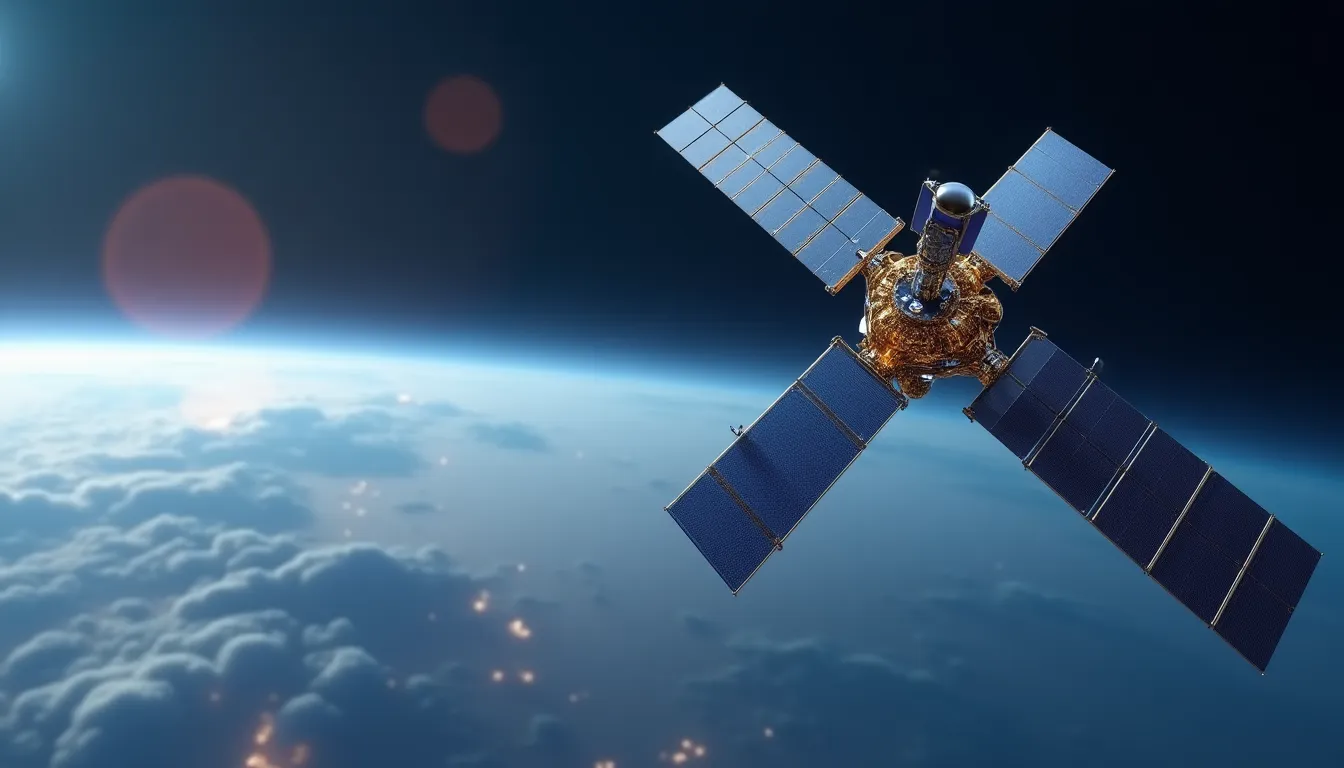
As the demand for high-speed connectivity and advanced surveillance capabilities continues to rise, the aerospace and defense sectors are witnessing a transformative leap in satellite technology. Recent developments in low Earth orbit (LEO) constellations, direct-to-cell satellite services, and innovative materials are driving this evolution, with significant implications for both commercial and defense applications.
High-Capacity LEO Constellations
SpaceX’s Starlink: A New Era of Broadband
SpaceX has reignited its satellite deployment efforts with the launch of the Starlink 6-88 mission, marking a critical milestone in its ambitious plan to enhance global broadband coverage. With approximately 4,400 satellites currently in orbit at an operational altitude of about 550 km, SpaceX is set to lower these satellites to 480 km. This strategic shift, coordinated with U.S. Space Command, aims to mitigate long-term debris risks while optimizing satellite performance.
The upcoming Starlink Version 3 satellites, scheduled for launch aboard the Starship–Super Heavy in 2026, promise to revolutionize satellite communication with over 1 Tb/s downlink capacity and more than 200 Gbps uplink per satellite. This represents an unprecedented increase in throughput, which is crucial for both civilian and defense applications, particularly as it enables direct-to-cell (DTC) services. Currently operational in 22 countries and serving over 6 million users, Starlink’s DTC service operates at an altitude of ~360 km, making it the lowest major LEO constellation and significantly enhancing connection speed and reliability for end-users.
Optical Data-Relay Networks
Kepler Communications: Pioneering Optical Connectivity
In a bid to enhance data transmission capabilities, Kepler Communications is set to deploy a constellation of 10 satellites as part of their optical data-relay network. Scheduled for launch on the Twilight mission, these 300 kg satellites will utilize optical terminals to facilitate real-time connectivity and dynamic data routing. This is particularly beneficial for defense applications, offering enhanced situational awareness and real-time data processing.
Kepler’s architecture allows for space-to-space and space-to-ground optical links, providing a robust alternative to traditional RF communications. The integration of hosted payloads from partners such as Aistech Space and HawkEye 360 will further bolster capabilities in intelligence, surveillance, and reconnaissance (ISR) operations.
Direct-to-Cell Satellite Services
Regulatory Focus on Satellite-to-Handset Innovations
The Federal Communications Commission (FCC) has identified direct-to-cell satellite technology as a pivotal trend in telecommunications. At the recent Consumer Electronics Show (CES), FCC Commissioner Brendan Carr emphasized the competitive landscape between SpaceX’s Starlink and Amazon’s Project Kuiper in extending connectivity without the need for extensive terrestrial infrastructure. This regulatory focus indicates a significant shift towards resilient, infrastructure-independent communication systems that are essential for both civilian and military applications.
Advanced Materials for Satellite Systems
Aerospace-Grade Ultra-Thin Glass for Power Systems
Recent advancements in materials science have led to the development of aerospace-grade ultra-thin glass (UTG), showcased by Lens Technology at CES 2026. This innovative material is designed specifically for solar panel applications on low-Earth orbit satellites, optimizing the power-to-mass ratio crucial for small satellite deployments. The UTG exhibits exceptional resistance to radiation and thermal cycling, ensuring durability and efficiency in the harsh conditions of space.
Competing Technologies: Terrestrial Optical Links vs. Satellites
The evolution of satellite technology is not without challenges. Mahesh Krishnaswamy, CEO of Taara, argues that Wireless Optical Communication (WOC) is increasingly outperforming satellite connectivity in high-density urban environments. With over 10,000 active satellites in orbit, the dilution of bandwidth due to large coverage areas may diminish per-user throughput, particularly for bandwidth-intensive applications. This has led to predictions of a hybrid infrastructure where satellites serve niche markets while terrestrial WOC technology dominates dense regions.
Defense Applications and Standardization Efforts
Enhancing Military Capabilities through Standardization
The need for standardized satellite interfaces and practices is becoming increasingly critical, especially in defense applications. Ongoing efforts reported by KeepTrack highlight the importance of interoperability among military and commercial space systems. By enabling shared tracking data and common communication standards, these initiatives aim to enhance capabilities in missile warning and tracking, thereby improving national security.
AI and Space Operations
NASA’s Advanced Research on the ISS
While not directly related to satellite development, NASA’s ongoing research aboard the International Space Station (ISS) is paving the way for future advancements in autonomous satellite operations. The introduction of AI systems for audio transcription and operational logging signifies a trend towards improved efficiency in mission management, which is likely to extend to satellite constellation operations in the future.
Conclusion
The satellite industry is at the forefront of technological innovation, with significant developments in LEO constellations, optical data relay networks, and new materials driving advancements in connectivity and defense capabilities. As the landscape evolves, the integration of direct-to-cell services and the pursuit of standardization will play crucial roles in shaping the future of satellite technology. The move toward higher performance and more resilient systems not only enhances commercial connectivity but also ensures that defense operations remain robust in an increasingly complex strategic environment.
References
-
Lab Report: Jan. 9, 2026 - Lawrence Livermore National Laboratory (www.llnl.gov) - 1/10/2026 Others resulted in a satellite either crashing into the moon, burning up in Earth’s atmosphere, or being ejected from the system entirely. So …
-
Twilight Rideshare Mission Set to Deploy First Tranche of Kepler’s … (www.satellitetoday.com) - 1/9/2026 SpaceX is targeting Sunday, January 11 for the Twilight mission on a Falcon 9 rocket, set to launch from Vandenberg Space Force Base in …
-
How invisible highways of light are outclassing orbital satellite … (news.satnews.com) - 1/9/2026 Back down to Earth: How invisible highways of light are outclassing orbital satellite connectivity (Reader Forum). January 9, 2026. Share.
-
FCC Chair Brendan Carr champions direct-to-cell satellite … (www.fierce-network.com) - 1/9/2026 FCC Chair Brendan Carr champions direct-to-cell satellite technology at CES · The most exciting news in telecom: Musk vs. Bezos in the satellite …
-
Expedition 74 Preps for Crew Departure, Keeps Up Advanced … (www.nasa.gov) - 1/9/2026 Four Expedition 74 crew members are preparing for their return to Earth aboard the SpaceX Dragon crew spacecraft.
-
Space Brief 8 Jan 2026 - KeepTrack (keeptrack.space) - 1/8/2026 Today’s brief covers satellite standardization efforts, missile tracking updates, and a medical delay impacting the ISS.
-
Lens Technology debuts aerospace grade UTG for satellites at CES (vir.com.vn) - 1/7/2026 The ultra-thin glass is designed for use in low-earth orbit satellite solar panels, or “energy canopies.”
-
SpaceX launches first Starlink deployment mission since problem … (spaceflightnow.com) - 1/4/2026 SpaceX launches the Starlink 6-88 mission from Space Launch Complex 40 at Cape Canaveral Space Force Station on Jan. 4, 2026.