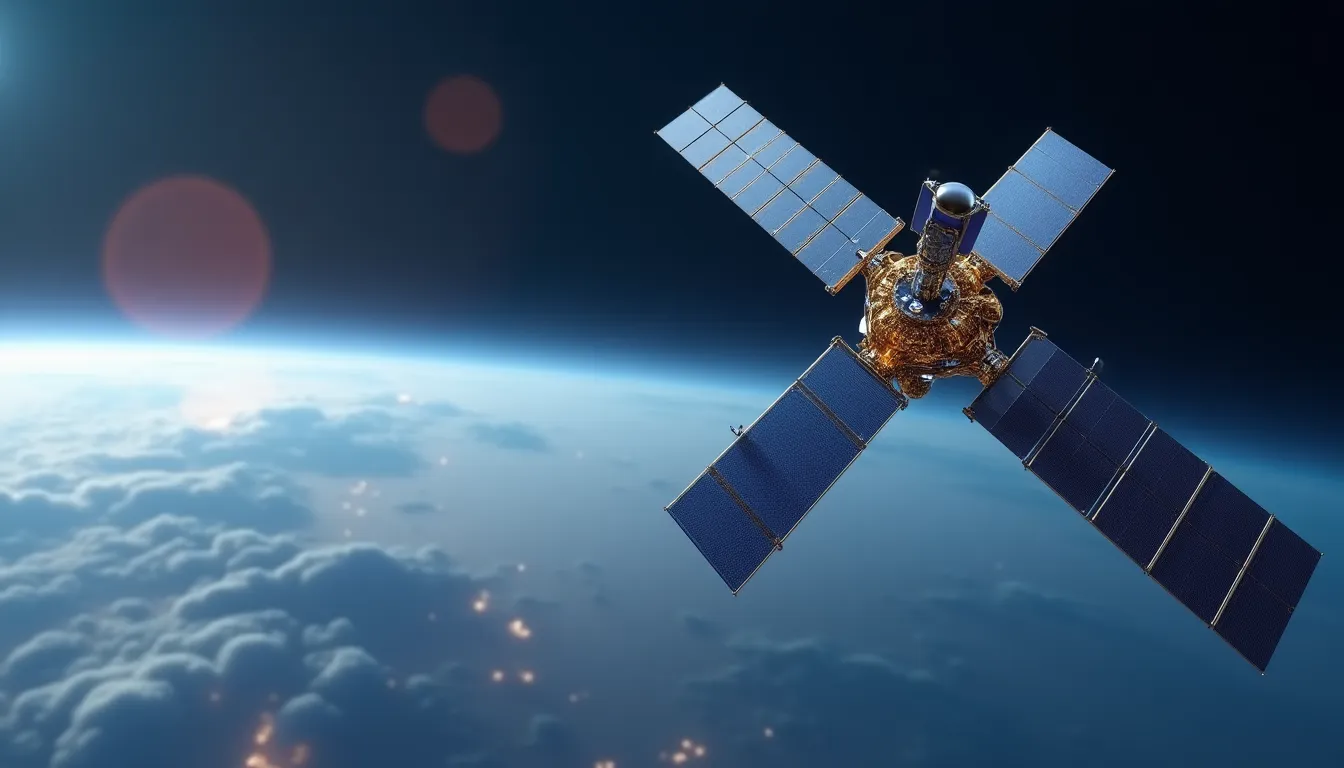
The aerospace and defense sectors are witnessing unprecedented advancements in satellite technology, reshaping our capabilities in exploration, communication, and environmental monitoring. As new players emerge and established entities innovate, the landscape of satellite deployment and utilization is evolving rapidly. This article highlights recent developments, technical insights, and the implications for future missions.
Blue Origin’s Mars Mission: A New Frontier
On November 17, 2025, Blue Origin achieved a significant milestone by successfully launching its New Glenn rocket carrying two NASA satellites destined for Mars. This mission not only marks a pivotal moment in the race for interplanetary exploration but also demonstrates the potential of reusable rocket technology, as the New Glenn’s first-stage booster landed successfully—a feat that underscores Blue Origin’s commitment to reducing launch costs and enhancing mission frequency.
The New Glenn rocket is designed to support deep-space satellite deployment, and the Mars-bound satellites will play a crucial role in enhancing NASA’s communication infrastructure and exploration capabilities. As a direct competitor to SpaceX, Blue Origin is redefining the standards for cost-effective access to space.
Groundbreaking Emergency Communications: OQ Technology’s Direct-to-Phone Broadcast
In a remarkable demonstration, OQ Technology successfully transmitted an emergency broadcast directly to standard smartphones using its satellite constellation on November 19, 2025. This pioneering achievement required no modifications to existing mobile devices, leveraging OQ’s ten Low-Earth Orbit (LEO) satellites.
The significance of this technology lies in its ability to deliver critical information to remote or underserved areas, thus enhancing disaster response and public safety. With support from the Luxembourg Space Agency and the European Space Agency, OQ Technology plans to expand its capabilities to include direct-to-mobile voice services by 2026, further solidifying its role in advancing satellite communication systems.
Powering the Future: Dcubed’s ARAQYS
In a bid to revolutionize satellite power solutions, Dcubed introduced ARAQYS, an innovative in-space power generation and storage system. Designed for small satellites, ARAQYS aims to lower the cost per kilowatt for satellite missions while enabling in-space manufacturing and large-scale power generation.
The ARAQYS technology will be demonstrated on the upcoming ARAQYS-D3 satellite, marking a significant advancement in directed-energy platforms and advanced orbital missions. As satellite missions increasingly demand higher energy outputs for applications like advanced communications and directed-energy weapons, ARAQYS represents a critical step forward in satellite design and efficiency.
European Space Agency’s Multi-Mission Launch
On November 26, 2025, the European Space Agency (ESA) is set to launch the HydroGNSS twin-satellite mission, alongside satellites for Italy’s IRIDE mission and Greece’s National Small Satellite Programme. This coordinated launch, conducted by SpaceX’s Falcon 9 rocket, exemplifies the efficiency of multi-mission satellite deployments.
HydroGNSS will gather vital data on Earth’s water cycle, significantly enhancing climate and weather modeling. Meanwhile, the IRIDE mission focuses on environmental monitoring, demonstrating how collaborative efforts can address critical global challenges through enhanced Earth observation capabilities.
Sentinel-6B: Monitoring Earth’s Oceans
In another significant collaboration, NASA and SpaceX successfully launched the Sentinel-6B satellite, which is part of a joint US-European mission aimed at monitoring sea level rise and ocean health. The Sentinel-6B satellite is designed to provide high-precision data on ocean surface topography, contributing to ongoing climate research and coastal management initiatives.
This mission continues the legacy of the Jason series, crucial for providing data that informs global responses to climate change and environmental sustainability. As satellite technology advances, the capacity to monitor our planet becomes increasingly sophisticated and essential for informed decision-making.
Global Trends: China and NATO’s Strategic Shifts
Recent developments also highlight the changing dynamics in the aerospace sector. China is preparing to deliver a new spacecraft to its astronauts, enhancing crew safety following a recent debris incident. Meanwhile, NATO is shifting its surveillance satellite plans, moving away from Boeing to diversify suppliers and enhance capabilities.
These shifts reflect the evolving nature of global security and the increasing importance of advanced satellite systems, such as high-performance MEMS accelerometers and thermal battery systems, to ensure operational readiness and resilience.
Conclusion
The advancements in satellite technology are not just transforming the aerospace and defense sectors; they are also creating new opportunities for innovation and collaboration. From Blue Origin’s reusable rockets to OQ Technology’s emergency communication breakthroughs, the future of satellite deployment is bright. As companies like Dcubed and ESA push the boundaries of what is possible, we can expect continued enhancement in our ability to monitor, communicate, and explore the universe. The integration of advanced systems and technologies will undoubtedly shape the next generation of satellite missions, ensuring that we remain at the forefront of aerospace and defense capabilities.
References
- OQ Technology Sends Emergency Broadcast By Satellite (www.satellitetoday.com) - 11/19/2025 *# Latest News
OQ Technology Sends Emergency Broadcast By Satellite
**OQ Technology **successfully sent an emergency broadcast message directly to phones through its satellite constellation in a recent demonstration.
The demonstration took place in Luxembourg, sending an emergency broadcast mess…*
-
Dcubed Powers Ahead: Introducing ARAQYS – The Power Solution … (dcubed.space) - 11/19/2025 This technology aims to dramatically reduce the cost per kilowatt, laying the groundwork for space infrastructure and directed-energy platforms …
-
Watch: HydroGNSS, IRIDE and Greek mission satellites launch (www.esa.int) - 11/19/2025 The European Space Agency’s HydroGNSS, a twin-satellite mission to gather data on Earth’s water cycle, is scheduled to launch on 26 November at …
-
Space Brief 18 Nov 2025 (keeptrack.space) - 11/19/2025 Top Stories · Chinese Astronauts to Receive New Spacecraft Following Debris Strike · NATO Allies Shift from Boeing for New Surveillance Plans.
-
NASA, SpaceX Launch US-European Satellite to Monitor Earth’s Oceans (www.nasa.gov) - 11/18/2025 The Sentinel-6B satellite lifted off aboard a SpaceX Falcon 9 rocket from Launch Complex 4 East at Vandenberg Space Force Base in central …
-
Blue Origin launches satellites bound for Mars | November 17, 2025 (www.youtube.com) - 11/17/2025 Today on CNN10: We get an update on the fallout from the longest US government shutdown on record - and how some communities are still …