Recent months have ushered in a wave of transformative developments in satellite technology, significantly impacting the aerospace, defense, and commercial sectors. From enhancing global connectivity through 5G non-terrestrial networks to pioneering scientific missions aimed at exploring exoplanets, the satellite landscape is rapidly evolving. This article delves into the key advancements that are setting the stage for future innovations and operational capabilities in space.
5G Non-Terrestrial Networks: Airbus UpNext SpaceRAN Demonstrator
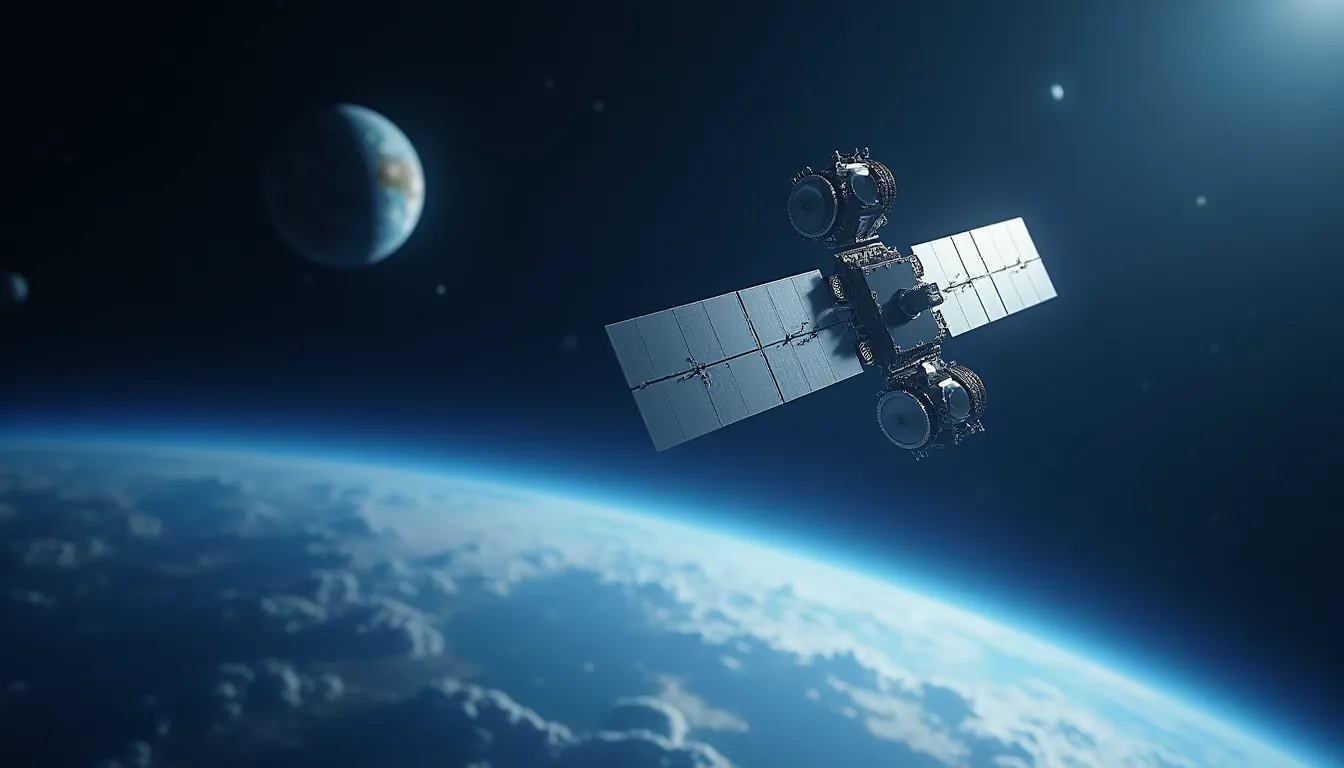
On January 14, 2026, Airbus unveiled its SpaceRAN demonstrator, a groundbreaking software-defined satellite designed to revolutionize global connectivity. This satellite processes and regenerates 5G signals in orbit, effectively reducing latency and increasing throughput. The innovative design enables inter-satellite links that facilitate efficient routing, minimizing reliance on terrestrial ground stations.
“This demonstrator is a significant step towards realizing sovereign connectivity for both military and commercial applications,” stated a spokesperson from Airbus. The anticipated outcomes of on-ground test beds and low Earth orbit (LEO) payload tests are expected by 2028, with partnerships involving Deutsche Telekom and Eutelsat paving the way for future collaboration in 5G NTN.
Military Maneuverability and Refueling Initiatives by the U.S. Space Force
The U.S. Space Force is actively exploring concepts of operations for maneuverable and refuelable satellites in geostationary orbit (GEO). This initiative aims to enhance the military’s ability to evade threats and reposition assets for ground support. Industry experts are closely monitoring upcoming demonstrations—Tetra-5 and Tetra-6—scheduled for 2026-2027, which will evaluate on-orbit docking and refueling technologies developed by multiple aerospace companies.
The integration of high-performance navigation systems, such as advanced MEMS accelerometers, will be crucial in these demonstrations, ensuring precise maneuverability and operational effectiveness in dynamic environments. As the military increasingly relies on satellite technology, these advancements promise to bolster national security and operational readiness.
Commercial Deployments: Exolaunch’s SpaceX Twilight Mission
In early January 2026, Exolaunch successfully deployed 22 satellites during SpaceX’s Twilight Mission, marking a significant milestone in commercial satellite rideshare capabilities. This mission is part of Exolaunch’s broader strategy to conduct over 20 launches throughout 2026, contributing to the delivery of hundreds of satellites to various orbital configurations.
This achievement builds upon Exolaunch’s previous success in 2025, when the company executed 197 deployments. The new satellites are expected to enhance global communication networks and support various applications, including Earth observation and scientific research.
Scientific Missions: NASA’s Pandora Project
On the same day as the Exolaunch mission, RTX launched the Saturn-200 minisatellite for NASA’s Pandora mission, which aims to investigate exoplanet atmospheres and their host stars. This satellite is equipped with the largest telescope payload on a Blue Canyon platform, featuring advanced precision guidance and control systems to maintain stability during observations.
The integration and commissioning of the Saturn-200 exemplify the collaboration between aerospace companies and governmental space agencies, showcasing how high-precision imaging systems can enable groundbreaking scientific discoveries beyond our solar system.
Spectrum Challenges and Regulatory Developments
As satellite technology advances, regulatory challenges also emerge. On January 15, 2026, SpaceX received a new FCC license, allowing for increased power flux density (PFD) for its Generation 2 Starlink satellites. However, this has raised concerns regarding potential interference with existing telecommunications networks, particularly with major providers like Verizon and T-Mobile.
Experts warn that the use of beamforming technologies to target high-power signals could lead to significant interference issues, necessitating discussions on balancing innovation with regulatory requirements. The outcome of these debates will be pivotal in shaping the operational landscape for satellite communication.
Earth Observation: Sentinel-2’s Environmental Monitoring
ESA’s Sentinel-2 satellite continues to play a crucial role in environmental monitoring. On January 14, 2026, it captured high-resolution, multi-spectral imagery of Greenland’s snowy peaks, contributing valuable data for the Copernicus program, which focuses on observing land, coasts, and the impacts of climate change.
The ability to acquire vivid imagery through advanced sensor modules allows researchers to study environmental changes with unprecedented detail, fostering informed decision-making for conservation efforts and climate action.
Future of Satellite Technology: China’s Expanding Capabilities
As 2026 unfolds, China has initiated multiple satellite launches, reinforcing its strategic capabilities in space. The country’s growing reliance on satellite data for military and civilian applications highlights the global competition in satellite technology and the importance of robust data infrastructures.
Conclusion
The advancements in satellite technology over the past month underscore a pivotal moment for the aerospace and defense industries. With innovations in 5G NTN, military maneuverability, commercial deployments, and scientific missions, the future of satellite applications appears promising. As the landscape evolves, it will be crucial for stakeholders to navigate emerging regulatory challenges while leveraging cutting-edge technologies like precision accelerometers and advanced navigation systems to enhance operational capabilities. The ongoing developments in this sector will undoubtedly shape the next generation of satellite technology and its myriad applications in our interconnected world.
References
-
Expanding 5G connectivity with the Airbus UpNext SpaceRAN demonstrator (www.airbus.com) - 1/15/2026 Satellite connectivity is essential for global communications, and Airbus is leveraging its experience in satellites to test the capabilities of a 5G non-terrestrial network.
-
Industry awaits Space Force guidance on maneuverable satellite refueling (aerospaceamerica.aiaa.org) - 1/15/2026 *### Stay Up to Date
Submit your email address to receive the latest industry and Aerospace America news.
As space becomes an increasingly kinetic and contested warfighting domain, the U.S. military has its eye on technologies that would allow satellites to maneuver in geostationary orbit — both to…*
-
Permission to Shout: The Risks Inside the New SpaceX License (news.satnews.com) - 1/15/2026 January 15, 2026 … Access daily or weekly satellite news updates covering all aspects of the commercial and military satellite industry.
-
Space Brief 15 Jan 2026 - KeepTrack (keeptrack.space) - 1/15/2026 Today’s brief covers China’s ambitious start to 2026 with satellite launches, the U.S. military’s reliance on NOAA data, and strategic …
-
Airbus launches demonstrator to test global 5G connectivity in orbit (www.airbus.com) - 1/14/2026 Airbus UpNext SpaceRAN will leverage Airbus’ software-defined satellite 1 capabilities to manage and optimise 5G signals in orbit. By processing …
-
Satellite sees snowy Greenland peaks from space photo of the day … (www.space.com) - 1/14/2026 Satellite sees snowy Greenland peaks from space | Space photo of the day for Jan. 14, 2026. News. By Kenna Hughes-Castleberry published 14 January 2026.
-
RTX provides Blue Canyon satellite for interstellar mission (www.rtx.com) - 1/14/2026 Pandora mission to utilize Saturn-200 minisatellite platform for exoplanet long observations. LAFAYETTE, Colo., Jan. 14, 2026 /PRNewswire/ …
-
Exolaunch Deploys 22 Satellites on SpaceX’s Twilight Mission … (www.exolaunch.com) - 1/1/2025 In 2026, Exolaunch is gearing up for another record-breaking year, with plans to execute over 20 missions and deliver several hundred satellites …