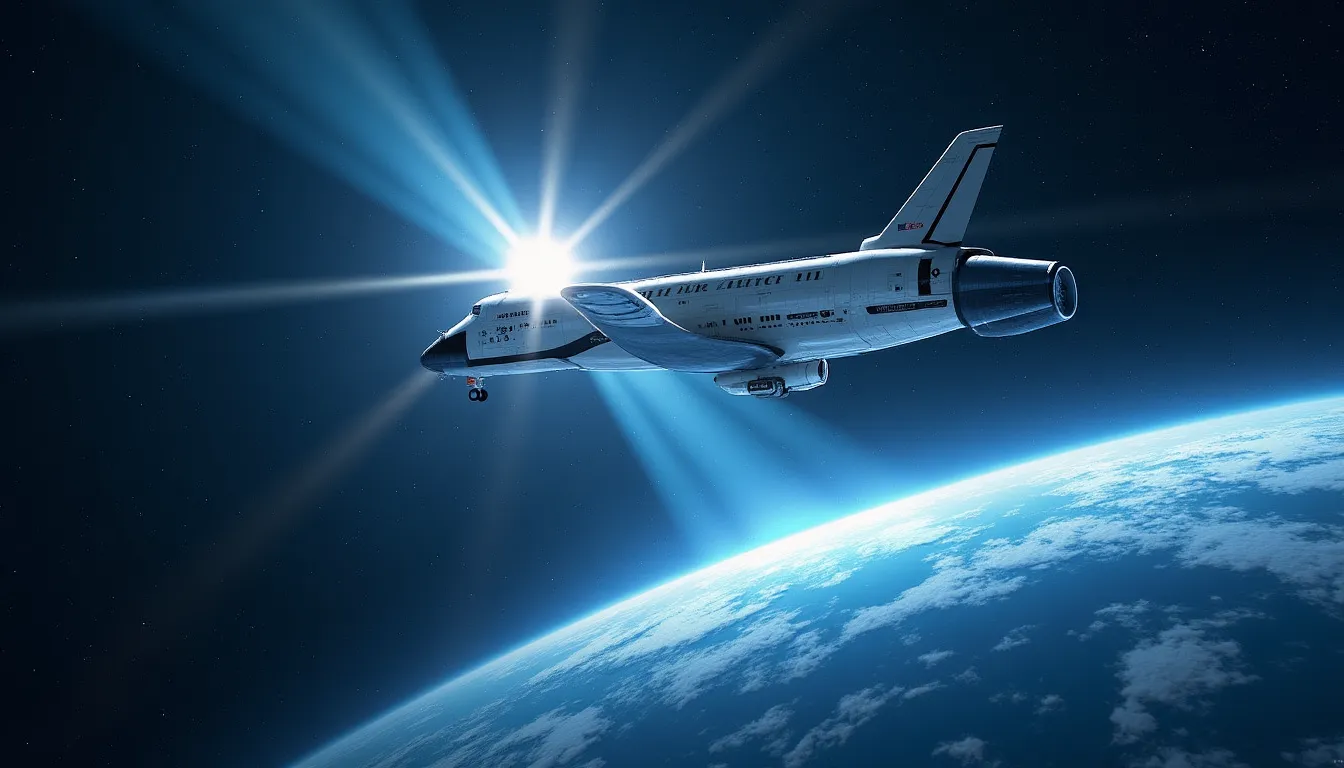
NASA continues to push the boundaries of aerospace technology with groundbreaking advancements in aeronautics and human spaceflight. Recently, the agency successfully completed its first flight test of a scale-model wing designed to enhance laminar flow, a significant innovation aimed at reducing drag and improving fuel efficiency in commercial aviation. In parallel, NASA has selected Axiom Space and Collins Aerospace to develop the next generation of Extravehicular Activity (EVA) suits, marking a pivotal shift in spacesuit technology that will support upcoming low-Earth orbit missions and the ambitious Artemis Moon program.
Aeronautics Breakthrough: Enhancing Laminar Flow
In a significant milestone for aeronautics, NASA has successfully executed the first flight test of a scale-model wing that aims to improve laminar flow, a critical factor in reducing aerodynamic drag. By optimizing laminar flow, the agency seeks to enhance fuel efficiency for future commercial aircraft. The test represents a key component of NASA’s ongoing efforts to innovate aviation technology for the National Airspace System.
The model wing incorporates advanced features, including precision accelerometers and control systems that analyze airflow dynamics. These technologies enable engineers to fine-tune wing performance, paving the way for more sustainable aviation solutions. According to NASA’s aeronautics chief, “This breakthrough will not only save fuel but also significantly reduce emissions, aligning with our goals for sustainable aviation.”
Next-Generation Spacesuits: A Leap Forward in Human Spaceflight
NASA’s initiative to develop next-generation EVA suits marks the first significant upgrade in spacesuit technology in four decades. The agency has partnered with Axiom Space and Collins Aerospace to create suits that will support missions to the International Space Station (ISS) and the Artemis program, which aims to return humans to the Moon by the mid-2020s.
These new suits will integrate advanced sensor modules and thermal battery systems designed to withstand the harsh conditions of space. The updated design prioritizes mobility and safety, featuring enhanced life support systems and improved thermal insulation. “These suits are not just about functionality; they’re about ensuring the safety and comfort of our astronauts as they embark on historic missions,” said a spokesperson from NASA.
Deep Space Exploration: Technology Partnerships and Innovations
NASA is also advancing its deep space exploration capabilities through technology partnerships with the Aerospace Corporation. This collaboration focuses on developing laser and electronic systems to analyze lunar and planetary samples, enabling scientists to determine the age of celestial bodies. The initiative represents a significant leap in our understanding of the solar system and the potential for life beyond Earth.
Additionally, aerospace engineers are conducting ground tests for the Gateway, a moon-orbiting space station that will serve as a vital staging ground for future Mars missions. These developments are crucial for ensuring the robustness of NASA’s long-term exploration strategies.
Mission Progress: Europa Clipper and Its Journey
The Europa Clipper mission is another exciting venture currently in progress, having already traveled 1.8 billion miles to study Jupiter’s moon, Europa. This mission aims to uncover the secrets hidden beneath Europa’s icy crust and assess its potential for harboring life. With advanced scientific instruments onboard, including high-performance CMOS imaging systems, the spacecraft will gather valuable data to enhance our understanding of this distant world.
Leadership and IT Advancements at NASA
On the organizational front, NASA has recently appointed Sean Gallagher as the agency’s new Chief Information Officer (CIO). Gallagher will oversee the entire portfolio of Information Technology products and services, reinforcing NASA’s commitment to integrating cutting-edge technology in its operations. His leadership will be pivotal as the agency begins processing awards for multiple SEWP VI contracts, ensuring that IT infrastructure keeps pace with NASA’s ambitious goals.
Conclusion
NASA’s recent advancements in aeronautics and human spaceflight reflect the agency’s commitment to innovation and exploration. From the flight tests of new wing technologies that promise to revolutionize commercial aviation to the development of next-generation spacesuits that will protect astronauts on their journeys to the Moon, these initiatives signal a bright future for aerospace technology. As NASA continues to push the envelope of exploration, the implications for both science and commercial aviation are profound, underscoring the agency’s role as a leader in the aerospace and defense sectors. The future looks promising, with continued advancements in technology poised to unlock new frontiers in space exploration and sustainable aviation.
References
-
Industry News Archives - AIAA - Shaping the future of aerospace (aiaa.org) - 6/23/2026 NASA X-59 Reaches Mach 1.4. Low Earth Orbit Emerges as a New Frontier. NASA Advances Quiet Supersonic Travel. SpaceX Sets New Reusability Record with Falcon 9 …
-
Current IV&V Projects - NASA (www.nasa.gov) - 5/18/2026 Current IV&V Projects · Artemis · Dragonfly · Exploration Ground Systems · Extravehicular Activity and Human Surface Mobility · Gateway · Human …
-
Missions - NASA (www.nasa.gov) - 11/26/2025 Europa Clipper is the first mission designed to conduct a detailed study of Jupiter’s moon Europa. The spacecraft will travel 1.8 billion miles to reach Jupiter … NASA Science seeks to discover the secrets of the universe, search for life elsewhere, and protect and improve life on Earth and in space. The agency’s science missions circle the Earth, the Sun, the Moon, Mars, and many other destinations within our solar system, including spacecraft that look out even further into our universe.
-
Aeronautics - NASA (www.nasa.gov) - 9/18/2025 NASA is exploring new designs, advanced propulsion, and novel integration techniques to enhance aircraft performance. Read More on Ultra-Efficient Aviation.
-
Space Exploration | The Aerospace Corporation (aerospace.org) - 7/17/2025 *NASA’s plans to put astronauts on the moon and Mars requires a new EVA suit —the first in 40 years— and Aerospace is assisting. March 2026 NSSL Falcon 9 launch … Laser and electronics experts at The Aerospace Corporation are developing new technology that could be sent to the moon and planets in the solar system to determine their age based on analysis of elements in collected surface samples. … NASA’s Orion will endure temperatures of 5000 degrees when it re-enters Earth’s atmosphere. Aerospace engineers developed a new tool to make sure the spacecraft -and those inside- survive the ride. … Aerospace is helping to design an innovative mission to view the surface of exoplanets light years away. This solar gravity lens project, being conducted jointly with the Jet Propulsion Laboratory, essentially makes our solar system and beyond into a giant optical lens. … Cameras designed by The Aerospace Corporation play a critical role in tracking the deployment of solar sails as scientists study their use for space exploration. … Aerospace engineers are ground-testing the Gateway, a moon-orbiting space station that NASA sees as the first step to Mars.
Building A Better Space Suit
NASA’s plans to put astronauts on the moon and Mars requires a new EVA suit —the first in 40 years— and Aerospace is assisting.*
-
All NASA News (www.nasa.gov) - 6/30/2023 As interstellar comet 3I/ATLAS began moving away from the Sun in December 2025, astronomers took the opportunity to turn NASA’s powerful James Webb Space … NASA has selected Sean Gallagher as the agency’s chief information officer (CIO). In this role, he is responsible for the agency’s entire portfolio of Information Technology products and services. … NASA will begin processing the awards of multiple contracts for the Solutions for Enterprise‑wide Procurement (SEWP) VI Government-wide Acquisition Contract.
-
Aeronautics Research - NASA (www.nasa.gov) - 5/18/2023 NASA completed the first flight test of a scale-model wing designed to improve laminar flow, reducing drag and lowering fuel costs for future commercial … Presented here are a collection of hand-picked stories that showcase the aviation technology NASA is working on — or has worked on and turned over to others for use in the National Airspace System.
-
Technology - NASA (www.nasa.gov) - 1/27/2023 NASA puts next‑generation propulsion to the test—a system powerful enough to carry crews to Mars and robots across the solar system.
-
NASA (www.nasa.gov) - 12/7/2022 NASA.gov brings you the latest news, images and videos from America’s space agency, pioneering the future in space exploration, scientific discovery and …
-
NASA chooses Axiom, Collins Aerospace for next generation of … (www.youtube.com) - 6/2/2022 NASA chooses Axiom, Collins Aerospace for next generation of spacesuit development. 10K views · 4 years ago …more. WKMG News 6 ClickOrlando. NASA officials on Wednesday announced the two companies that will develop the agency’s next generation of spacesuits. Axiom Space and Collins Aerospace will develop and provide the suits for low-Earth orbit missions outside the International Space Station, and for the Artemis Moon missions. … {ts:27} ST RU GG LE D TO DE VE LO P A NE W SU IT O F IT S OW N, F