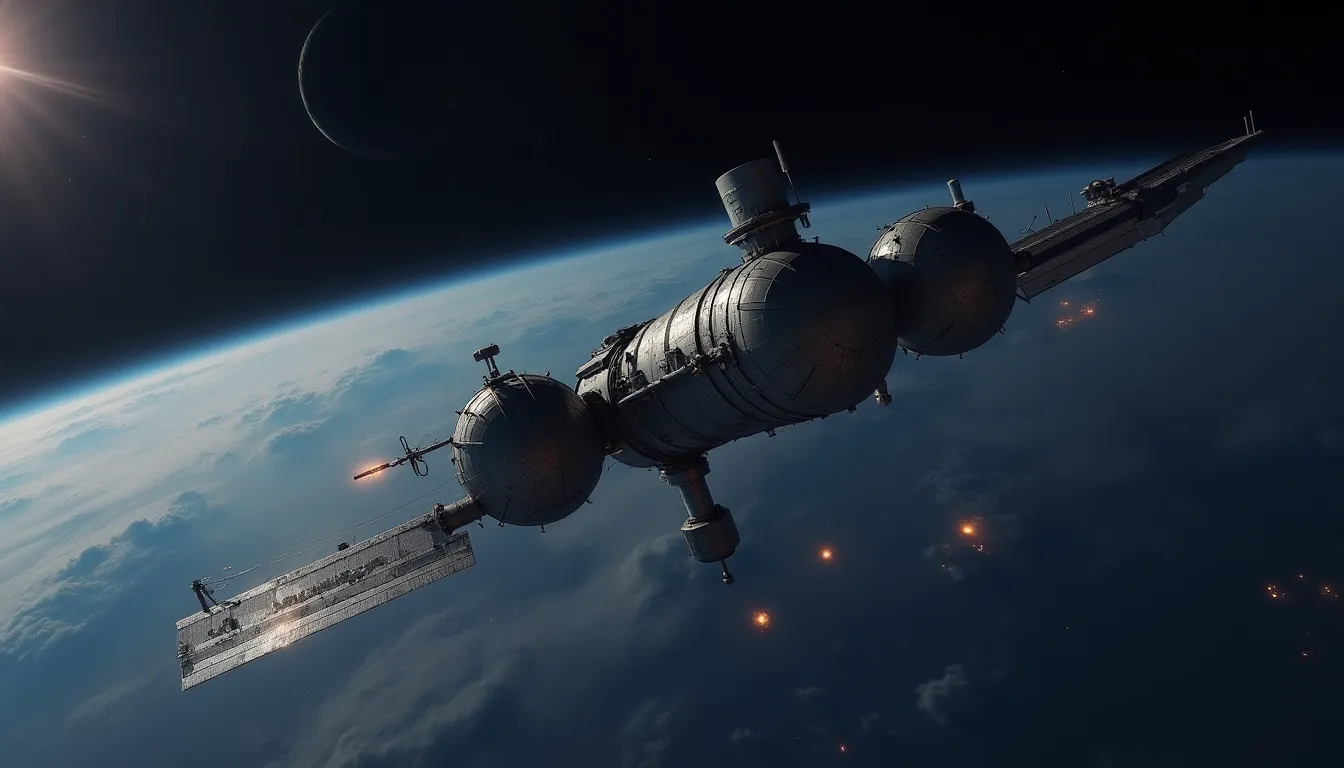
In recent weeks, NASA has made significant strides in aerospace systems, defense-adjacent space capabilities, and advanced technology demonstrations. These developments are critical not only for space exploration but also for enhancing national security through improved situational awareness and operational capabilities in space.
Recent Breakthroughs in Aerospace Systems
NASA’s Space Technology Mission Directorate (STMD) is at the forefront of advancing next-generation propulsion systems and deep-space mission architectures. One of the most notable achievements is the testing of a lithium-fed thruster, which NASA is evaluating for potential use in missions to Mars. This high-performance electric propulsion system is designed to operate more efficiently than traditional chemical propulsion, allowing for longer missions and greater payload capabilities.
The lithium-fed thruster’s testing aligns with NASA’s goal of transforming future missions and maintaining U.S. leadership in aerospace technology. According to a spokesperson from NASA, “Our advancements in propulsion technology are essential for the future of interplanetary exploration.” These efforts underscore the agency’s commitment to exploring Mars and beyond, aiming for a sustainable human presence on other planets.
Artemis II Milestones and Precision Landing Technologies
Another significant milestone was achieved on April 10, 2026, when the Artemis II mission successfully demonstrated its heat shield performance during reentry into Earth’s atmosphere. This achievement is pivotal as it paves the way for future crewed missions to the Moon and Mars. The Artemis program aims to establish a sustainable human presence on the Moon as a stepping stone for further lunar exploration and eventual Mars missions.
In addition, NASA has made rapid progress in Entry, Descent, and Landing (EDL) technologies, completing its fourth EDL technology test within three months. These advancements are crucial for ensuring safe landings on extraterrestrial surfaces, enhancing the reliability of future missions. The increased precision afforded by these technologies is essential for landing heavy payloads and crewed missions on the Moon and Mars.
Defense-Adjacent Space Capabilities
As the line between space exploration and defense continues to blur, NASA’s recent technology developments also reflect a growing focus on defense-adjacent capabilities. The agency has conducted live flight testing of the Airspace Management System for Emergency Response Operations (ACERO), showcasing its ability to manage airspace effectively during emergencies. This system is vital for coordinating responses in natural disasters and other critical situations where air traffic must be managed efficiently.
Moreover, NASA is pioneering autonomous space traffic coordination through its collaboration with SpaceX’s Starlink and its own Starling spacecraft. This initiative aims to enhance space situational awareness and collision avoidance in increasingly crowded orbits, a critical aspect of national security as satellite deployments proliferate.
Advanced Technology Demonstration Initiatives
NASA’s commitment to advanced technology demonstration is evident in its ongoing projects under the STMD. The agency’s efforts to develop high-performance MEMS accelerometers and quartz MEMS gyroscopes are paving the way for more sophisticated navigation systems, which are crucial for both aerospace applications and defense operations. These components are designed to offer superior stability and precision, catering to the demanding requirements of modern navigation and surveillance tasks.
Additionally, NASA’s Advanced Sensor Module, which integrates a three-axis gyroscope, accelerometer, and magnetic sensor, is set to revolutionize motion sensing capabilities. This technology will be essential for precise tracking and positioning in various industrial and defense applications.
Future Outlook: Bridging Aerospace and Defense
The developments emerging from NASA’s technology portfolio not only demonstrate the agency’s commitment to advancing space exploration but also highlight the increasing intersection of aerospace technology and defense. As NASA continues to push the boundaries of what is possible in space, the implications for national security and defense capabilities are profound. The agency’s focus on thermal battery systems and precision navigation clearly illustrates a forward-thinking approach that addresses both exploration and defense needs.
As we look to the future, the collaboration between NASA and defense entities is expected to grow, fostering innovation that will benefit both sectors. The continued advancement of technologies that enhance space situational awareness and operational readiness will be critical in maintaining U.S. leadership in aerospace and defense.
Conclusion
In summary, NASA’s recent advancements in aerospace systems, defense capabilities, and advanced technology demonstrations reflect a robust commitment to innovation and excellence. As the agency prepares for future missions to Mars and enhances its defense-adjacent capabilities, the implications for both space exploration and national security are significant. The path forward is one of collaboration and technological advancement, ensuring that the United States remains at the forefront of aerospace technology for years to come.
References
-
Mission-Integrated Space Capabilities - Lockheed Martin (www.lockheedmartin.com) - 5/20/2026 We’re designing, building and testing lunar and deep space exploration capabilities, including NASA’s Orion spacecraft, and creating early-warning weather and …
-
Space Development Agency – Increasing Warfighters’ Lethality … (www.sda.mil) - 5/19/2026 The Space Development Agency (SDA) will quickly deliver needed space-based capabilities to the joint warfighter to support terrestrial missions.
-
NASA’s Recent Breakthroughs: Pioneering Advances in Aerospace … (orbysa.com) - 4/21/2026 Explore NASA’s latest advancements in aerospace and defense, including the successful Artemis II mission, cutting-edge technologies, …
-
From Detection to Deflection: Evaluating NASA’s Planetary Defense … (www.youtube.com) - 5/15/2025 Space and Aeronautics Subcommittee - From Detection to Deflection: Evaluating NASA’s Planetary Defense Strategy Full details here: …
-
How the DoD Is Evolving - AiDA (aida.mitre.org) - 7/1/2020 The DoD is focusing on a core set of game-changing technologies that will shape future warfare. It looks to harness leading commercial technologies for military …
-
NASA spin-off technologies - Wikipedia (en.wikipedia.org) - 7/10/2008 NASA spin-off technologies are commercial products and services which have been developed with the help of NASA, through research and development contracts.
-
[PDF] The Aerospace Technology Enterprise mission is to pioneer and (www.nasa.gov) The pro- gram will create new models for aviation safety management, including real-time identification and mitigation of risk at all levels, while contin- uing …
-
Technology - NASA (www.nasa.gov) - 1/27/2023 NASA Fires Up Powerful Lithium-Fed Thruster for Trips to Mars. NASA puts next‑generation propulsion to the test—a system powerful enough to carry crews to Mars …
-
Space Technology Mission Directorate - NASA (www.nasa.gov) - 12/13/2022 NASA’s Space Technology Mission Directorate (STMD) aims to transform future missions while ensuring American leadership in aerospace.