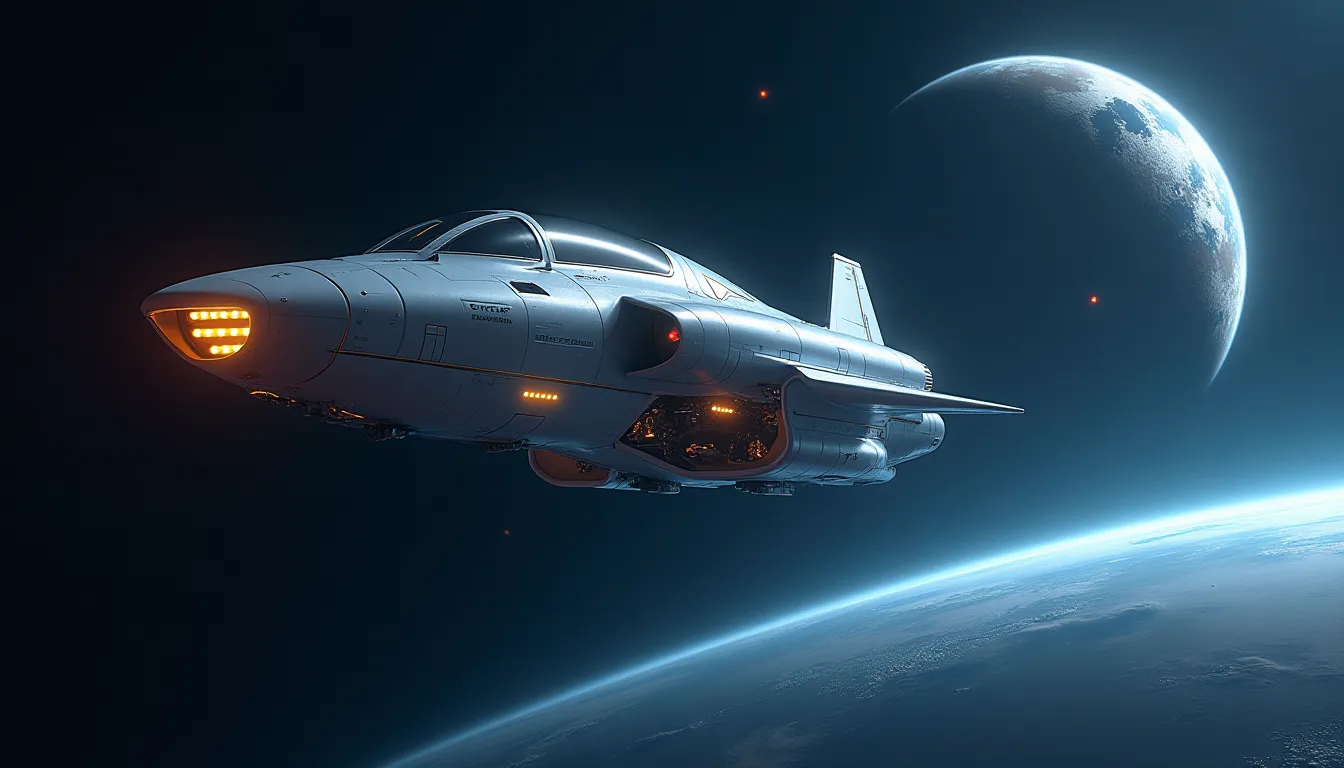
In an era where space exploration is rapidly advancing, the aerospace and defense industries are witnessing significant transformations in spacecraft technology. Recent trends highlight a shift from traditional large satellite systems to more innovative approaches such as distributed satellite architectures, reusable launch systems, and the integration of artificial intelligence (AI) in operations. This article delves into these pivotal developments and their implications for the future of space exploration.
Distributed Satellite Architectures: A Collaborative Approach
Distributed spacecraft systems are emerging as a cornerstone of modern space missions. Unlike traditional models that rely on a single, large satellite, these systems utilize multiple smaller spacecraft that work collaboratively to achieve complex tasks. According to the Stanford Emerging Technology Review, this approach enhances mission capability and resilience, enabling tasks that would be challenging or impossible for a single spacecraft. This shift not only maximizes efficiency but also allows for more flexible mission designs that can adapt to changing requirements in real-time.
The Impact of Commercialization on Spacecraft Development
The privatization of spaceflight is reshaping the landscape of spacecraft development. Governments are increasingly turning to commercial entities for satellite capabilities, marking a departure from legacy systems owned and operated by state agencies. As noted in Deloitte’s 2026 Aerospace and Defense Industry Outlook, this shift towards NewSpace architectures—developed by private companies—fosters innovation and reduces costs. Companies like SpaceX and Blue Origin are at the forefront, providing reliable launch services that facilitate a new era of commercial space exploration.
Reusable Launch Systems: Reducing Costs and Increasing Cadence
A critical development in spacecraft technology is the rise of reusable launch vehicles. These systems are designed to be launched multiple times, significantly lowering the cost of access to space. Deloitte emphasizes that this trend will continue to gain traction as the aerospace sector seeks to enhance launch cadence and improve cost efficiency. The successful deployment of reusable systems like SpaceX’s Falcon 9 has set a benchmark for future endeavors, encouraging investment in technologies that support sustainability and economic viability in space missions.
The Role of AI in Space Operations
Artificial intelligence is making significant inroads into spacecraft operations, particularly in areas such as decision-making, logistics, and maintenance. As highlighted by Epicflow, AI tools are transitioning from pilot projects to widespread deployment within the aerospace and defense sectors. These advancements are not just limited to autonomous systems; AI is being integrated into support infrastructure, enhancing operational efficiency and enabling more sophisticated mission planning.
Advanced Propulsion Technologies for Future Missions
Propulsion remains a critical focus area in spacecraft development. NASA’s ongoing tests of a powerful lithium-fed thruster illustrate the agency’s commitment to developing advanced propulsion systems capable of supporting future Mars exploration missions. This innovation is indicative of a broader trend towards enhancing propulsion efficiency and enabling longer-duration missions. The development of high-efficiency engines will be essential for deep-space travel, paving the way for human exploration beyond low Earth orbit.
Innovations in Manufacturing: 3D Printing and Digital Engineering
The advancement of manufacturing technologies, particularly additive manufacturing and digital engineering, is revolutionizing spacecraft production. Companies are increasingly adopting 3D-printed components to reduce mass and costs while improving design precision. According to NI’s report on next-generation space technologies, these innovations are crucial for achieving the rapid development cycles required in today’s fast-paced aerospace environment. By leveraging advanced sensor modules and high-precision advanced navigation systems, manufacturers can enhance the reliability and performance of spacecraft hardware.
Conclusion
The future of spacecraft technology is bright, driven by innovations in distributed systems, AI applications, and advanced propulsion methods. As the aerospace and defense industries continue to evolve, the integration of commercial space capabilities and cutting-edge manufacturing techniques will play a pivotal role in shaping the next generation of space exploration. With ongoing investments in these technologies, we are likely to witness an exciting new chapter in humanity’s quest to explore the cosmos.
By embracing these advancements, the aerospace sector is not only enhancing its operational capabilities but also ensuring that space remains accessible for generations to come.
References
-
Space - Stanford Emerging Technology Review (setr.stanford.edu) - 5/1/2026 KEY DEVELOPMENTS. One major development is the increased use of distributed space systems comprised of multiple spacecraft that interact and work together to … By definition, space technology is any technology developed for the purpose of conducting or supporting activities beyond the Kármán line (i.e., one hundred kilometers or sixty-two miles above the Earth’s surface). Space systems can be crewed (e.g., the International Space Station, SpaceX Dragon) or uncrewed (e.g., telecommunication and navigation satellites). They also vary in size from large structures like the International Space Station (420 tons mass) to small and micro satellites that can weigh less than ten kilograms and are about the size of a loaf of bread. Today, a large majority of functional satellites in space weigh between one hundred and one thousand kilograms, less than the weight of a motorcycle. … One major development is the increased use of distributed space systems comprised of multiple spacecraft that interact and work together to accomplish objectives that would be difficult or impossible with a single spacecraft. There is also an increasing trend toward privatization across most space technologies as the space sector moves away from legacy space technologies owned by governments or large contractors. These legacy systems are characterized by large, expensive spacecraft with long development timelines. Today, a “NewSpace” economy is turning to private companies, creating a global space environment in which systems and services are more accessible and less expensive—and available to all. Governments are also looking to commercial space for new capabilities. … Current applications of space technology include Global Navigation Satellite Systems (GNSS) for position, navigation, and timing services; voice, SMS (short message service), and internet data communications via satellites and lasers; remote sensing to observe locations and conditions on Earth; and national security spacecraft. Future applications of space might include manufacturing materials like pharmaceuticals, optics, and semiconductors in space; mining the Moon and asteroids; capturing energy, generating power, and beaming it to Earth; increased military equipment and presence in space; and in-space logistics, servicing assembly, and manufacturing (ISAM) capabilities.
-
STELLAR EXPLORATION – ADVANCED SPACE SYSTEMS AND … (www.facebook.com) - 3/18/2026 STELLAR EXPLORATION – ADVANCED SPACE SYSTEMS AND PROPULSION TECHNOLOGIES FOR DEFENSE MISSIONS Stellar Exploration develops high performance …
-
Building the future of space defense - YouTube (www.youtube.com) - 12/11/2025 • Space Minds About Space Minds Space Minds is a new audio and video … technologies and exciting opportunities in space. This weekly …
-
2026 Aerospace and Defense Industry Outlook | Deloitte Insights (www.deloitte.com) - 11/13/2025 *The A&D industry is rapidly expanding beyond traditional aircraft and weapons systems to include reusable launch vehicles, hypersonic weapons, …
-
AI and agentic AI: Transforming A&D
-
Aftermarket: Reshaping maintenance, repair, and overhaul
-
Supply chain: Building resiliency and efficiency amid volatility
-
Contracting and procurement: Unlocking competitive advantage in A&D
-
AI-driven workforce transformation: Shifting from ‘big data’ to multidisciplinary skill sets … By 2026, agentic AI is expected to progress from pilot projects to scaled deployments, with the most visible advances occurring in the decision-making, procurement, planning, logistics, maintenance, and administrative functions. … In parallel, agentic AI will play a growing, but supplementary, role in battlefield operations, primarily as a decision support tool.*
-
50 Space Technologies that ARE or CAN be developed with help of … (www.eclipsesuite.com) - 2/17/2025 *This list covers advancements in propulsion, space exploration, satellite technology, planetary defense, and more. Discover 50 cutting-edge space technologies that could define the future of the space industry. Some are already in development, while others remain theoretical. This list covers advancements in propulsion, space exploration, satellite technology, planetary defense, and more. …
-
Interstellar Travel: Developing craft capable of sending data back from beyond our solar system.
-
Detecting Exoplanets: Tools for exploring the distant regions of outer space.
-
Deep Space Navigation: Utilizing pulsars and other celestial markers for precise navigation.
-
Gravimetry: Measuring variations in planetary gravity to study internal structures and inform geological models.
-
Mercury Surface Exploration: Investigating the composition and atmosphere of Mercury through advanced technological platforms. …
-
Technologies for Mars Surface Analysis: Focusing on detecting past microbial life and assessing current conditions on Mars.
-
Gravitational Wave Detection: Deploying space-based instruments to detect and analyze cosmic gravitational waves.
-
Exoplanet Characterization: Techniques for studying the size, composition, and atmospheres of distant planets. …
Earth and Environmental Monitoring
- Remote Sensing: Detecting and monitoring the characteristics of an area by measuring its reflected and emitted radiation at a distance
- Earth Observation Systems: High-resolution imaging systems providing real-time, detailed environmental data.
- Planetary Atmosphere Analysis: Developing technologies to study and analyze the atmospheres of other planets in our solar system.
- Climate Monitoring Satellites: Specialized satellites dedicated to monitoring global climate patterns and atmospheric changes.
Safety
- Atmospheric Entry Technologies: Developing advanced materials and technologies for safe planetary re-entry.
- Planetary Defense: Systems designed to detect and deflect potentially hazardous asteroids and comets.
- Space Debris Monitoring and Mitigation: Technologies aimed at identifying and removing space debris.
Infrastructure*
-
The New Frontier of Satellite Technology | Dassault Systèmes (www.3ds.com) - 4/3/2024 It hastens their ability to design and manufacture sustainable first-time-right rocketry and satellite systems with the required quality at lower costs, and …
-
5 Next-Generation Space Technologies Being Tested Today - NI (www.ni.com) - 3/22/2024 New Space Technology · 1. 3D Printed Components · 2. Reusable Launch Vehicles · 3. Smart Propulsion · 4. Artificial Intelligence · 5. Nanotechnology.
-
Technology - NASA (www.nasa.gov) - 1/27/2023 NASA Fires Up Powerful Lithium-Fed Thruster for Trips to Mars. NASA puts next‑generation propulsion to the test—a system powerful enough to carry crews to Mars …
-
New Technology Trends in Aerospace and Defense Industry [2026] (www.epicflow.com) - 4/6/2022 *Among the notable developments that will impact aerospace and defense trends next year are artificial intelligence and agentic AI, additive manufacturing, and … – the rise of automation and artificial intelligence, – wide application of augmented and virtual reality, – the rise of Industry 4.0 (e.g., additive manufacturing and digitization). …
- Supporting decision-making. …
- Reducing the weight of defense equipment: 3D-printed parts and components are more lightweight, require less material than the ones traditionally manufactured, and are less costly. … In 2026, robotics and autonomous systems are expected to become integral components of military operations, which is, among other things, explained by increased popularity of AI agents. … In 2026, we expect even wider adoption of immersive technologies and market growth. New immersive systems combine AR/VR with AI to create a dynamic, adaptive, and realistic training environment. …
- utilization of advanced technologies (e.g., digital twins, smart factory, digital threads) to improve aircraft design and engineering and achieve fuel efficiency;
- selection of sustainable alternative fuels, e.g., sustainable aviation fuels or SAFs;
- new propulsion technologies (electric, hydrogen, hybrid);
- combining smart technologies and green energy (the factory of the future);
- aerospace supply chain reconfiguration and streamlining shipping and distribution. … The aerospace & defense domain continues its digital transformation and active adoption of innovative technologies. In 2026, recent technological advancements will continue to shape the aerospace and defense industry landscape. Among the notable developments that will impact aerospace and defense trends next year are artificial intelligence and agentic AI, additive manufacturing, and immersive technologies. Also, aerospace & defense organizations will continue their decarbonization efforts supported by technological developments, improve defense equipment and satellite technologies, as well as take advantage of robotics, increased connectivity, and blockchain. … Key aerospace and defense innovations will include the application of artificial intelligence and agentic AI, immersive technologies, additive manufacturing, cybersecurity solutions, blockchain, IoT, and robotics. What is more, next year will be marked by further sustainability efforts, space exploration, and developments in aerial mobility.*