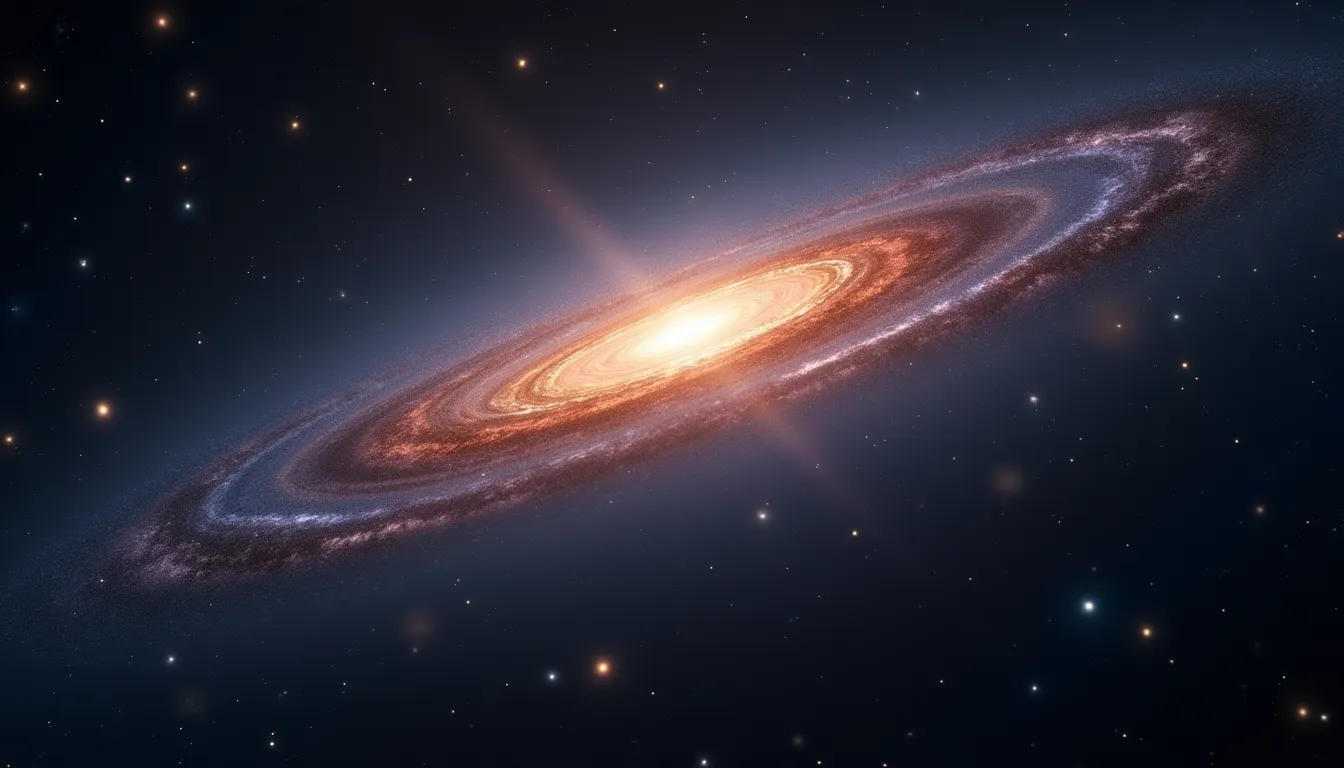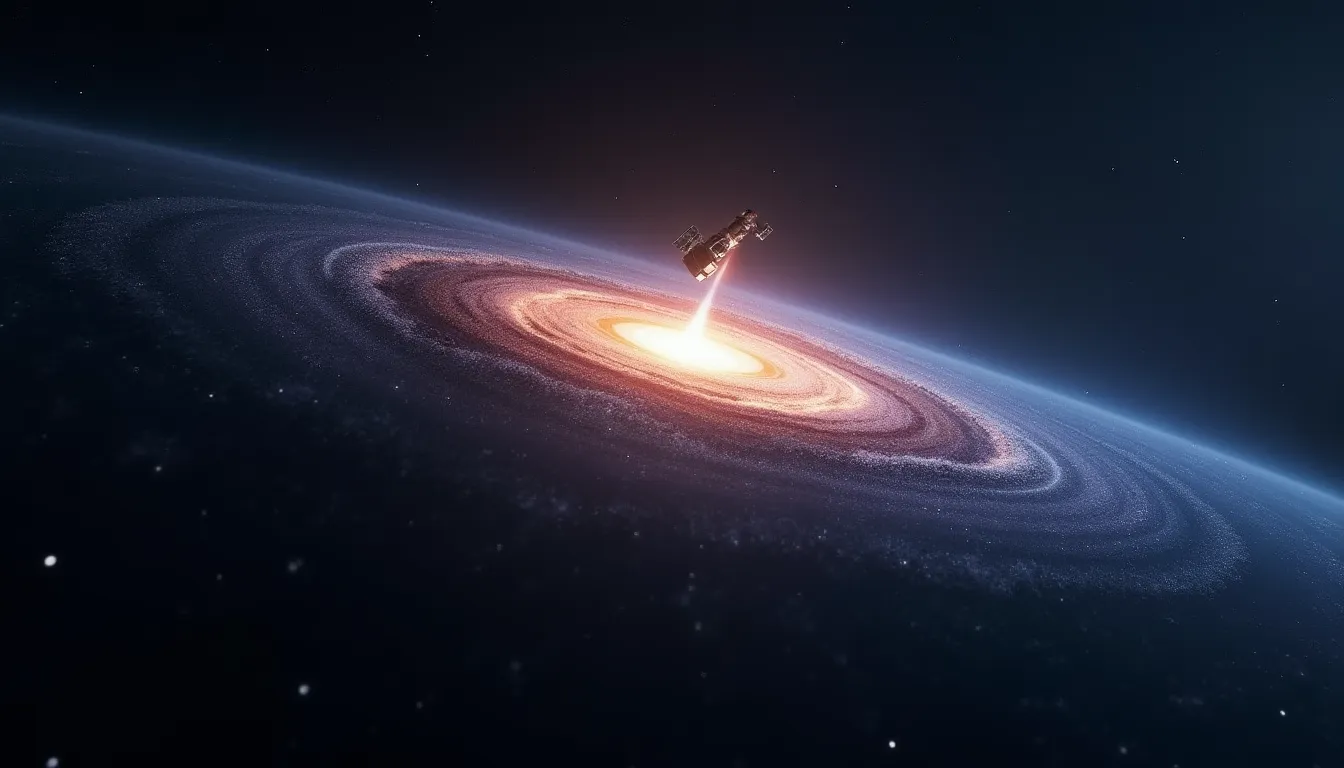
The Hubble Space Telescope, a joint project of NASA and the European Space Agency (ESA), continues to be at the forefront of astronomical research, unveiling cosmic phenomena that challenge our understanding of the universe. Recent developments highlight not only Hubble’s ongoing discoveries but also its future through the anticipated ‘Super Hubble’ and advancements by Hubble Network in satellite technology.
Recent Scientific Discoveries by Hubble Space Telescope
Cloud-9: A Starless Dark Matter Cloud
On January 5, 2026, ESA/Hubble announced a groundbreaking discovery: the identification of Cloud-9, a starless and gas-rich dark matter cloud. This celestial entity is thought to be a relic from the early stages of galaxy formation. Hubble’s Advanced Camera for Surveys confirmed the absence of stars, suggesting that Cloud-9 is not a faint dwarf galaxy, but rather a unique formation that could shed light on dark matter’s role in the universe’s evolution. Lead author Gagandeep Anand from the Space Telescope Science Institute stated, “This discovery could change our understanding of dark matter and its influence on galaxy formation.”

Refining Uranus’ Rotation Rate
In another significant finding, Hubble refined the rotation period of Uranus using more than a decade’s worth of auroral observations. The new measurements, reported on April 7, 2025, achieved an impressive 1,000 times greater accuracy than previous estimates. This advancement sets a new benchmark for planetary research, providing essential data for understanding the dynamics of our solar system.
The Super Hubble: Future Prospects
NASA has initiated an exciting new chapter in space exploration with the ‘Super Hubble’ project, officially known as the Habitable Worlds Observatory (HWO). In late 2025, NASA awarded contracts to seven companies, including Northrop Grumman and Lockheed Martin, to develop advanced technologies aimed at detecting alien life. The HWO is targeted for launch in the late 2030s or early 2040s and will focus on overcoming significant engineering challenges like advanced optics and precision imaging. As part of this endeavor, high-performance CMOS imaging systems are being considered to enhance observational capabilities.
Hubble Network: Revolutionizing Satellite Connectivity
Satellite Upgrade with Muon Space
In a parallel development, the Hubble Network, a Seattle-based startup, is poised to revolutionize global connectivity with its satellite upgrades. Announced on August 7, 2025, the partnership with Muon Space will deploy two MuSat XL satellites equipped with phased-array receivers. These satellites aim to create a seamless Bluetooth layer around the Earth, allowing devices to communicate over vast distances while consuming minimal power. The system will offer a 12-hour global revisit capability and can detect Bluetooth Low Energy (BLE) signals at 30 times lower power, significantly extending battery life for IoT devices.
As Hubble Network’s advancements unfold, they aim to enhance enterprise IoT tracking, similar to Apple’s Find My network, by utilizing high-volume downlink capabilities and optical crosslinks for efficient data transmission. This innovative approach could redefine how we connect and track devices globally.
Historical Context: Hubble’s Defense Contributions
While current discussions focus on the astronomical advancements of the Hubble Space Telescope, it is essential to acknowledge its historical context. Between 1978 and 1980, DARPA played a pivotal role in the development of the Hubble Telescope by funding critical advancements such as lightweight graphite-fiber and aluminum antenna booms. These innovations contributed to a 60% reduction in weight, improving the telescope’s overall performance. Optical algorithms developed during this period also enhanced mirror deformation corrections, enabling more precise imaging capabilities that continue to benefit scientific research today.
Conclusion
The Hubble Space Telescope remains a cornerstone of astrophysical research, continuously reshaping our understanding of the universe through its groundbreaking discoveries. As we look ahead, the launch of the ‘Super Hubble’ promises to unlock new frontiers in the search for extraterrestrial life. Concurrently, the Hubble Network’s innovative satellite technologies are set to transform global connectivity, paving the way for a future where devices communicate with unprecedented efficiency. The synergy between cosmic exploration and technological advancement underscores the evolving landscape of aerospace and defense, where the boundaries of possibility are continually expanded.
References
-
Hubble Network plans massive satellite upgrade to create global … (techcrunch.com) - 8/7/2025 This advanced payload will fly on two massive new satellites from four-year-old Muon Space, called MuSat XL, which are slated to launch in 2027.
-
Hubble Telescope assist - DARPA (www.darpa.mil) Through this new material technology, DARPA met NASAs design requirements for weight, stiffness, and dimensional stability. DARPA also contributed to the …
-
NASA funds new tech for upcoming ‘Super Hubble’ to … - Space (www.space.com) - 1/12/2026 NASA funds new tech for upcoming ‘Super Hubble’ to search for alien life: ‘We intend to move with urgency’ · On the left, a giant orange arc …
-
Cloud-9: a new celestial object found by Hubble - ESA (www.esa.int) A team using the NASA/ESA Hubble Space Telescope has uncovered a new type of astronomical object – a starless, gas-rich, dark-matter cloud that is …
-
Press Releases - ESA/Hubble (esahubble.org) 5 January 2026: A team using the NASA/ESA Hubble Space Telescope has uncovered a new type of astronomical object —a starless, gas-rich, dark-matter cloud that …
-
Honeywell Advances Autonomous Defense Capabilities for Modern … (www.unmannedsystemstechnology.com) - 6/23/2025 Honeywell is driving advancements in autonomous military systems, from AI copilots to drone defense, enhancing operational effectiveness and supporting future- …
-
NASA Hubble News (science.nasa.gov) - 3/31/2025 Here you will find Hubble’s latest discoveries and its most recent images. You can also explore Hubble’s archive of older image and science releases.