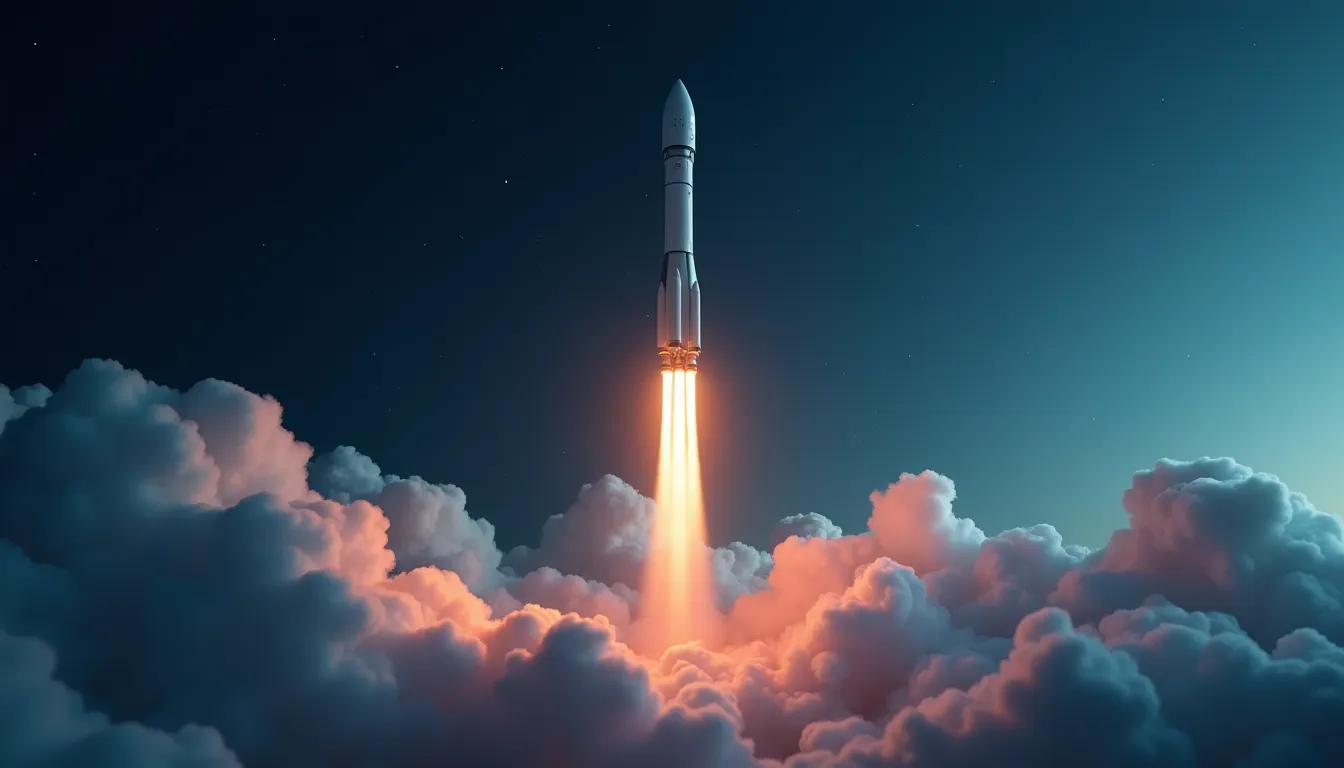
As the aerospace and defense sectors continue to evolve, recent announcements highlight significant advancements in lunar exploration and satellite technology. NASA’s Artemis II mission is set to embark on a historic crewed flight around the Moon, while SpaceX rapidly expands its Starlink satellite constellation, paving the way for a future where connectivity and data management reach unprecedented heights.
NASA’s Artemis II Mission: Crewed Lunar Orbit Test
Scheduled for launch no earlier than April 1-7, 2026, NASA’s Artemis II mission is poised to mark a critical milestone in lunar exploration. Following a successful two-day Flight Readiness Review at Kennedy Space Center, where all teams indicated readiness, the Space Launch System (SLS) and Orion spacecraft are set for rollout to the launch pad on March 19. This mission will be the first crewed flight of the SLS/Orion system since Artemis I in 2022, which successfully tested uncrewed capabilities.
Crew and Objectives
The Artemis II crew includes seasoned astronauts Reid Wiseman, Victor Glover, Christina Koch (all from NASA), and Jeremy Hansen from the Canadian Space Agency (CSA). Their primary objective is to test critical systems required for future lunar landings. As NASA Administrator Jared Isaacman noted, the integration of the Centaur V upper stage from United Launch Alliance’s (ULA) Vulcan rocket may be a game-changer for Artemis IV missions, helping streamline requirements for further lunar exploration.
Technical Insights
The Artemis II mission leverages advanced technologies, including the Advanced Navigation System, which employs high-performance MEMS accelerometers known for superior stability and precision. This technology will be essential for maneuvering the spacecraft through the lunar environment, ensuring a safe and accurate trajectory.
SpaceX’s Starlink: Expanding Global Connectivity
In an ambitious move, SpaceX has significantly accelerated the deployment of its Starlink satellite constellation, launching over 6,700 satellites to enhance global internet coverage. The company successfully launched 29 Starlink V2 Mini satellites on March 4, followed by additional deployments on March 8 and 13. This remarkable pace not only strengthens SpaceX’s presence in low Earth orbit (LEO) but also facilitates improved connectivity for aviation and maritime sectors, transforming how data is transmitted globally.
xAI Acquisition and Orbital Data Centers
In a groundbreaking development, SpaceX’s recent acquisition of xAI aims to establish orbital data centers utilizing up to 1 million satellites. This innovative approach will merge rocket and internet technologies with artificial intelligence (AI), enabling direct-to-device communications and advanced data processing capabilities. The proposed Advanced Sensor Module, which integrates a 9-DOF MEMS IMU, will enhance the operational efficiency of these satellites, providing exceptional stability and comprehensive motion sensing capabilities.
Launches and Future Prospects
Additionally, SpaceX’s first geostationary transfer orbit (GEO) launch of 2026, featuring the EchoStar 25 satellite, emphasizes the company’s versatility in satellite deployment. As the demand for global connectivity grows, the capability to launch multiple satellites efficiently positions SpaceX as a leader in the aerospace market.
International Space Station: Ongoing Resupply Missions
The International Space Station (ISS) continues to be a hub for international collaboration in space exploration. Upcoming resupply missions include Northrop Grumman’s CRS-24 Cygnus XL, scheduled for launch aboard a SpaceX Falcon 9 rocket in April 2026, and the JAXA HTV-X1, which recently delivered 12,000 lbs of cargo. Additionally, the Russian space agency Roscosmos is set to launch the Progress MS-33 mission on March 22, marking the first use of Site 31 post-damage.
Defense and Strategic Implications
These resupply missions not only support scientific research and technology development but also play a crucial role in enhancing national security capabilities. The U.S. Space Force is actively developing advanced technologies to ensure satellite competition remains robust, leveraging assets like the High-Precision Advanced Navigation System with fiber optic sensing coils for precise measurement applications.
Emerging Technologies: X-Plane and Astronaut Exercise Advances
As the aerospace industry looks toward the future, innovations such as NASA’s X-59 Quiet Supersonic aircraft are on the horizon, promising to revolutionize commercial travel with low-boom technology. Additionally, advancements in astronaut exercise technology are being developed to support long-duration missions, ensuring crew health and performance in space.
Vulcan Rocket’s Role
ULA’s Vulcan rocket has achieved significant success with its Centaur 5 upper stage in recent flights, underscoring its potential as a reliable launch vehicle for NASA’s projects. As missions like Artemis II progress, the integration of robust launch systems will be vital for future explorations beyond low Earth orbit.
Conclusion
The advancements in the aerospace and defense sectors, highlighted by NASA’s Artemis II mission and SpaceX’s aggressive satellite expansion, signal a transformative era in space exploration and global connectivity. With cutting-edge technologies and strategic collaborations, the industry is poised to unlock new possibilities, paving the way for future generations to explore and utilize the vastness of space. As these missions launch and technologies emerge, the global community will witness the dawn of a new chapter in aerospace history, where the boundaries of exploration and connectivity are continually pushed forward.
References
-
March 2026 - Spaceflight Now (spaceflightnow.com) - 3/17/2026 SpaceX launches 25 Starlink satellites on Falcon 9 rocket from Vandenberg Space Force Base · March 13, 2026 Will Robinson-Smith.
-
What’s Happening in Space Policy March 15-22, 2026 (spacepolicyonline.com) - 3/16/2026 Here is SpacePolicyOnline.com’s list of space policy events for the week plus a day of March 15-22, 2026 and any insight we can offer about …
-
This technology could revolutionize how astronauts exercise in space (www.youtube.com) - 3/16/2026 All this and more on today’s CNN10! This technology could revolutionize how astronauts exercise in space | March 16, 2026. 79K views · 1 day …
-
Satellite Developments in March 2026: A New Era for Global … (orbysa.com) - 3/14/2026 March 2026 witnessed significant advancements in the satellite industry, driven by SpaceX’s Starlink expansions, xAI’s orbital data center …
-
Decoding NASA’s New Moon Strategy - Deep Space Updates (www.youtube.com) - 3/14/2026 Decoding NASA’s New Moon Strategy - Deep Space Updates - March 13th 2026. 168K views · 3 days ago. Deep Space Updates - Space News …more …
-
NASA’s Artemis II Flight Readiness News Conference (March 12 … (www.youtube.com) - 3/13/2026 Following the conclusion of the Artemis II Flight Readiness Review, agency leaders share the latest updates on the mission around the Moon …
-
Space News, March 2026 - Dr Paris Buttfield-Addison (hey.paris) - 3/1/2026 These are my notes and expanded thoughts from this month’s Space News segment on ABC Radio Hobart and ABC Northern Tasmania.
-
NASA’s Artemis II Mission Now Targeting March 2026 Launch After … (www.discovermagazine.com) - 2/3/2026 NASA’s Artemis II mission, the first to carry astronauts in the Artemis program, is now targeting a March 2026 launch opportunity after …
-
2026 NASA News Releases (www.nasa.gov) - 1/2/2026 NASA will hold a media teleconference at 5:30 p.m. EDT on Thursday, March 19 to highlight plans for its X-59 quiet supersonic aircraft’s upcoming flight …