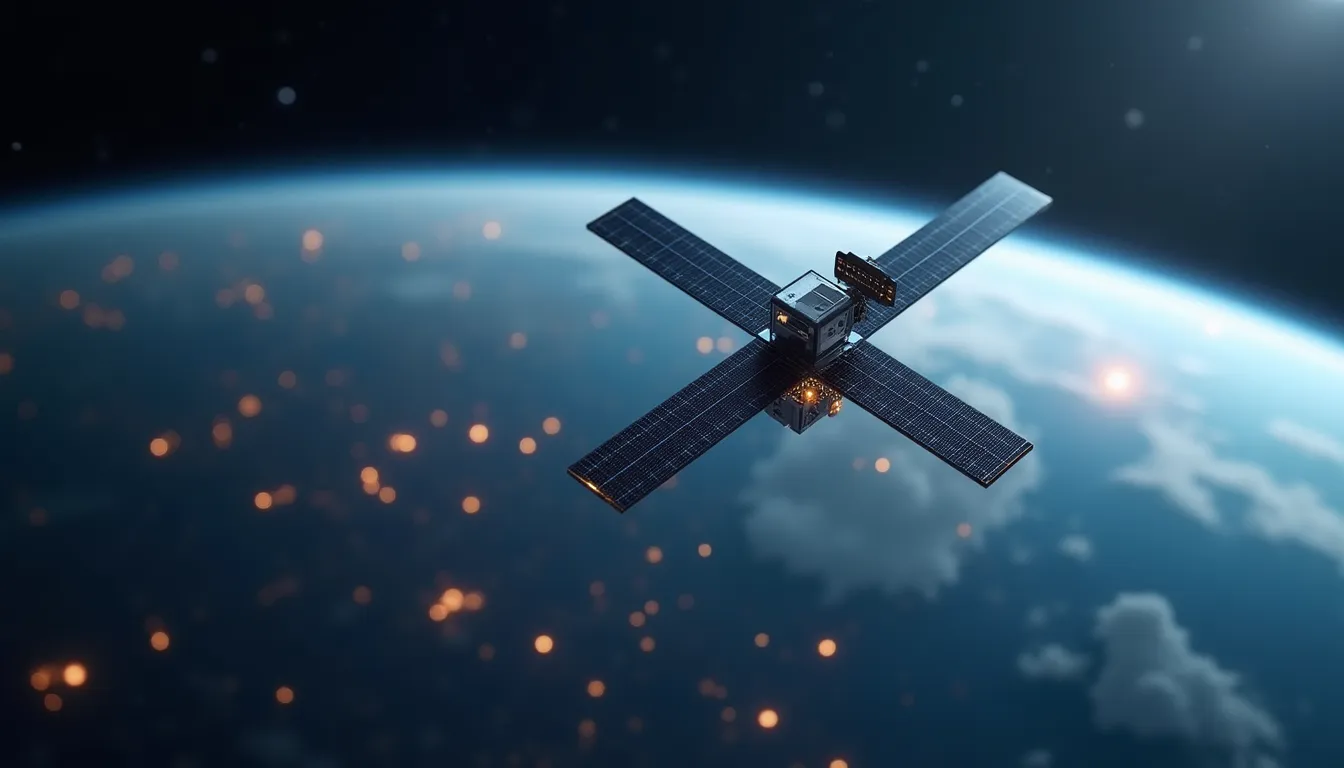
As the aerospace and defense sectors continue to evolve, recent advancements in satellite technology are reshaping communication and intelligence, surveillance, and reconnaissance (ISR) capabilities. The period from January 7 to February 7, 2026, has seen significant developments, including resilient satellite constellations, enhanced space domain awareness through mergers and AI, and challenges in missile tracking programs. This article delves into these advancements and their implications for national security and technological innovation.
Analyzing Missile Tracking Challenges
The Space Development Agency (SDA) is currently grappling with delays in its missile tracking constellation, known as Tranche 3. A recent report from the Government Accountability Office (GAO) highlighted issues such as overestimated technology readiness, inadequate communication with combatant commands, and unclear life-cycle costs. Experts recommend improving cost estimates and enhancing contractor reporting to mitigate these challenges. The implications of these setbacks are critical, as effective missile tracking is essential for maintaining a strategic edge against adversarial threats, particularly from nations like China and Russia.
In a contrasting development, BlackSky Technology secured notable contracts for its Gen-3 Assured ISR services, which provide high-resolution imagery at 35 cm and utilize AI for rapid detection of aircraft, vehicles, and vessels. This capability allows for multiple daily revisits and data delivery within one hour to priority areas, marking a significant advancement in real-time ISR operations. Such technologies underscore the importance of integrating precision accelerometers and advanced sensor modules that enhance situational awareness in defense applications.
The Rise of AI and Mergers in Space Domain Awareness
In a strategic move towards bolstering missile defense and space awareness, Qualis, InTrack Radar Technologies, and Tektonux announced their merger on February 4, 2026, forming a robust firm comprising over 400 employees. This new entity is set to leverage AI-enabled systems for missile defense and sensor-to-shooter frameworks. Their flagship software, Phoenix NexGen, is being tailored for use across various defense entities, including the U.S. Space Force and the Missile Defense Agency. The integration of advanced technologies such as high-performance CMOS imaging systems will play a pivotal role in enhancing the effectiveness of these systems in responding to missile threats.
Advancements in Satellite Communication and Debris Management
The landscape of satellite communications is rapidly changing with the proliferation of low-Earth orbit (LEO) constellations, which promise increased resilience and cybersecurity. The FORGE C2 initiative is advancing the development of cyber-secure Multi-Operational Systems Architecture (MOSA) for missile warning satellites, with the next phase of awards anticipated by early 2025. These advancements are crucial as the Pentagon expresses concerns over the dominance of companies like SpaceX in the satellite launch domain, prompting discussions on reforms to ensure U.S. space superiority amid rising threats from global competitors.
Additionally, the need for effective space debris management is becoming paramount. Automated avoidance technologies and debris removal systems are being developed to address the pressing issue of orbital debris, which poses risks to operational satellites. Integrating advanced navigation systems that utilize quartz MEMS gyroscopes will be essential for ensuring the safety and reliability of satellite operations in increasingly crowded orbits.
Innovative Technologies and Future Prospects
Among the most innovative developments is SpaceX’s plan to deploy up to 1 million solar-powered satellites as orbital AI data centers. This initiative aims to leverage the company’s Starship capabilities, which have seen 11 successful test flights since 2023. The goal is to reduce launch costs while enabling on-orbit processing, particularly vital in environments where terrestrial power sources are limited. This ambitious project aligns with SpaceX’s broader strategy of expanding its Starlink network and enhancing global internet connectivity.
Moreover, Singapore’s announcement of a new Synthetic Aperture Radar (SAR) satellite constellation for Earth observation demonstrates the growing international investment in satellite technology. These advancements not only bolster national capabilities but also contribute to global data sharing and environmental monitoring efforts.
Conclusion
The recent developments in satellite technology reflect a dynamic and rapidly evolving landscape within the aerospace and defense sectors. From addressing missile tracking challenges to pioneering AI integrations and enhancing satellite communications, these advancements have significant implications for national security and technological progress. As countries continue to invest in resilient satellite constellations and innovative solutions for space domain awareness, the future of satellite technology looks promising. Continued collaboration and investment in advanced sensor systems, such as high-performance PIN quadrant detectors, will be crucial in shaping the next generation of defense capabilities and maintaining strategic advantages in an increasingly complex global environment.
References
-
BlackSky Secures New International Defense Contracts for ISR … (thedefensepost.com) - 2/6/2026 European Multi-Mission Aircraft Heads Into Advanced ISR Territory With New Tech. February 6, 2026. A modern U.S. Navy destroyer moored at port, …
-
Qualis, InTrack, and Tektonux Merge to Form Advanced Missile … (news.satnews.com) - 2/6/2026 On February 4, 2026, Qualis, InTrack Radar Technologies, and Tektonux announced a definitive merger to create a unified defense technology …
-
Space Brief 6 Feb 2026 - KeepTrack (keeptrack.space) - 2/6/2026 Today’s Space Brief highlights military advances in satellite technology, innovative defense purchasing models, and international agreements …
-
A Quick Note on Orbiting Data Centers - CEPA (cepa.org) - 2/6/2026 Dividing the load among many smaller data satellites could make the cost more manageable, but not yet competitive with terrestrial facilities.
-
26AERP02: Aerospace & Defense Technology: February 2026 (saemobilus.sae.org) - 2/5/2026 Plasma Surface Activation for Stronger, More Durable CFRP Bonds in Aerospace · Smarter Pyrovalve Alternatives for Modern Missile and Munition …
-
Defense Business Brief: The case for more ground stations | Drone … (www.defenseone.com) - 2/5/2026 Rockets and satellites draw the spotlight, sure, but could 2026 be the year the ground stations that command them get a bit more love from …
-
Defense Tech Trends for 2026: Innovation in Action - NSTXL (nstxl.org) - 2/4/2026 OTA-enabled projects are pushing the boundaries of space situational awareness, satellite communications, management of space debris, and space- …
-
Next Up in Pentagon’s Push for Defense Industry Reforms: Space (www.airandspaceforces.com) - 2/4/2026 “Folks across government are getting more and more concerned about the level of dominance of SpaceX, both in launch and in satellite production.
-
Aerospace Daily & Defense Report, February 4, 2026 - Aviation Week (aviationweek.com) - 2/4/2026 Singapore is set to deploy a new constellation of SAR satellites as it builds out its Earth-observation portfolio, including through a …
-
SpaceX to align space launch, satellite infrastructure and AI … (spaceanddefense.io) - 2/2/2026 SpaceX has outlined an ambitious plan to deploy solar-powered satellite data centres in orbit, signalling how far the race to support …