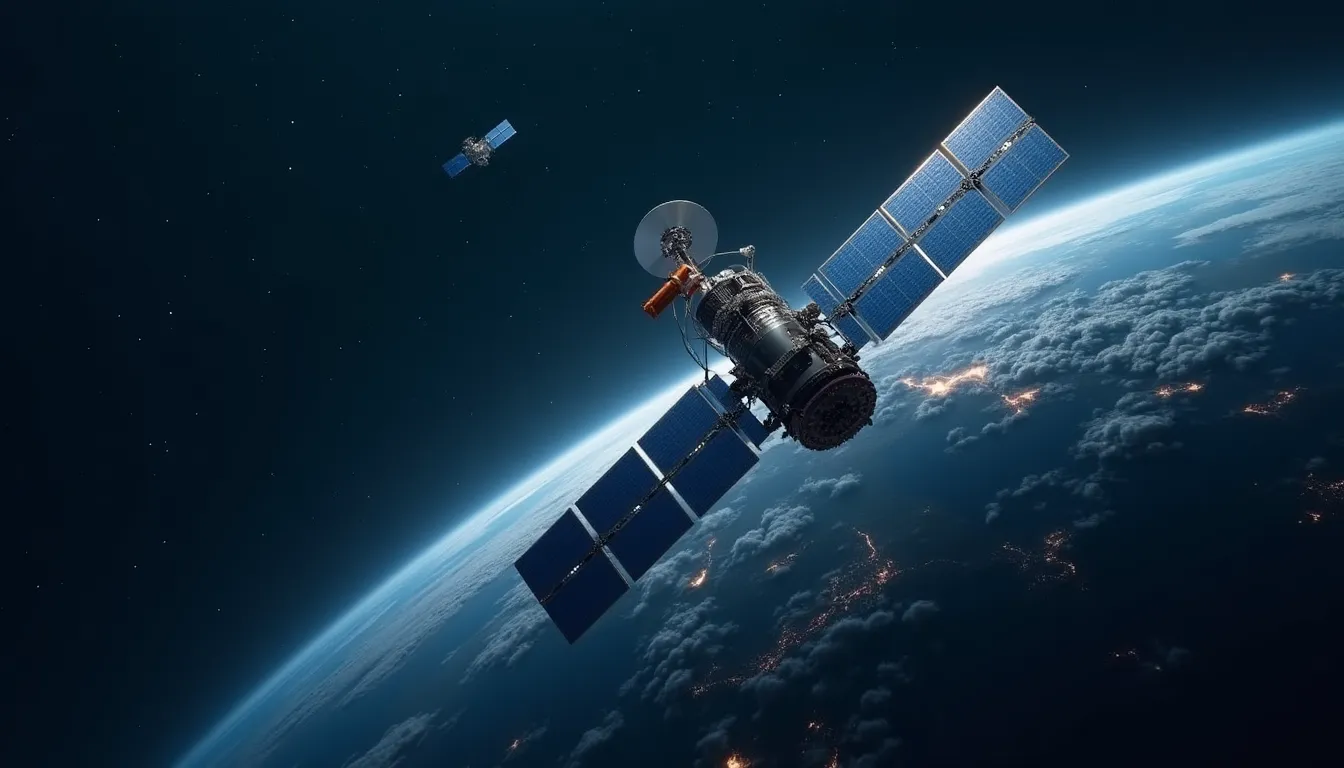
The aerospace and defense industries are witnessing an unprecedented surge in satellite technology advancements. Over the past month, significant developments include multiple successful launches by SpaceX and Rocket Lab, a strategic pivot in U.S. Space Force operations, and emerging innovations in commercial satellite connectivity. This article delves into these advancements, highlighting their implications for national security, global connectivity, and emerging market trends.
Satellite Launches: Pioneering Connectivity and Observation
In January 2026, two key players in the aerospace sector, SpaceX and Rocket Lab, executed notable satellite launches that underscore the dynamic landscape of low Earth orbit (LEO) deployments.
SpaceX Starlink Mission
On January 25, 2026, SpaceX successfully launched 25 Starlink V2 Mini Optimized satellites from Vandenberg Space Force Base using the Falcon 9 booster B1097. This mission marked the booster’s sixth flight and SpaceX’s impressive milestone of 563 successful booster landings. The Starlink V2 Mini satellites are designed to enhance global broadband coverage, particularly in underserved regions, emphasizing the company’s commitment to improving terrestrial and non-terrestrial network integration. The launch is pivotal for expanding the Starlink constellation, which aims to provide high-speed internet access across the globe.

Source: Spaceflight Now
Rocket Lab’s Electron Mission
Just days earlier, on January 22, Rocket Lab launched its first mission of 2026, aptly named “The Cosmos Will See You Now.” This mission successfully deployed two Open Cosmos satellites for a telecom constellation in LEO. The Electron rocket’s ascent from New Zealand not only marked its 80th mission but also illustrated the growing trend of small satellite rideshare programs, which facilitate access to space for non-space customers seeking Earth observation data.

Source: Space.com
Upcoming Defense Launches
Additionally, SpaceX is slated to launch the GPS III satellite (SV09) on January 26, 2026. This satellite will incorporate M-Code technology, which enhances jam-resistant positioning, navigation, and timing (PNT) capabilities. This mission is crucial for national security, reflecting a shift from the United Launch Alliance’s Vulcan rocket to SpaceX’s Falcon 9 due to certification delays. Such developments indicate a growing reliance on commercial space solutions for critical defense operations.
Advancements in Earth Observation and Data Accessibility
Another significant milestone is the European Space Agency’s (ESA) recent launch of the Biomass satellite, which has begun providing free global forest biomass data. This operational Earth observation satellite plays a critical role in environmental monitoring, contributing to climate change studies and sustainable resource management. The availability of such data underscores the trend toward open-access satellite data, which is increasingly vital for researchers and policymakers alike.
The Convergence of Satellite Technologies and Consumer Devices
As satellite technology evolves, the convergence of satellite-to-handset communication has gained momentum. The emergence of commercial direct-to-device (D2D) connectivity signifies a transformative shift in how consumers interact with satellite networks. Notably, the collaboration between Apple and Globalstar has introduced satellite messaging and emergency SOS features to iPhones, making it easier for users to maintain connectivity in remote areas. This convergence is primarily driven by advancements in 5G-Advanced (Rel-19) technologies, providing reliable connectivity for IoT applications, such as those deployed in offshore energy operations.
Strategic Developments in Defense Capabilities
The U.S. Space Force’s RG-XX program underscores a strategic pivot in military satellite operations. Set to begin initial contracts in early 2026, this program aims to deploy proliferated, maneuverable small satellites capable of tracking geosynchronous orbit (GEO) objects at altitudes reaching 22,000 miles. Utilizing off-the-shelf technology, the RG-XX program is expected to enhance the U.S. military’s surveillance and reconnaissance capabilities, offering rapid updates through collaborations with multiple vendors. This approach not only streamlines procurement but also accelerates the integration of advanced technologies, such as high-performance CMOS imaging systems for enhanced imaging capabilities in reconnaissance missions.
Growth in GNSS Market
The Global Navigation Satellite System (GNSS) augmentation market is projected to reach $14.47 billion in 2026, reflecting an 8.8% compound annual growth rate (CAGR). Driven by the demand for precision navigation in aviation and maritime sectors, technological advancements such as the Airoha AG3335MA chip are set to revolutionize positioning accuracy. This growth is further supported by strategic acquisitions, such as CNH’s acquisition of Hemisphere GNSS, enhancing the capabilities of GNSS systems worldwide.
Future Outlook
The rapid advancements in satellite technology are reshaping the aerospace and defense landscape, highlighting the importance of innovation, national security, and global connectivity. As commercial entities continue to push the boundaries of what is possible in low Earth orbit and beyond, we can expect a future marked by enhanced satellite capabilities, greater data accessibility, and improved defense systems. The integration of advanced sensor technologies, such as precision accelerometers and MEMS gyroscopes, will further bolster the reliability and performance of satellite systems, ensuring they meet the evolving demands of both commercial and governmental sectors.
In conclusion, the ongoing developments in satellite technology signal a new era of connectivity, security, and operational efficiency that will redefine how we interact with our planet and beyond. The coming years promise exciting advancements that will enhance global communication capabilities while ensuring robust defense mechanisms are in place to protect national interests.
References
-
New Space Force Reconnaissance Satellites Could Be Online by … (www.airandspaceforces.com) - 1/27/2026 The Space Force plans to issue the first contracts for its new fleet of reconnaissance satellites as soon as next month.
-
SpaceX launches 25 Starlink satellites to polar, low Earth orbit (spaceflightnow.com) - 1/26/2026 *SpaceX launched 25 of its Starlink V2 Mini Optimized satellites from California on Sunday morning.
The Starlink 17-20 mission sent the broadband satellites into a polar low Earth orbit. The Falcon 9 rocket flew on a southerly trajectory upon leaving Vandenberg Space Force Base.
Liftoff from Space …*
-
SpaceX to launch GPS 3 satellite following switch from ULA Vulcan … (spaceflightnow.com) - 1/26/2026 Live coverage: SpaceX to launch GPS 3 satellite following switch from ULA Vulcan rocket. January 26, 2026 Will Robinson-Smith. The GPS 3 Space …
-
Satellite-Based Global Navigation Satellite System (GNSS) (www.globenewswire.com) - 1/26/2026 Dublin, Jan. 26, 2026 (GLOBE NEWSWIRE) — The “Satellite-Based Global Navigation Satellite System (GNSS) Augmentation System Market Report …
-
ESA’s Biomass goes live with data now open to all (www.esa.int) - 1/26/2026 The European Space Agency’s innovative Biomass satellite is now fully commissioned, opening free access to a powerful new stream of data …
-
HyPrSpace (France) and deltaVision Sign Strategic Partnership (aeromorning.com) - 1/26/2026 HyPrSpace (France) and deltaVision (Germany–France) Sign Strategic Partnership to Support European Space Sovereignty.
-
Rocket Lab launches its 1st mission of 2026, sending 2 satellites to … (www.space.com) - 1/22/2026 Rocket Lab launched its first mission of 2026 this morning (Jan. 22), sending two satellites aloft for the European company Open Cosmos.
-
Convergence Comes of Age: 2026 Shifts Satellite Promise into … (www.satellitetoday.com) - 1/16/2026 For the better part of a decade, the promise of satellite-to-handset connectivity has sat somewhere between trial and theory.
-
SWFO-L1 Launch | NESDIS - NOAA (www.nesdis.noaa.gov) - 6/1/2025 Separated from Space X Falcon 9; Acquired first signal. January 2026: Arrival at Lagrange Point 1, nearly 1 million miles from Earth; Mid-2026: Commissioning …