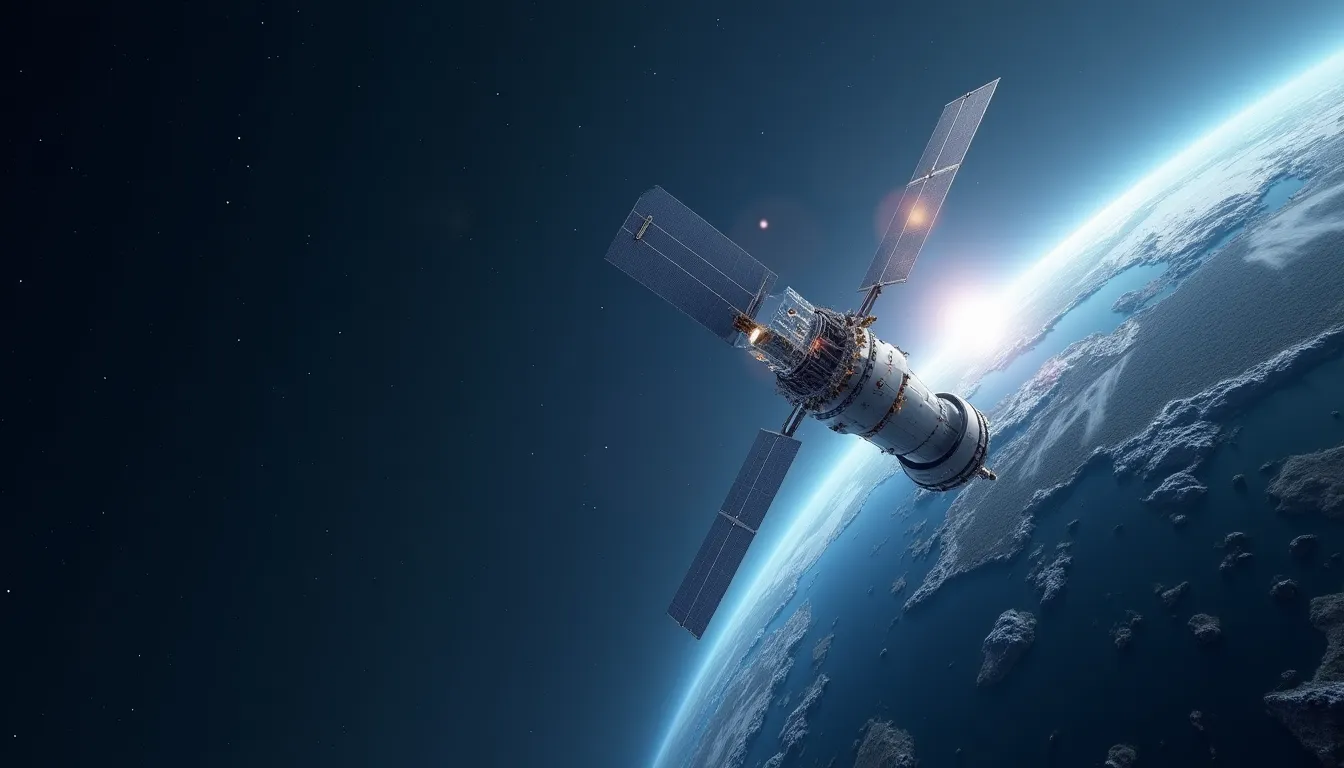
In the past month, the landscape of satellite technology has experienced significant transformations, driven by advancements in regulatory frameworks, innovative scientific missions, and the integration of satellite connectivity into everyday consumer devices. This article delves into the major developments shaping the future of satellites and their applications across various sectors.
Major Developments in Satellite Technology
SpaceX Starlink Expansion: FCC Approval for 7,500 New Satellites
The U.S. Federal Communications Commission (FCC) has granted SpaceX approval to launch an additional 7,500 Gen2 Starlink satellites, bringing the total authorized constellation to 15,000 satellites. This expansion is a crucial step in enhancing global internet coverage, especially in underserved regions. SpaceX must complete the launch of 50% of these satellites by December 1, 2028, with the remainder by 2031.
The Gen2 satellites are engineered to operate across five frequency bands, enabling them to provide direct-to-cell (D2D) connectivity both within and outside the U.S. Notably, these next-generation satellites are designed to deliver up to 20 times higher throughput compared to their predecessors, alongside reduced latency and simplified user terminal connectivity.
This expansion positions Starlink as a vital dual-use communications infrastructure, relevant not only in commercial sectors but also in military applications, providing robust communications capabilities in challenging environments.
NASA’s Pandora Small Satellite: A New Frontier in Exoplanet Research
NASA’s upcoming Pandora mission is set to revolutionize our understanding of exoplanets. This small satellite, roughly the size of a refrigerator, is designed to investigate the atmospheres of exoplanets by conducting continuous observations in the visible and near-infrared spectrum. Integrated into a Falcon 9 rocket at Vandenberg Space Force Base, Pandora is expected to launch soon, embarking on a mission to study at least 20 known exoplanets over one year.
Accompanying Pandora are several CubeSats, including SPARCS and BlackCAT, which will utilize thermal infrared cameras and X-ray technologies, respectively, to enhance our comprehension of stellar and galactic phenomena.
NISAR: Pioneering Earth Observation for Earthquake Analysis
The NASA-ISRO Synthetic Aperture Radar (NISAR) satellite is poised to advance our capabilities in earthquake monitoring and analysis significantly. This cutting-edge radar Earth-observation satellite can detect ground deformation with millimeter precision, allowing scientists to monitor fault movements more accurately between seismic events. The NISAR mission utilizes interferometric SAR (InSAR) techniques, which are less affected by vegetation cover, providing clearer insights into ground motion than previous radar missions. This capability is not only crucial for scientific research but also has implications for infrastructure monitoring and disaster response efforts.
Consumer Technology Meets Satellite Connectivity
At the recent CES 2026, satellite connectivity emerged as a standard feature rather than a niche emergency option for premium consumer devices. Major manufacturers are incorporating Direct-to-Device (D2D) satellite messaging capabilities into their products, making it a baseline expectation for modern technology users.
For instance, the Samsung Galaxy S26 features an Exynos 6000 chipset with an integrated Non-Terrestrial Network (NTN) modem, offering functionalities like two-way SMS and low-resolution photo sharing via the Skylo network in partnership with Telesat Lightspeed. Similarly, Apple’s upcoming iPhone 17 will leverage Globalstar’s satellite constellation for real-time video SOS capabilities and enhanced tracking features through the Find My Anywhere service.
Innovations in Satellite Materials: Ultra-Thin Glass for Solar Panels
Innovative materials are also playing a pivotal role in satellite technology. Lens Technology has introduced an aerospace-grade ultra-thin glass (UTG) designed specifically for low-Earth orbit (LEO) solar panels. This material boasts high radiation resistance, thermal stability, and impact protection, all while maintaining a lightweight profile. This advancement enables denser and more efficient solar arrays, which are critical for powering the next generation of satellites.
Conclusion
The rapid advancements in satellite technology, as highlighted by recent developments from SpaceX, NASA, and consumer electronics manufacturers, illustrate a dynamic landscape poised for growth. From enhancing global internet access to facilitating groundbreaking scientific research and integrating satellite capabilities into consumer devices, these innovations are setting the stage for a more connected and informed world. As the aerospace and defense sectors continue to evolve, the implications of these satellite technologies will resonate across various domains, showcasing the potential of space-based systems to transform our daily lives and scientific understanding.
References
-
SpaceX just got approval to launch another 7,500 next-gen Starlink … (www.techradar.com) - 1/11/2026 SpaceX just got approval to launch another 7,500 next-gen Starlink satellites into orbit. News. By David Nield published 7 hours ago. Improving …
-
SpaceX gets FCC approval to launch 7,500 more Starlink satellites (techcrunch.com) - 1/11/2026 The Federal Communications Commission has given SpaceX approval to launch another 7500 of its second generation Starlink satellites.
-
NASA’s Pandora Mission, CubeSats Ready for Flight (www.nasa.gov) - 1/11/2026 NASA’s Pandora small satellite is preparing to launch to low Earth orbit, where it will study exoplanet atmospheres and their stars.
-
NASA uses satellite technology to better understand earthquakes (www.cbsnews.com) - 1/11/2026 Scientists are using the cutting-edge satellite technology from the NASA-ISRO Synthetic Aperture Radar (NASIR) to rethink how we understand …
-
Pandora, a keen-eyed satellite built to study exoplanets, readies for … (phys.org) - 1/10/2026 SpaceX will provide a livestream of the event. The Pandora satellite will provide in-depth study of at least 20 known planets orbiting distant …
-
Space Brief 8 Jan 2026 - KeepTrack (keeptrack.space) - 1/8/2026 Today’s brief covers satellite standardization efforts, missile tracking updates, and a medical delay impacting the ISS.
-
Lens Technology debuts aerospace grade UTG for satellites at CES (vir.com.vn) - 1/7/2026 The ultra-thin glass is designed for use in low-earth orbit satellite solar panels, or “energy canopies.”
-
The Consumer Electronics Show is Powering the $1 Trillion Space … (news.satnews.com) - 1/6/2026 How Satellite Tech Drives CES. For the 2026 product cycle, satellite connectivity has transitioned from a “niche emergency feature” to a …