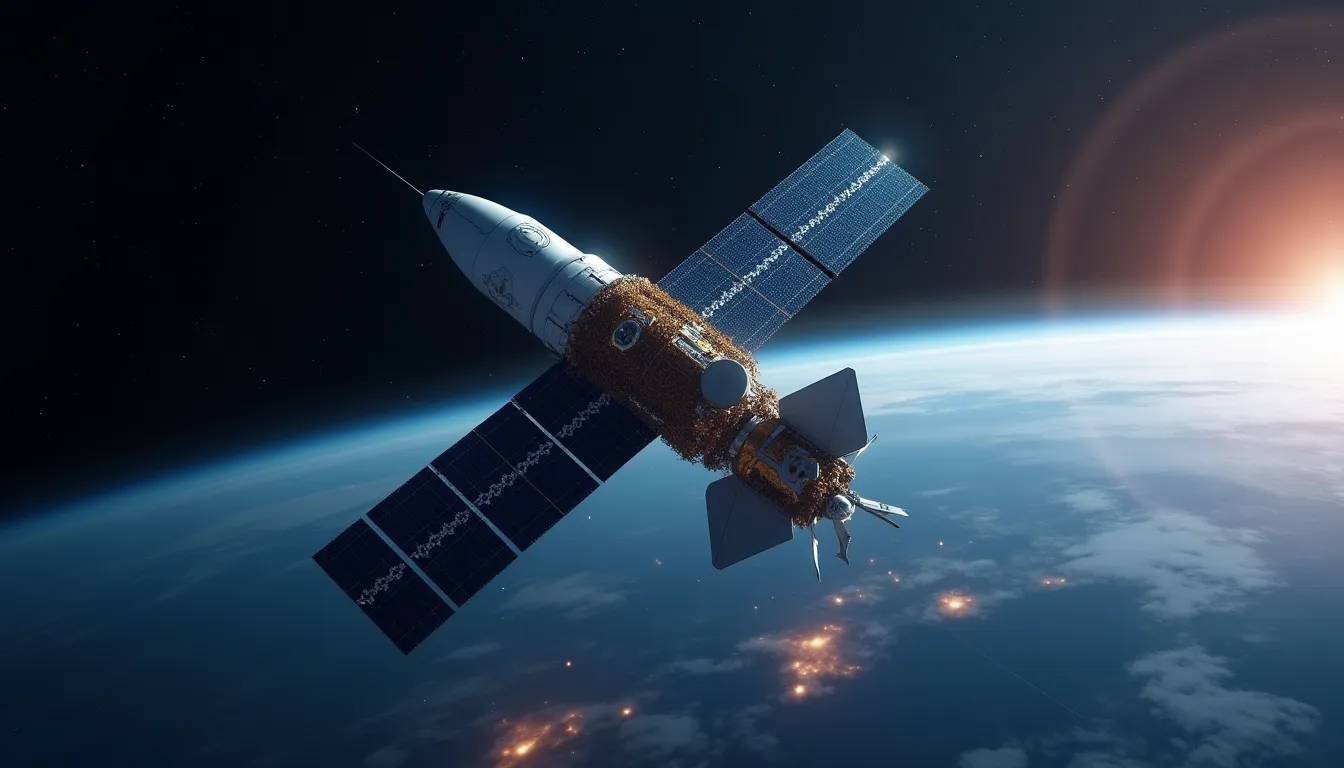
The aerospace and defense industries are on the cusp of a satellite revolution, with recent advancements in connectivity, scientific exploration, and defense applications. As satellite technology evolves, it promises to enhance global communication, improve military operations, and facilitate groundbreaking scientific research. This article delves into the latest developments in satellite technology and their implications for various sectors.
Connectivity and 5G Integration
One of the most significant trends in satellite technology is the transition towards satellite-to-handset connectivity. AST SpaceMobile’s BlueWalker platform is leading the charge, in collaboration with AT&T, to deploy beta device-to-device (D2D) services by mid-2026. This initiative will utilize a constellation of 60 satellites, enabling direct communication with mobile devices in remote locations, including offshore oil and gas sites. This capability is expected to bridge connectivity gaps and enhance operational efficiency in industries reliant on remote communications.
Additionally, on January 14, 2026, Airbus UpNext introduced the SpaceRAN demonstrator, a breakthrough in 5G non-terrestrial network (NTN) connectivity. This software-defined satellite system processes signals onboard rather than merely relaying them, allowing for reduced latency and increased data throughput. By enabling inter-satellite links, the SpaceRAN technology minimizes the need for ground stations, thus lowering operational costs and improving network management. This innovation represents a significant leap toward seamless global connectivity.
Consumer-grade satellite connectivity is also witnessing rapid expansion. Infinix captured attention at CES 2026 with its two-way satellite communication solution, set to launch with the Infinix NOTE 60 Series. This technology will provide voice and messaging services across nearly two-thirds of the Earth’s surface, with automatic switching between terrestrial and satellite networks—a game changer for users in remote areas. Moreover, Apple’s partnership with Globalstar has made satellite connectivity mainstream, with future iPhones expected to support messaging, roadside assistance, and geo-location services through satellite connections.
Scientific and Exploration Missions
NASA’s recent Pandora mission, launched on January 14, 2026, marks a significant advance in scientific exploration using satellite technology. This mission features RTX’s Blue Canyon Technologies’ Saturn-200 minisatellite equipped with the largest telescope payload ever integrated onto a Blue Canyon spacecraft. The sophisticated guidance, navigation, and control systems onboard enable precise pointing and stability, crucial for studying exoplanet atmospheres and host star activity. These advancements not only enhance scientific research capabilities but also pave the way for future interstellar missions.
Defense and Intelligence Applications
The military sector is leveraging satellite technology to enhance its operational capabilities. On January 19, 2026, ICEYE announced an expansion of its collaboration with Ukraine’s Ministry of Defence, utilizing its Generation 4 (Gen4) synthetic aperture radar (SAR) satellites. These satellites boast a ground resolution of up to 16 cm and cover areas of 200 km by 300 km, equipped with electronic beam-steering technology that allows for rapid high-resolution imagery capture. SAR technology’s radar-based approach enables continuous monitoring, unaffected by nighttime, cloud cover, or smoke—conditions that typically hinder traditional optical imaging.
As satellite constellations proliferate, military and intelligence operations benefit from enhanced flexibility, swift deployment capabilities, and improved revisit rates for intelligence gathering. The integration of advanced sensor modules, such as precision accelerometers and quartz MEMS gyroscopes, is becoming essential for accurate data collection and analysis in these operations.
Launch and Deployment Activity
The pace of satellite deployment is accelerating, with Exolaunch successfully deploying 22 satellites during SpaceX’s Twilight Mission in January 2026. This mission marked the first dawn-dusk rideshare launch, with Exolaunch planning over 20 missions throughout 2026 to deliver hundreds of satellites. These launches are critical for establishing robust satellite networks that support global connectivity and various applications across industries.
Emerging Technologies and Industry Trends
The satellite industry is witnessing not just advancements in technology but also a shift in operational strategies. Companies are now focusing on artificial intelligence applications to enhance autonomous satellite functions, improving efficiency and reducing the need for human intervention. Furthermore, innovations in debris shielding technology are becoming critical as the number of satellites in orbit continues to rise, addressing the growing concern for space debris.
The landscape of the satellite market is diverse, with companies like Iridium, Viasat, Lynk, and Sateliot carving out niches in specific regions or for specialized applications. Notably, there is anticipated growth in remote connectivity solutions tailored to agriculture, offshore energy infrastructure, and isolated communities, emphasizing the versatility of satellite technology.
Conclusion
As satellite technology continues to evolve, its impact on aerospace, defense, and communication sectors is profound. From advancing global connectivity through 5G integration to enhancing military operations and enabling groundbreaking scientific research, the innovations in satellite technology are setting the stage for a new era in telecommunications and exploration. The future holds immense potential for further advancements, making it an exciting time for the aerospace and defense industries as they leverage these technologies to meet emerging challenges and opportunities.
References
-
ICEYE Expands Space-Based Intelligence Cooperation … - SatNews (news.satnews.com) - 1/19/2026 ICEYE Expands Space-Based Intelligence Cooperation with Ukraine’s Ministry of Defence. January 19, 2026. Share. Share on Facebook. Share.
-
Revolutionizing Connectivity: Recent Advances in Satellite … (orbysa.com) - 1/18/2026 On January 14, 2026, Airbus UpNext unveiled the SpaceRAN demonstrator, a groundbreaking initiative designed to streamline 5G connectivity via …
-
Convergence Comes of Age: 2026 Shifts Satellite Promise into … (www.satellitetoday.com) - 1/17/2026 For the better part of a decade, the promise of satellite-to-handset connectivity has sat somewhere between trial and theory.
-
Space Brief 17 Jan 2026 - KeepTrack (keeptrack.space) - 1/17/2026 Today’s brief covers SpaceX’s national security mission, GE and Lockheed’s innovations in hypersonic technology, ThinkOrbital’s funding for …
-
Infinix Wins Multiple “Best of CES 2026” Awards for … - PR Newswire (www.prnewswire.com) - 1/16/2026 Infinix Wins Multiple “Best of CES 2026” Awards for Satellite Communication and Breakthrough Innovations. News provided by. Infinix. Jan 16, …
-
Airbus UpNext SpaceRAN expands 5G NTN connectivity (www.airbus.com) - 1/14/2026 The Airbus UpNext SpaceRAN demonstrator aims to explore the capabilities of a standardised 5G non-terrestrial network on two different …
-
RTX provides Blue Canyon satellite for interstellar mission (www.rtx.com) - 1/14/2026 Pandora mission to utilize Saturn-200 minisatellite platform for exoplanet long observations. LAFAYETTE, Colo., Jan. 14, 2026 /PRNewswire/ …
-
Exolaunch Deploys 22 Satellites on SpaceX’s Twilight Mission (www.exolaunch.com) - 1/1/2025 In 2026, Exolaunch is gearing up for another record-breaking year, with plans to execute over 20 missions and deliver several hundred satellites …