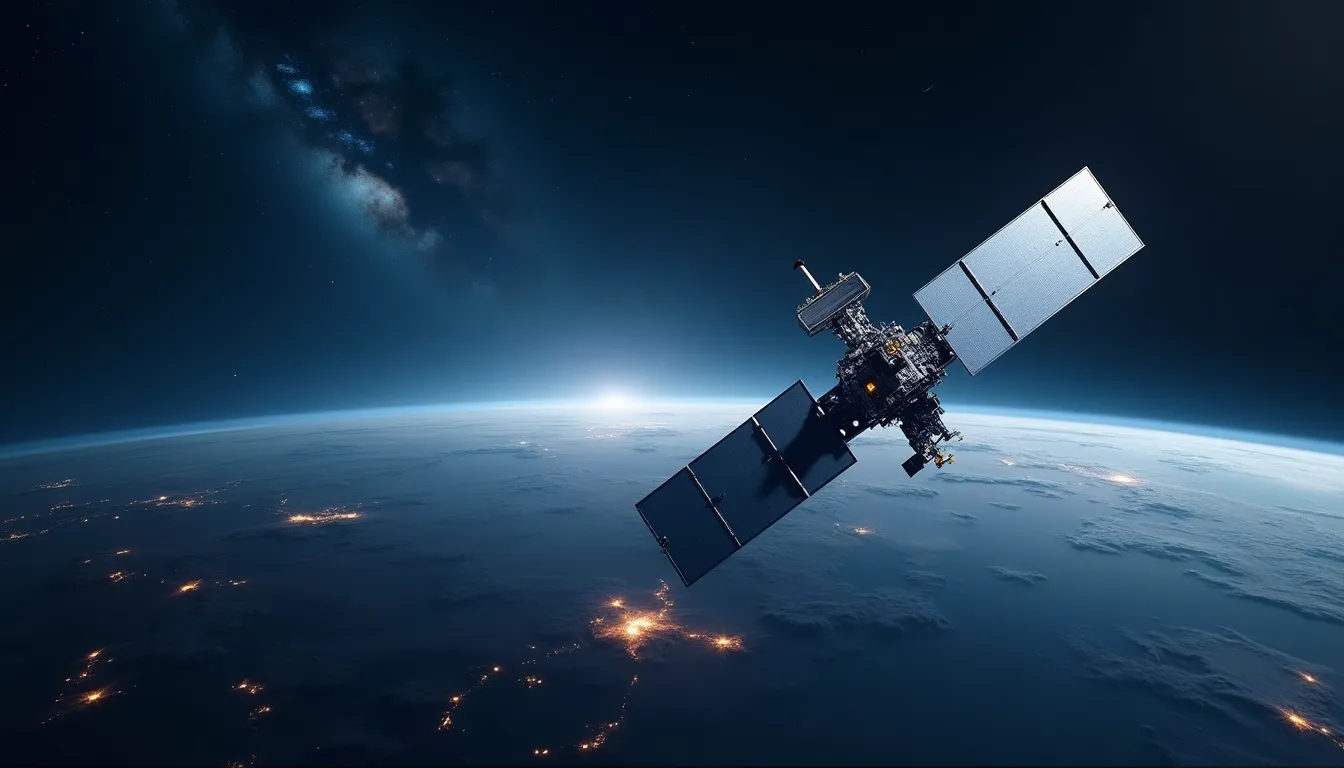
Recent developments in satellite technology have marked a significant leap forward in both scientific exploration and commercial applications. From NASA’s groundbreaking Pandora satellite designed to observe exoplanets, to the deployment of optical relay satellites by Kepler Communications, the aerospace and defense sectors are witnessing transformative changes. Additionally, Europe’s ambitious EPS-Sterna polar constellation promises to enhance weather forecasting capabilities. This article delves into these advancements, providing insights into their technical specifications and implications for the future.
NASA’s Pandora Satellite Mission
On January 11, 2026, NASA successfully launched the Pandora satellite aboard a SpaceX Falcon 9 rocket from Vandenberg Space Force Base. This mission aims to probe the atmospheres of distant exoplanets, marking a significant milestone in astronomical research. Upon launch, Pandora quickly established a strong signal during its first ground pass, confirming its operational status as it entered a sun-synchronous orbit.
Technical Capabilities
Pandora is a compact satellite, roughly the size of a refrigerator, equipped with advanced sensors designed to monitor the brightness of host stars while simultaneously capturing near-infrared data. This dual-capability allows Pandora to differentiate between stellar and planetary signals, enabling detailed analysis of how stars influence the detection of exoplanetary atmospheres.
The satellite’s infrared sensor is provided by NASA’s Goddard Space Flight Center, while the spacecraft bus is developed by Blue Canyon Technologies. Data processing will occur at NASA Ames Research Center, with operational management led by the University of Arizona. A public data release is planned, promising to enrich the scientific community’s understanding of exoplanetary systems.

Kepler Optical Relay Satellites
On the same day as Pandora’s launch, Kepler Communications introduced its first tranche of 10 optical relay satellites, each weighing approximately 300 kg. This new constellation aims to revolutionize space data networking by enabling low-latency communication across various platforms.
Technical Features
Equipped with Space Development Agency (SDA)-compatible optical terminals and multi-GPU on-orbit computing capabilities, these satellites are optimized for high-speed data transfer and secure routing. With terabytes of onboard storage, they can support real-time connectivity and facilitate the operation of cloud-like environments in space. The architecture allows for hosted payloads, making it possible to accommodate diverse missions, including those from Axiom Space’s data centers.
Mina Mitry, CEO of Kepler Communications, emphasized the transformative potential of these satellites, stating, “This represents a paradigm shift in how data flows in orbit, creating unprecedented opportunities for both commercial and government missions.”

Europe’s EPS-Sterna Polar Constellation
In January 2026, Europe’s EUMETSAT council approved the EPS-Sterna polar constellation project, set to deploy its first six microsatellites by 2029. This initiative aims to enhance meteorological monitoring and improve weather forecasting accuracy.
Performance Enhancements
The EPS-Sterna constellation will utilize advanced microwave sounders to measure atmospheric temperature, humidity, and cloud conditions, achieving global coverage in under five hours and enabling same-spot revisits in less than three hours. This improvement significantly outpaces current capabilities, which allow for only twice-daily data collection.
The expected reduction in forecast errors—up to 6%, and 9% in the Arctic—underscores the potential impact of this project on storm prediction and climate monitoring. EUMETSAT will manage ground systems and data dissemination through the EUMETCast and EUMETView platforms.
Trends in Consumer Electronics and Defense Integration
The Consumer Electronics Show (CES) 2026 showcased how satellite connectivity is becoming an integrated feature in consumer devices. Notable examples include the Samsung Galaxy S26, which utilizes a Non-Terrestrial Network (NTN) modem for two-way SMS communication via Skylo and Telesat, and Apple’s iPhone 17, which incorporates Globalstar’s LEO capabilities for emergency video SOS services.
Furthermore, the convergence between commercial satellite technologies and defense applications is becoming increasingly evident. Companies like Lanteris and BlackSky are adapting their satellite systems to meet the stringent requirements of secure imaging and data relay for defense purposes.
Conclusion
The recent advancements in satellite technology, exemplified by NASA’s Pandora mission, Kepler’s optical relay satellites, and the EPS-Sterna constellation, highlight the rapid evolution of the aerospace and defense sectors. As these technologies continue to develop, they promise not only to enhance our understanding of the universe but also to improve services such as weather forecasting and secure data communications. The integration of satellite capabilities into consumer electronics further illustrates the growing importance of space technology in everyday life, paving the way for a more connected and informed global community.
As we look to the future, innovations like high-performance MEMS accelerometers and precision gyroscopes will be critical in supporting these advancements, ensuring that our navigation and data systems remain at the forefront of technology.
References
- NASA’s Pandora Satellite Acquires Signal (www.nasa.gov) - 1/12/2026 *# NASA’s Pandora Satellite Acquires Signal
NASA’s Pandora satellite mission controllers received full acquisition of signal from the spacecraft on Jan. 11 on the first ground pass after liftoff from Space Launch Complex 4 East at Vandenberg Space Force Base in California.
Pandora will study planet…*
-
Liftoff of NASA’s Newest Planet-Observing Satellite (www.nasa.gov) - 1/12/2026
-
Kepler Successfully Launches First Tranche of Optical Relay Satellites (kepler.space) - 1/12/2026 Future tranches will expand network capacity and introduce new capabilities, including 100-gigabit optical technology designed for backward …
-
Kepler launches first optical relay satellites - Smart Maritime Network (smartmaritimenetwork.com) - 1/12/2026 Kepler Communications reports that it has completed the successful launch of the first tranche of its optical relay satellite constellation.
-
Europe backs transformative polar satellite constellation | EUMETSAT (www.eumetsat.int) - 1/12/2026 Europe backs transformative polar satellite constellation. EPS-Sterna programme will deliver unprecedented atmospheric observations from 2029.
-
The Commercial-Defense Convergence: 2026 Trends to Watch (www.satellitetoday.com) - 1/12/2026 This episode of On Orbit features a webinar Via Satellite editors hosted in December on space and defense trends for 2026.
-
NASA’s Exoplanet Observing Satellite Separated From Rocket (www.nasa.gov) - 1/11/2026 NASA’s Pandora space telescope satellite is in sun-synchronous orbit following separation of SpaceX’s second stage on Sunday, Jan. 11, 2025. A …
-
Pandora, a keen-eyed satellite built to study exoplanets, readies for … (phys.org) - 1/10/2026 SpaceX will provide a livestream of the event. The Pandora satellite will provide in-depth study of at least 20 known planets orbiting distant …
-
Space Brief 8 Jan 2026 (keeptrack.space) - 1/9/2026
-
The Consumer Electronics Show is Powering the $1 Trillion Space … (news.satnews.com) - 1/6/2026 How Satellite Tech Drives CES. For the 2026 product cycle, satellite connectivity has transitioned from a “niche emergency feature” to a …