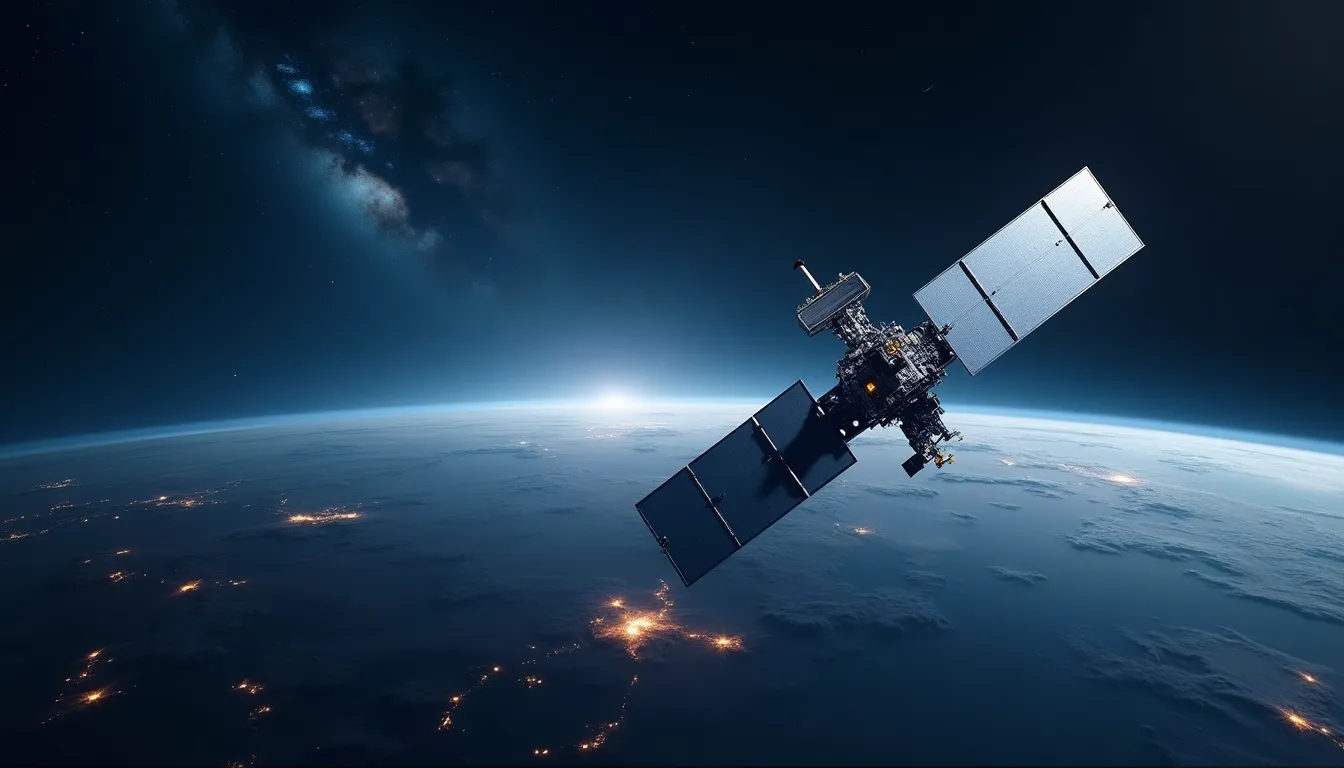
In the rapidly evolving landscape of aerospace and defense, recent satellite advancements have taken center stage, marking significant progress in commercial broadband, scientific exploration, and environmental monitoring. This article delves into the latest developments as of January 2026, highlighting critical missions and technology trends that are reshaping the satellite industry.
SpaceX Starlink Expansion: Pioneering Global Connectivity
On January 10, 2026, the Federal Communications Commission (FCC) granted SpaceX approval to launch an additional 7,500 second-generation Starlink satellites. This expansion aims to enhance high-speed internet access and direct-to-cell connectivity, with a total of 15,000 satellites planned worldwide. Notably, the deployment will utilize five frequency bands, primarily focusing on markets outside the United States while providing supplemental coverage domestically.
SpaceX’s commitment to this ambitious project is evident, as the company must launch 50% of the newly approved satellites by December 1, 2028, with the remaining expected by December 2031. This effort not only underscores the growing demand for global internet access but also positions SpaceX as a leader in commercial satellite communications.
NASA’s Pandora Mission: Unlocking the Mysteries of Exoplanets
NASA’s recent launch of the Pandora satellite on January 11, 2026, via a SpaceX Falcon 9 rocket marks a significant milestone in the exploration of exoplanet atmospheres. The Pandora mission is designed to monitor the brightness of host stars in both visible light and near-infrared data, enabling scientists to distinguish planetary signals from stellar interference effectively.
This small satellite, developed with contributions from NASA Goddard’s infrared sensor technology, Blue Canyon Technologies, and the University of Arizona’s operational expertise, will conduct ten observations per system over 24 hours. Following a month-long commissioning phase, Pandora’s one-year prime mission promises to yield invaluable data, contributing to our understanding of planetary atmospheres and their potential for supporting life.
Kepler Optical Relay Satellites: Transforming Data Transmission
Another noteworthy advancement in satellite technology is the launch of Kepler Communications’ first tranche of ten optical relay satellites on January 11, 2026. Equipped with Space Development Agency (SDA)-compatible optical terminals, these satellites are engineered for low-latency data transfer and secure routing. They feature multi-GPU compute modules and terabytes of storage, facilitating on-orbit processing of data for commercial and sovereign missions.
The optical relay network will support real-time cloud environments for applications such as Earth observation and data centers. Future satellite tranches are expected to incorporate 100-gigabit optical links, significantly enhancing data transmission capabilities in space.
EUMETSAT’s EPS-Sterna Constellation: Advancing Weather Monitoring
In January 2026, the EUMETSAT Council approved the EPS-Sterna polar microsatellite constellation, which is set to revolutionize atmospheric monitoring. The first six satellites are scheduled for launch in 2029, with plans for a total of 20 satellites by 2042. This constellation will provide hourly global data on temperature, humidity, and cloud cover, reducing forecast errors significantly—by as much as 6% globally and 9% in Arctic regions.
This innovative approach builds on the European Space Agency’s (ESA) AWS, operational since August 2024, and represents a transformative step in meteorological data acquisition.
Commercial-Defense Convergence: Trends Shaping the Future
The integration of commercial satellite capabilities into defense applications is becoming increasingly prevalent. As outlined in a recent report, the defense sector is increasingly relying on commercial satellites for secure communications, intelligence, surveillance, and reconnaissance (ISR). This trend aligns with the broader investment in space technology, driven by advancements such as the Golden Dome missile defense system.
Experts from Lanteris Space Systems and BlackSky emphasize that evolving commercial offerings are meeting defense needs, showcasing the potential for collaboration between private companies and military organizations.
Other Notable Mentions
In addition to the highlighted advancements, NASA is actively seeking industry input on technology shortfalls for lunar and Martian habitation, a call for innovation aimed at accelerating human exploration of the Moon and Mars.
Conclusion
The past month has witnessed remarkable advancements in satellite technology, paving the way for enhanced connectivity, scientific exploration, and environmental monitoring. As SpaceX continues to expand its Starlink network and NASA’s Pandora mission embarks on its planetary exploration journey, the future of satellite technology looks promising. With increasing convergence between commercial and defense sectors, these developments signal a transformative era in aerospace and defense, highlighting the critical role of satellites in shaping our technological landscape.
References
- NASA’s Pandora Satellite Acquires Signal (www.nasa.gov) - 1/12/2026 *# NASA’s Pandora Satellite Acquires Signal
NASA’s Pandora satellite mission controllers received full acquisition of signal from the spacecraft on Jan. 11 on the first ground pass after liftoff from Space Launch Complex 4 East at Vandenberg Space Force Base in California.
Pandora will study planet…*
-
Kepler Successfully Launches First Tranche of Optical Relay Satellites (kepler.space) - 1/12/2026 TORONTO, ONTARIO — January 11, 2026 — Kepler Communications today announced the successful launch of the first tranche of its optical relay …
-
Europe backs transformative polar satellite constellation | EUMETSAT (www.eumetsat.int) - 1/12/2026 Europe backs transformative polar satellite constellation. EPS-Sterna programme will deliver unprecedented atmospheric observations from 2029.
-
The Commercial-Defense Convergence: 2026 Trends to Watch (www.satellitetoday.com) - 1/12/2026 This episode of On Orbit features a webinar Via Satellite editors hosted in December on space and defense trends for 2026.
-
NASA Targets Critical Technology Shortfalls to Accelerate Lunar … (news.satnews.com) - 1/12/2026 NASA Targets Critical Technology Shortfalls to Accelerate Lunar and Martian Exploration. January 12, 2026. Share. Share on Facebook. Share.
-
SpaceX gets FCC approval to launch 7,500 more Starlink satellites (techcrunch.com) - 1/11/2026 *The Federal Communications Commission announced Friday that it has given SpaceX approval to launch another 7,500 of its second-generation Starlink satellites, for a total of 15,000 satellites worldwide.
Beyond simply allowing SpaceX to launch more satellites and expand its high-speed internet cover…*
-
Liftoff of NASA’s Newest Planet-Observing Satellite (www.nasa.gov) - 1/11/2026 A SpaceX Falcon 9 rocket carrying NASA’s Pandora small satellite lifted off at 5:44 a.m. PST Sunday, Jan. 11, from Space Launch Complex 4 …
-
Pandora, a keen-eyed satellite built to study exoplanets, readies for … (phys.org) - 1/10/2026 SpaceX will provide a livestream of the event. The Pandora satellite will provide in-depth study of at least 20 known planets orbiting distant …
-
Space Brief 8 Jan 2026 - KeepTrack (keeptrack.space) - 1/8/2026 Today’s brief covers satellite standardization efforts, missile tracking updates, and a medical delay impacting the ISS.