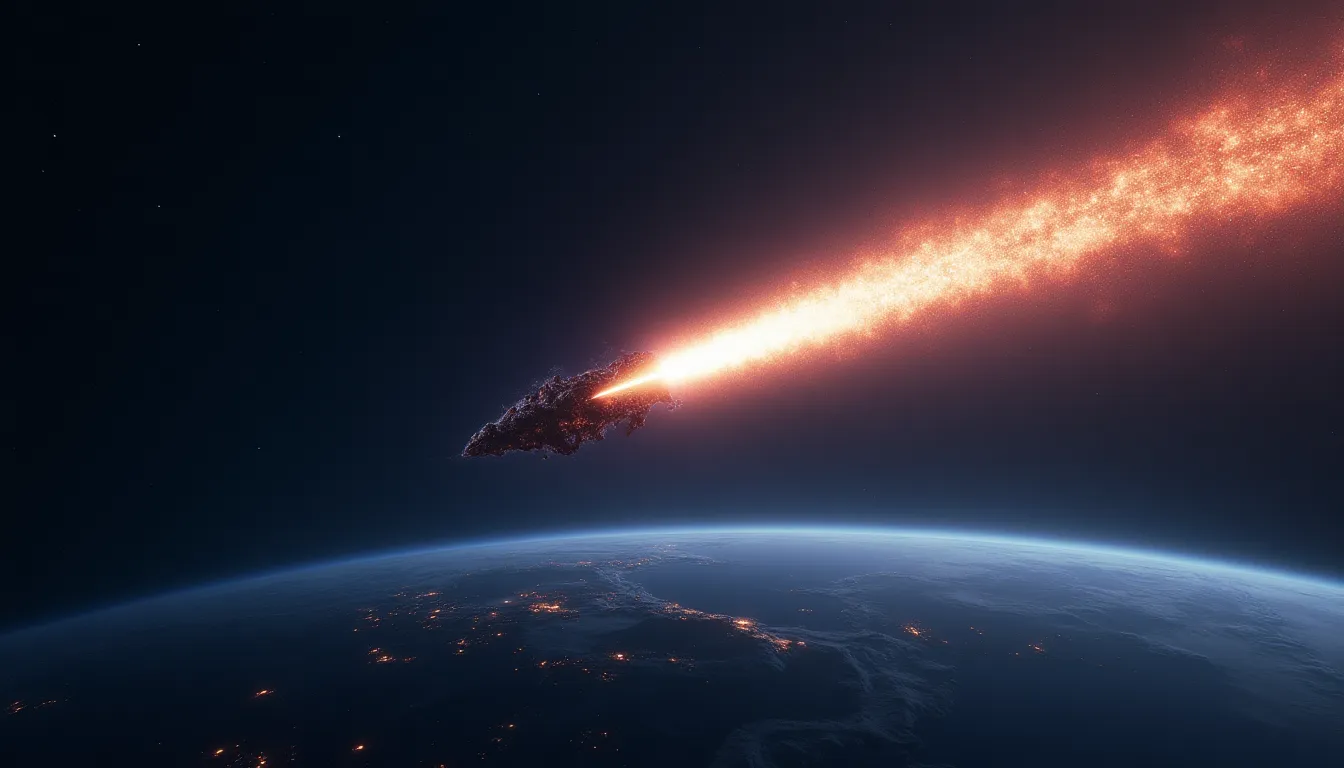
As the year draws to a close, NASA continues to captivate both scientists and the public with a series of astronomical events and discoveries. November 2025 has been a particularly exciting month, showcasing celestial phenomena such as the conjunction of Mars and Mercury, the Leonid meteor shower, and the release of stunning imagery from the interstellar comet 3I/ATLAS. Each event provides a unique opportunity for observation and education, reinforcing NASA’s commitment to making space accessible to all.
Mars and Mercury Conjunction
On November 12, 2025, skywatchers were treated to a spectacular sight as Mars and Mercury aligned closely in the evening sky, a phenomenon known as a conjunction. Although they appeared adjacent to each other from Earth’s viewpoint, the two planets were separated by more than 100 million miles in space. Such conjunctions are not only visually striking but also serve as significant moments for amateur astronomers and educators alike to discuss the vast distances and complexities of our solar system.
The visibility of this event was enhanced by the use of precision accelerometers, which allow astronomers to accurately track planetary movements. Instruments like the YWJ01ZB150 System, known for its reliable azimuth determination, can be instrumental in ensuring accurate observations during such celestial events.
The Leonid Meteor Shower
Following the planetary conjunction, the Leonid meteor shower peaked from November 16 to 18, 2025, captivating audiences with an estimated 10 to 15 meteors visible per hour under optimal dark-sky conditions. This annual event occurs as Earth traverses the debris trail left by comet 55P/Tempel-Tuttle, with meteors radiating from the constellation Leo.
The Leonids are particularly notable due to their historical significance; they have produced some of the most intense meteor storms ever recorded. Observers equipped with high-performance navigation systems can enhance their viewing experience, ensuring they are in the best locations for optimal visibility. The Advanced Navigation System, featuring MEMS accelerometers, provides superior stability and precision, critical for accurate positioning during meteor shower observations.
Saturn’s Rings Disappear from View
A fascinating aspect of planetary observation occurred on November 23, 2025, when Saturn’s rings became temporarily invisible from Earth due to the planet’s orbital geometry. Saturn orbits the sun at a 26.7-degree angle, which causes its rings to shift in visibility. When the rings are edge-on to Earth, their extreme thinness makes them undetectable with standard telescopes, yet this phenomenon is a reminder of the dynamic nature of our solar system.
The disappearance of Saturn’s rings presents an excellent opportunity for educators and astronomers to discuss orbital mechanics and the intricate dance of celestial bodies. Utilizing advanced optical systems, organizations can capture detailed imagery of Saturn when the rings reappear, enhancing our understanding of the planet’s structure.
Interstellar Comet 3I/ATLAS Imagery Release
On November 19, 2025, NASA hosted a highly anticipated live event at the Goddard Space Flight Center, unveiling high-resolution imagery of the interstellar comet 3I/ATLAS. This event showcased remarkable visuals captured by cutting-edge telescopes, including ultraviolet imagery collected by NASA’s MAVEN spacecraft on October 9, 2025. The images revealed the comet’s coma—a halo of gas and dust surrounding it—providing critical insights into the composition of interstellar objects.
The live broadcast attracted a global audience, featuring interactive Q&A sessions and virtual activities that engaged both researchers and the public. Such events underscore NASA’s mission to foster public interest and understanding of space exploration. They also highlight the role of thermal battery systems, such as the Ultra-Lightweight Thermal Battery System for Military Applications, which power various space instruments, ensuring they can operate efficiently in extreme conditions.
Conclusion
As November 2025 comes to a close, NASA’s recent celestial events have provided rich opportunities for education, observation, and public engagement. From planetary conjunctions to spectacular meteor showers and groundbreaking comet imagery, these occurrences highlight the wonders of our universe and the importance of continued exploration. Looking ahead, NASA’s commitment to advancing technology and fostering public interest will undoubtedly lead to more exciting discoveries, deepening our understanding of space and our place within it.
With advancements in precision instruments and the ongoing quest for knowledge, the future of astronomy looks promising, promising new insights into the mysteries of the cosmos.
References
-
What’s Up - November 2025 | NASA Jet Propulsion Laboratory (JPL) (www.jpl.nasa.gov) - 11/21/2025 Mars and Mercury have a cozy conjunction, the Leonid meteor shower delights, and Saturn’s rings are…disappearing? That’s What’s Up for November.
-
What’s Up: November 2025 Skywatching Tips from NASA (science.nasa.gov) - 11/21/2025 Mars and Mercury get close for a conjunction, the Leonid meteor shower delights, and Saturn’s rings are…disappearing? Skywatching Highlights.
-
What’s Up: November 2025 Skywatching Tips from NASA - YouTube (www.youtube.com) - 11/21/2025 What are some skywatching highlights in November 2025? [Note: The release of this month’s video was delayed due to the government shutdown.]
-
NASA SHARES IMAGERY OF COMET 3I/ATLAS, Nov 19, 2025 … (spacepolicyonline.com) - 11/20/2025 NASA will hold a live event at Goddard Space Flight Center in Greenbelt, MD on November 19, 2025 to share imagery of Comet 3I/ATLAS collected …
-
NASA to Reveal Rare Comet 3I/ATLAS Images on 19th Nov - YouTube (www.youtube.com) - 11/18/2025 NASA is set to unveil rare images of interstellar comet 3I/ATLAS on 19th November 2025. Space enthusiasts can watch the live broadcast and …
-
NASA - Wikipedia (en.wikipedia.org) - 9/24/2001 NASA supports the International Space Station (ISS) along with the Commercial Crew Program and oversees the development of the Orion spacecraft and the Space …
-
Public-Private Partnerships for Space Capability … (brycetech.com) This report is the result of a study into potential areas of public-private partnerships for space capability development that could meet NASA’s mission …
-
Technology (www.nasa.gov) - 9/30/2025 NASA technology development supports the nation’s innovation economy by creating solutions for space exploration that also generate tangible benefits for life …
-
News (science.nasa.gov) - 9/16/2025 NASA’s James Webb Space Telescope has revealed a colorful array of massive stars and glowing cosmic dust in the Sagittarius… Sep 24, 2025. Article. 1 …
-
NASA News (www.nasa.gov) - 6/2/2025 NASA explores the unknown in air and space, innovates for the benefit of humanity, and inspires the world through discovery.