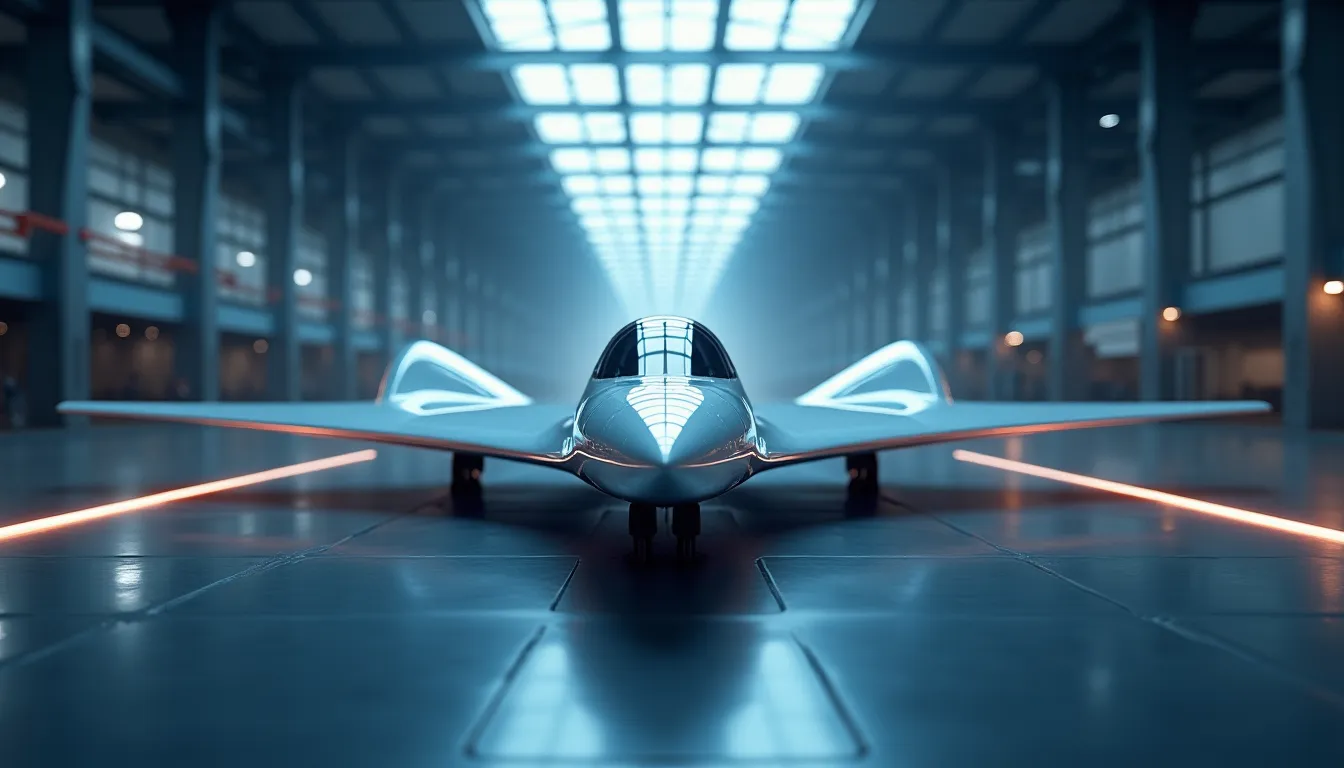
The hypersonic technology landscape is rapidly evolving, with a surge of recent developments indicating a significant shift in military and civilian applications. As we enter 2026, key players such as Lockheed Martin and Castelion are making substantial investments, while academic institutions contribute innovative research aimed at enhancing hypersonic capabilities. The ongoing global race in hypersonic technology is not just about speed; it encompasses a complex interplay of advanced propulsion systems, thermal management, and manufacturing techniques that promise to redefine aerospace defense.
Major Infrastructure Investments
One of the most noteworthy advancements comes from Lockheed Martin, which recently inaugurated a state-of-the-art Hypersonics System Integration Lab in Huntsville, Alabama. This facility spans 17,000 square feet and represents a $17.1 million investment aimed at accelerating the development cycles of hypersonic systems. The lab will facilitate the integration of various test equipment and simulation tools, ultimately supporting U.S. homeland defense initiatives.
Lockheed Martin plans to inject an additional $500 million into this facility, building on prior investments that totaled $185 million since 2021. As a leader in hypersonic technology, Lockheed’s efforts are crucial for streamlining the transition from concept to operational capability, emphasizing the need for faster development timelines and enhanced military integration.
Funding and Production Scaling
In a parallel development, Castelion has successfully secured $350 million in Series B funding, enabling the mass production of their hypersonic missile system known as the Blackbeard. This funding round, led by prominent investment firms like Altimeter Capital and Lightspeed, will support the establishment of the Project Ranger facility, slated for multi-service testing in 2026.
Castelion’s rapid progress is underscored by conducting over 20 flight tests in 2025, validating critical components such as solid rocket motors and thermal protection systems. The U.S. Army is also onboard, earmarking $25 million in FY26 for Blackbeard prototypes derived from the HIMARS platform, with demonstrations expected from January to March 2026. This leap in production capability aims to produce thousands of Blackbeard missiles annually, compressing development timelines from years to mere months.
Academic Contributions to Hypersonic Research
The academic sector is also making strides in hypersonic technologies. Virginia Tech’s Assistant Professor Liselle Joseph has been awarded a $450,000 grant from the Air Force Office for a pioneering three-year experimental study focused on hypersonic vehicles capable of sustaining speeds over Mach 5 at temperatures reaching 3,000°F. Utilizing the university’s wind tunnel, this study will delve into critical areas such as aerodynamics, material science, and ablation techniques, contributing to the next generation of hypersonic designs. This initiative represents a unique non-Air Force effort and highlights the significance of interdisciplinary collaboration in advancing hypersonic research.
The Global Competitive Landscape
As the U.S. accelerates its hypersonic efforts, international competitors are also making notable advancements. The Department of Defense’s MACH-TB program has demonstrated reusable hypersonic test vehicles, significantly reducing the turnaround time for testing from months to weeks. These vehicles leverage advanced propulsion systems, including ramjets and scramjets, which are essential for developing air-launched and sea-launched hypersonic missiles.
China is reportedly working on the Mach 6+ Nanqiang No.1 passenger aircraft and hypersonic stealth fighters, while Russia is advancing its Ayaks system for strike and reconnaissance missions. Notably, India’s Defense Research and Development Organization (DRDO) is preparing to test the Dhvani boost-glide vehicle, designed to achieve speeds exceeding Mach 5, in early 2026. These developments underscore the global race to harness hypersonic technology for strategic military advantages.
Technical Innovations Driving Hypersonic Advances
At the heart of these advancements are several technical innovations that drive the capabilities of hypersonic systems. Air-breathing propulsion remains a focal point, with systems like hydrocarbon scramjet engines gaining traction. These engines are pivotal for achieving sustained hypersonic speeds without the need for onboard oxidizers, offering significant weight and design advantages.
Moreover, the integration of advanced navigation systems, such as high-performance MEMS accelerometers, plays a crucial role in ensuring the precision and stability of hypersonic vehicles during flight. These systems provide critical feedback for maneuvering and trajectory adjustments, which are vital for both military missions and potential civilian applications.
Additionally, the development of advanced sensor modules, including 9-DOF MEMS IMUs, enhances motion sensing capabilities, allowing for real-time adjustments and improved flight stability. The integration of these technologies is paving the way for more reliable and effective hypersonic platforms.
Conclusion
The advancements in hypersonic technology represent a transformative period for both defense and potential civilian aerospace applications. With substantial investments in infrastructure, production capabilities, and academic research, the U.S. is well-positioned to lead the global hypersonic race. As competitors like China, Russia, and India continue to push boundaries, the focus on air-breathing propulsion, thermal management, and high-rate manufacturing will be critical in shaping the future of hypersonic systems. The next few years will be pivotal in determining how these technologies evolve and their implications for global security and commercial aviation.
References
-
What sectors will lead the defence industry in 2026? - Airforce … (www.airforce-technology.com) - 12/26/2025 2026 will likely focus on building digital networks, intercepting European drone incursions and securing critical subsea infrastructure.
-
Explained: Ramjets, scramjets, and the race to hypersonic speeds (aerospaceglobalnews.com) - 12/25/2025 China and Russia have made significant strides in hypersonic technology, building massive investments in the development and testing of systems.
-
Castelion raises $350 million to accelerate mass production of U.S. … (defence-industry.eu) - 12/7/2025 Castelion has secured $350 million in Series B financing to support large-scale U.S. hypersonic weapons production.
-
Lockheed Martin Opens Hypersonics System Integration Lab (www.executivebiz.com) - 12/5/2025 Lockheed has unveiled a Huntsville, Alabama-based lab to speed up hypersonic development and strengthen U.S. defense capabilities.
-
New Hypersonic Technology research at Virginia Tech - WSLS 10 (www.wsls.com) - 11/25/2025 A professor at Virginia Tech was recently awarded a grant of $450000 from the Air Force Office of Scientific Research to study cutting edge …
-
Hypersonic Horizons 2025: The High-Speed Video Challenge (www.opp.purdue.edu) - 10/21/2025 This video competition is intended to introduce students to hypersonics science concepts and career opportunities. Students will answer …
-
Army eyes new program, test with Castelion’s Blackbeard … (breakingdefense.com) - 7/2/2025 Army eyes new program, test with Castelion’s Blackbeard hypersonic missile in 2026. “If we can build this better, faster, cheaper, both sides …
-
DARPA taps Raytheon for next phase of air-breathing hypersonic … (defensescoop.com) - 7/17/2023 DARPA’s budget request for fiscal 2024 includes $30 million for MoHAWC. The program’s estimated deadline is January 2026, according to the …
-
DRDO Set to Test Dhvani Hypersonic Glide Vehicle in Early 2026 (idrw.org) This boost-glide system, designed to travel at speeds exceeding Mach 5, represents a major advancement in India’s strategic deterrence …