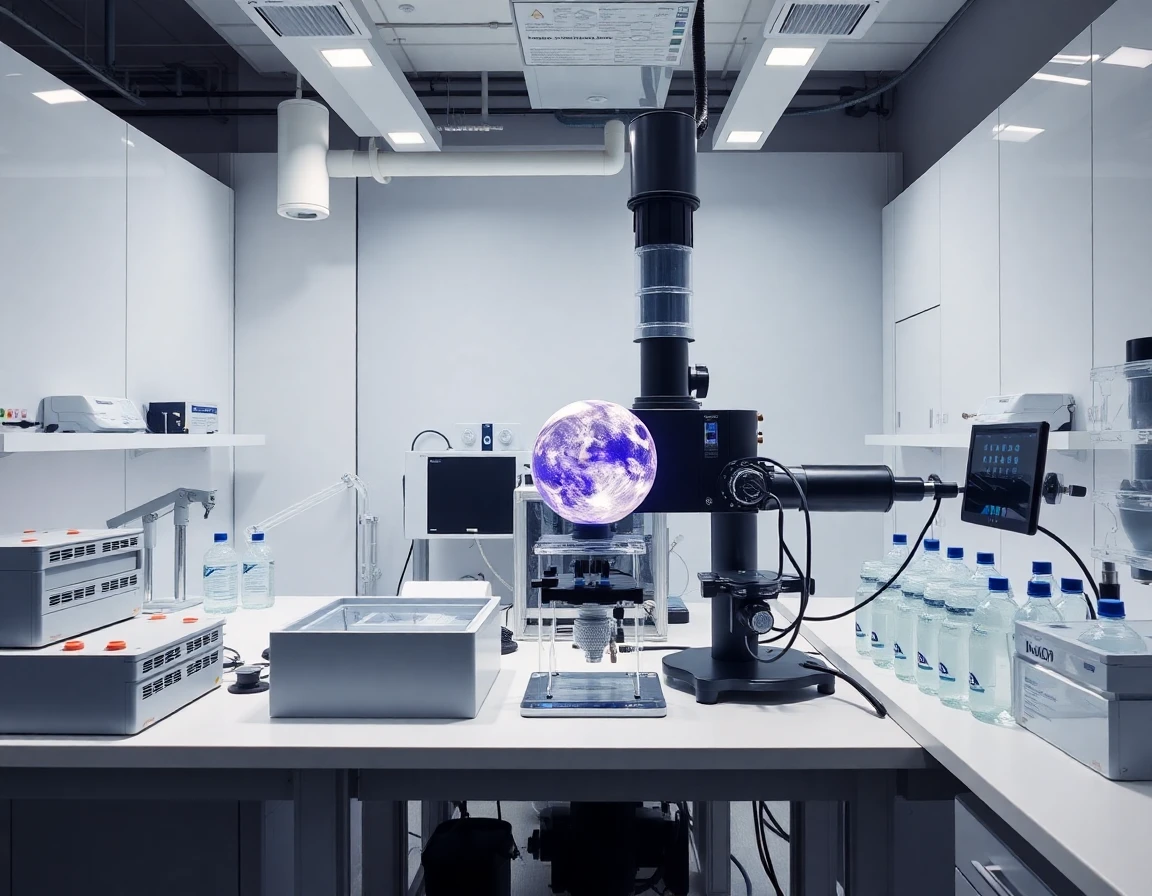
As 2026 unfolds, the lunar mining sector is witnessing significant momentum, driven primarily by private sector innovations and strategic government initiatives. Key developments this month highlight the extraction of helium-3, advancements in power systems for sustained lunar operations, and the intertwining of lunar resources with quantum technology and U.S. space policy. While active extraction remains in its infancy, the groundwork being laid suggests a promising future for lunar resource utilization.
The Role of Helium-3 in Quantum Technology
On February 9, 2026, Lunar Helium-3 Mining, LLC (LH3M), headquartered in Scottsdale, Arizona, announced a pivotal live discussion titled “The Coolant for Quantum Computers – Helium-3 and What Happens Without It.” This event, featuring experts Dr. David Reilly and Dr. Sugam Kumar, underscored helium-3’s critical role as a coolant in quantum computing systems, particularly in ultra-low temperature cryogenic applications essential for maintaining qubit stability.
Helium-3, which is rare on Earth, can be abundantly sourced from lunar regolith, making it a vital resource for the burgeoning quantum technology market. As Dr. Reilly noted, “The scarcity of helium-3 poses a significant bottleneck for scaling quantum tech on Earth; lunar mining could provide a sustainable solution.” LH3M is also developing patented extraction technologies aimed at harnessing helium-3 for fusion energy applications, thereby positioning lunar-sourced helium-3 as a key player in both terrestrial and extraterrestrial economies.
Innovations in Power Systems for Lunar Missions
The sustainability of lunar operations hinges on reliable power systems, particularly during the protracted lunar night, which lasts approximately 14 Earth days. Addressing this challenge, Deep Space Energy, a Latvian startup, recently secured €980K (approximately $1.1 million) to develop a radioisotope power generation system. This innovative technology is designed to operate efficiently during the lunar night, requiring five times less fuel than traditional electric generators.
Mihailis Ščepanskis, CEO of Deep Space Energy, envisions a future where the Moon’s surface is populated with “small rovers” by 2035, facilitating extensive mining operations. The lab-validated system aims for a demonstration flight in 2029, setting the stage for operational missions in the early 2030s. Such advancements are critical for supporting resource prospecting and mining activities, ensuring that missions can survive and thrive in the harsh lunar environment.
NASA’s Lunar Resource Acquisition Strategy
In alignment with the growing interest in lunar resource mining, NASA has announced plans to purchase between 50 to 500 grams of lunar regolith from private companies by 2024, offering financial incentives ranging from $15,000 to $25,000 per award. This policy requires only imagery proof of extraction or possession, eliminating the need for the physical delivery of resources back to Earth. This initiative not only incentivizes private sector involvement but also reaffirms the U.S. commitment to utilizing space resources under the Outer Space Treaty framework.
The implications of this policy are significant, as it opens the door for non-U.S. firms to participate, albeit with certain restrictions, such as the exclusion of Chinese entities under the Wolf Amendment. This approach is closely tied to the Artemis program, which aims to establish a sustainable human presence on the Moon by the end of this decade.
SpaceX and Geopolitical Dynamics in Lunar Development
In a surprising pivot, Elon Musk, CEO of SpaceX, recently announced the company’s plans to establish a “self-growing city” on the Moon within a decade, shifting focus from Mars. This ambitious plan positions SpaceX in direct competition with China’s lunar research ambitions, signaling a potential escalation in geopolitical tensions surrounding lunar resource utilization.
While Musk’s announcement did not explicitly mention mining, the underlying implication is clear: resource utilization will be a cornerstone of these lunar initiatives. To achieve this, extensive infrastructure, including advanced navigation systems and precision accelerometers, will be required to ensure the successful deployment and operation of mining technologies.
Future Outlook on Lunar Mining Initiatives
As the lunar mining sector continues to evolve, the convergence of emerging technologies, strategic funding, and supportive policies will play a crucial role in shaping its future. The extraction of helium-3, advancements in power systems, and NASA’s proactive purchasing strategy are all indicative of a growing acknowledgment of the Moon’s potential as a resource-rich environment.
The next few years will likely see increased collaboration between government agencies and private companies, fostering an environment ripe for innovation. As the industry matures, the implications for both commercial enterprises and national security will become increasingly intertwined, particularly as nations vie for dominance in space resource exploration.
Conclusion
The developments in lunar mining herald a new era of exploration and resource utilization. With private companies at the forefront and government policies aligning to support these initiatives, the lunar surface may soon become a bustling hub of activity. The successful extraction and application of lunar resources, particularly helium-3, could not only revolutionize energy production on Earth but also lay the groundwork for sustained human presence beyond our planet. As we look ahead, the potential for technological advancements and strategic partnerships will shape the trajectory of lunar mining in the years to come.
References
-
Copper Demand to Drop as Chinese Buyers Extend Annual Lunar … (www.miningnewswire.com) - 2/13/2026 Chinese copper purchasers are lengthening their Lunar New Year holiday as prices hover near record levels, dampening industrial demand for …
-
Deep Space Energy Pockets €980K to Build European Space … (payloadspace.com) - 2/12/2026 The Latvian nuclear power startup is working on a solution for lunar missions hoping to survive the lunar night.
-
Will Musk’s moon pivot put SpaceX on collision course with China’s … (www.scmp.com) - 2/10/2026 Elon Musk shifts short-term sights from Mars to the moon, where the race for prime space could pit his company against Chinese research base.
-
Lunar Helium-3 Mining Announces Upcoming Live Series on … (natlawreview.com) - 2/9/2026 The session will feature Dr. David Reilly and Dr. Sugam Kumar, two leading voices in quantum science and cryogenic systems. The discussion will …
-
NASA To Buy Lunar Resources From Private Companies (spacepolicyonline.com) - 9/10/2020 NASA wants to buy lunar resources mined by private sector companies by 2024. Companies do not have to physically deliver the material to NASA.