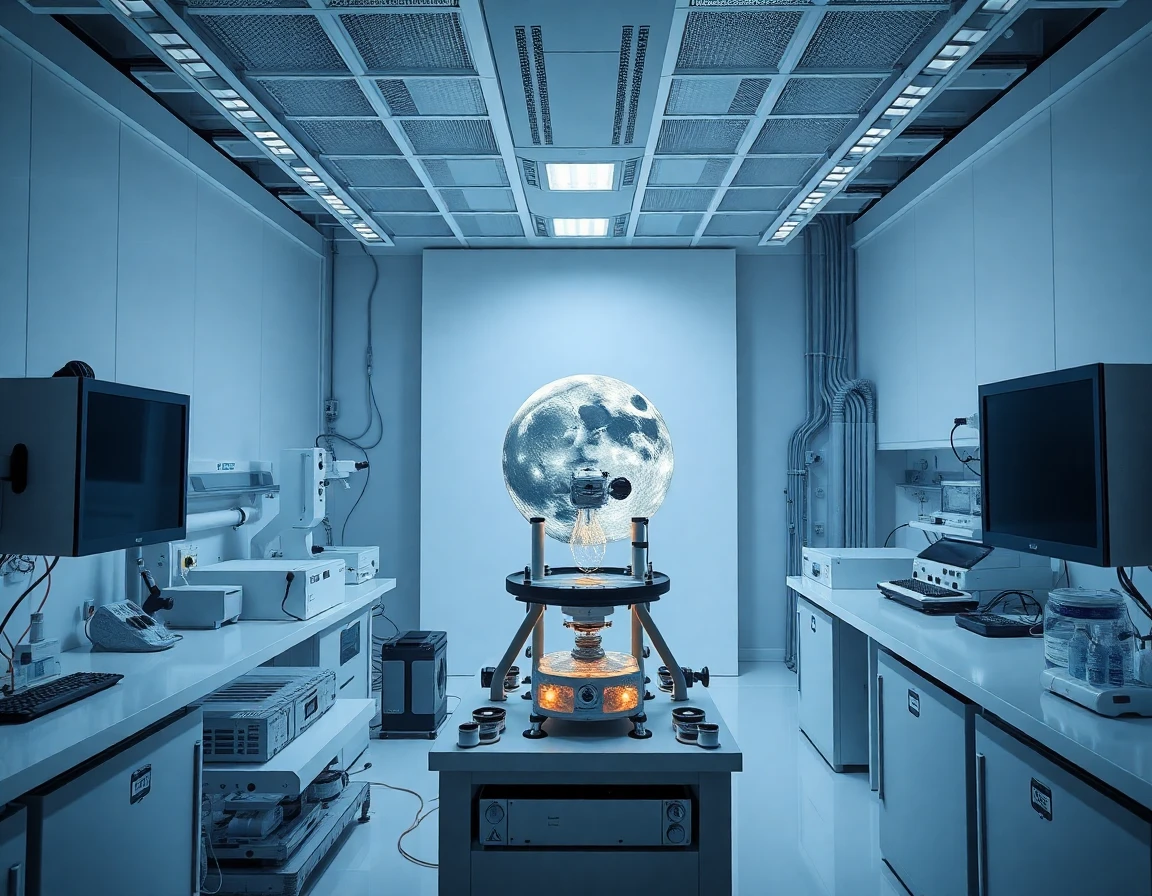
As humanity sets its sights on the Moon, the prospect of lunar mining has emerged as a key area of research and development. With growing interest from both government agencies and private companies, the technical and economic feasibility of extracting lunar resources is being rigorously explored. This article delves into the current state of lunar mining initiatives, the technologies involved, and the potential implications for our future.
The Promise of Lunar Resources
The Moon is believed to be rich in various resources, including water ice, rare earth elements, and Helium-3, an isotope that could potentially serve as a fuel for future nuclear fusion reactors. According to recent studies by NASA and other space agencies, the presence of these materials makes lunar mining not just a possibility, but a necessity for long-term human presence on the Moon and beyond.
“The lunar surface holds vast amounts of water ice, particularly at the poles, which could support life and fuel missions deeper into space,” says Dr. Emily Chen, a lunar resource expert at the Space Research Institute. “Moreover, Helium-3 is scarce on Earth but abundant on the Moon, making it a strategic resource for energy production.”
Technical Feasibility of Lunar Mining
Current research is focused on developing technologies that can withstand the harsh lunar environment and effectively extract resources. One critical area of development is in precision control systems for robotic mining operations. Advanced high-precision linear electric actuator systems are being designed to ensure accurate movement and operation of mining equipment on the lunar surface. These systems can provide the precise control needed for the delicate task of resource extraction while navigating the Moon’s rugged terrain.
Moreover, surveying the lunar landscape is essential for successful mining operations. Professional gyro theodolites, such as the Standard Precision Gyro Theodolite Series, offer reliable azimuth determination and precise angle measurement, enabling teams to accurately map potential mining sites and plan operations accordingly.
Economic Considerations
The economic viability of lunar mining is a subject of intense debate. Initial estimates suggest that the cost of launching and operating lunar mining operations could be substantial, with some projections running into billions of dollars. However, proponents argue that the long-term benefits could outweigh these costs.
“Investments in lunar mining can lead to breakthroughs in resource availability on Earth, particularly for rare minerals that are increasingly difficult to source,” explains Dr. Mark Thompson, an economist specializing in space resources. “The key will be developing a sustainable business model that incorporates both extraction costs and potential returns.”
The Role of International Collaboration
As interest in lunar mining grows, international cooperation is becoming increasingly important. Various space agencies and private companies are exploring partnerships to share knowledge, technology, and investment. The Artemis program, led by NASA, is one example of an international effort aimed at returning humans to the Moon and establishing a sustainable presence.
“Collaboration will be crucial in addressing the technological and ethical challenges of lunar mining,” says Dr. Sarah Lopez, a space law expert at the International Space Institute. “We must ensure that resource extraction is conducted responsibly and benefits all of humanity.”
Future Developments and Impacts
Looking ahead, the implications of successful lunar mining could be transformative. Beyond providing essential resources for space missions, lunar mining could lead to advancements in technologies that benefit life on Earth. For instance, innovations developed for extracting and processing lunar materials could lead to improved materials and processes in industries ranging from construction to renewable energy.
Moreover, the establishment of a lunar economy could pave the way for further exploration of Mars and beyond, providing the infrastructure and resources necessary for sustained human presence in outer space. “Lunar mining could be the first step towards a multi-planetary civilization,” Dr. Chen emphasizes.
Conclusion
Lunar mining stands at the forefront of aerospace innovation, promising a future where resources from the Moon could significantly impact life on Earth and in space. As research continues and technologies advance, the dream of harnessing the Moon’s resources may soon become a reality, unlocking new frontiers for humanity. With ongoing collaboration and investment, the next decade could see the first steps toward a thriving lunar resource economy.
For more insights on the technologies driving lunar mining, stay tuned to our upcoming reports as we track the developments in this exciting field.
References
-
lunar mining Research - defensenews.com (defensenews.com)
-
lunar mining Research - aviationweek.com (aviationweek.com)
-
lunar mining Research - spacenews.com (spacenews.com)