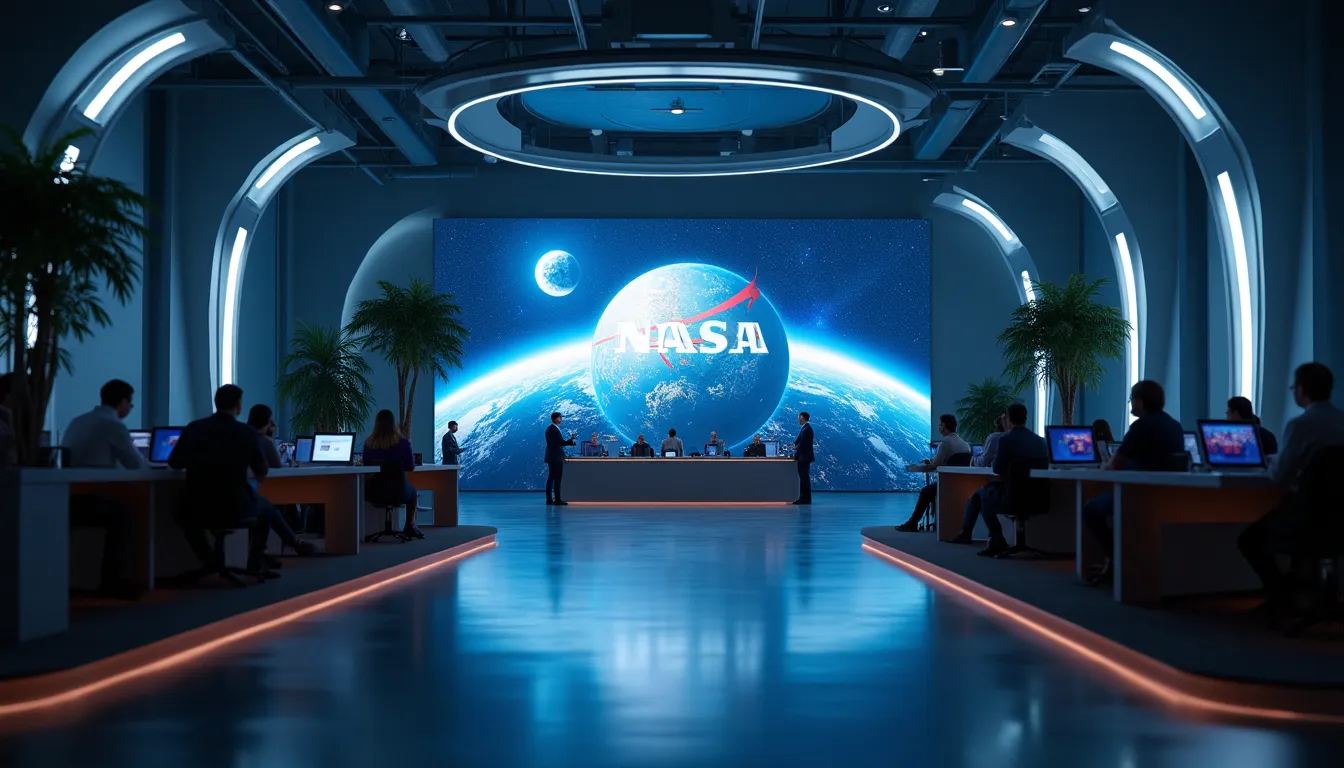
In recent weeks, NASA has made significant strides in the realms of autonomous technology and planetary defense, reflecting a broader shift toward operational readiness and practical applications in space exploration. As the agency enhances its capabilities, these advancements not only promise to revolutionize deep-space missions but also have implications for national defense and emergency response systems.
Enhanced Autonomy in Space Technology
NASA’s current focus on flight-tested autonomy represents a pivotal evolution from theoretical models to systems primed for real-world application. Key areas of development include autonomous guidance and navigation systems designed specifically for planetary missions. These systems leverage cutting-edge technology to enhance the safety and efficiency of spacecraft operations.
Precision Landing Technologies
One of the critical components of NASA’s strategy is the development of Entry, Descent, and Landing (EDL) technologies. By employing terrain-relative navigation and lidar-based hazard detection, NASA aims to ensure safer landings on celestial bodies, particularly for upcoming Mars and lunar missions. These technologies allow spacecraft to autonomously assess landing conditions and adjust their approach accordingly, significantly reducing the risk of accidents.
Advanced Computing for Autonomous Operations
At the heart of these advancements is the push for radiation-hardened computing and onboard processing capabilities. NASA is investing in next-generation space processors that enhance onboard AI, enabling real-time decision-making with reduced reliance on Earth-based control. This is crucial for missions venturing into the deeper reaches of space, where communication delays can hinder immediate responses to unforeseen challenges.
The integration of systems such as the Advanced Navigation System, featuring high-performance MEMS accelerometers, ensures superior stability and precision in navigation tasks, making it a vital tool for autonomous spacecraft.
Planetary Defense Initiatives
Parallel to its advancements in autonomous technology, NASA’s planetary defense portfolio remains robust, with the NEO Surveyor mission leading the charge. This mission aims to detect potentially hazardous asteroids and comets through infrared observations, a vital step in safeguarding Earth from potential impacts.
Current Status of NEO Surveyor
As of now, the NEO Surveyor is undergoing integration and testing, with its launch anticipated no earlier than September 2027. The mission is positioned as a critical component of NASA’s strategy to enhance our understanding and monitoring of near-Earth objects (NEOs). Furthermore, recent observations by the James Webb Space Telescope have successfully refined the orbit of asteroid 2024 YR4, eliminating the previously estimated risk of a lunar impact in 2032.
Dual-Use Technologies in Aerospace and Defense
NASA’s innovations are not limited to space exploration; they are increasingly influencing the defense sector as well. Technologies originally developed for space missions are finding applications in military and emergency response environments, showcasing their versatility and impact across multiple domains.
Spin-off Technologies and Their Applications
The agency’s work in advanced propulsion, silicon carbide electronics, and thermal protection materials exemplifies how NASA’s research translates into practical applications. For instance, the Advanced Sensor Module, which integrates a 9-DOF MEMS IMU, enhances motion sensing capabilities crucial for both aerospace and defense operations. Additionally, NASA’s focus on developing radiation detectors and high-temperature materials demonstrates the agency’s commitment to fostering technologies with dual-use potential.
Caution on Third-Party Claims
While numerous reports highlight NASA’s achievements, it is essential to approach some third-party claims with caution. Recent articles from sources like Orbysa have presented specific defense-related contracts and systems tied to NASA programs that should be independently verified for accuracy. Ensuring information integrity is crucial in an industry where precision and reliability are paramount.
Conclusion
NASA’s recent advancements in autonomous technology and planetary defense mark a transformative period for the agency and the aerospace industry at large. As these technologies transition from concept to operational capabilities, they not only enhance space exploration but also provide valuable resources for defense applications. Looking ahead, the continued collaboration between NASA and defense sectors promises to yield innovative solutions that will further secure our planet and expand our reach into the cosmos. The future of aerospace and defense is bright, bolstered by NASA’s pioneering spirit and commitment to excellence.
References
-
NASA’s Recent Advances in Space Technology: Bridging Earth and … (orbysa.com) - 5/14/2026 Explore the latest developments in NASA-supported space technologies that are revolutionizing aerospace, defense, and terrestrial …
-
Mission-Integrated Space Capabilities - Lockheed Martin (www.lockheedmartin.com) - 5/1/2026 We’re designing, building and testing lunar and deep space exploration capabilities, including NASA’s Orion spacecraft, and creating early-warning weather and …
-
NASA’s Recent Breakthroughs: Pioneering Advances in Aerospace … (orbysa.com) - 4/21/2026 Explore NASA’s latest advancements in aerospace and defense, including the successful Artemis II mission, cutting-edge technologies, …
-
Game Changing Development Projects - NASA (www.nasa.gov) - 3/27/2026 Game Changing Development projects aim to advance space technologies that could lead to new approaches for the agency’s future space missions.
-
Planetary Defense News - NASA Science (science.nasa.gov) - 3/5/2026 The Near-Earth Object (NEO) Surveyor — NASA’s first infrared space telescope purposely designed to discover potentially hazardous asteroids …
-
NASA Glenn Research and Technology (www.nasa.gov) - 8/6/2025 NASA is advancing inlets and nozzles for aircraft engines and aerospace applications through research supporting commercial, military aircraft, …
-
NASA Advances 6 New Innovative Space Tech Concepts … - YouTube (www.youtube.com) - 5/22/2024 NASA is funding six radically new technologies that could transform its future missions. Such projects include new types of space telescopes …
-
Technology - NASA (www.nasa.gov) - 1/27/2023 NASA Fires Up Powerful Lithium-Fed Thruster for Trips to Mars. NASA puts next‑generation propulsion to the test—a system powerful enough to carry crews to Mars …
-
NASA spin-off technologies - Wikipedia (en.wikipedia.org) - 7/10/2008 NASA spin-off technologies are commercial products and services which have been developed with the help of NASA, through research and development contracts.