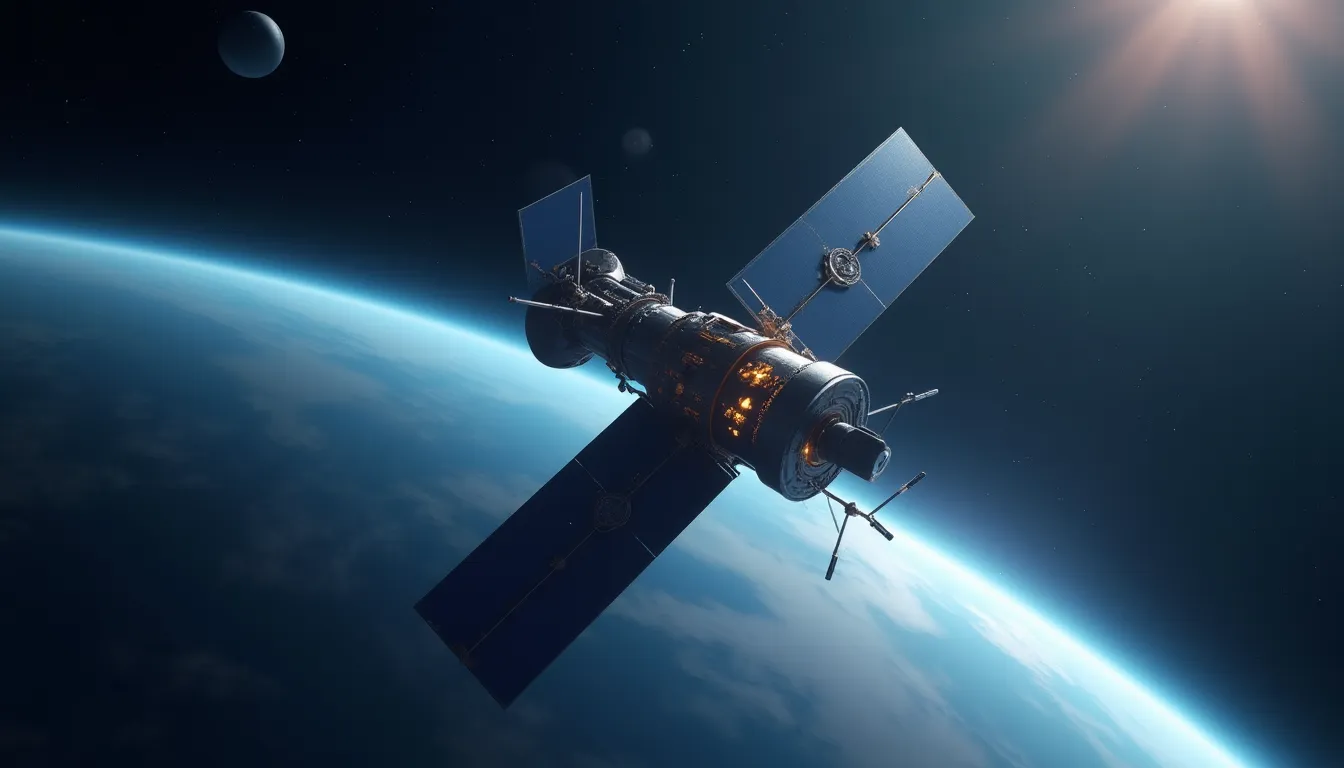
As we transition into 2026, the aerospace and defense sectors are witnessing significant advancements that promise to reshape our approach to space security and technology. Recent initiatives led by the U.S. Space Force and the Space Development Agency (SDA) emphasize the development of resilient satellite constellations, advanced hypersonic propulsion systems, and AI-enhanced space situational awareness. This article delves into these developments and their implications for the future of space operations.
Resilient Satellite Constellations for Missile Defense
In response to evolving global threats, the U.S. is enhancing its missile warning and tracking capabilities through next-generation satellite systems. Lockheed Martin is at the forefront, constructing the Next-Gen GEO Overhead Persistent Infrared (OPIR) satellites utilizing the LM 2100 bus. These satellites are designed with cyber hardening and improved propulsion systems, enabling them to detect hypersonic threats effectively.
As part of the SDA’s Tracking Layer Tranche 2 initiative, Lockheed Martin has been awarded contracts to deliver 16 wide-field-of-view satellites equipped with advanced infrared sensors along with two missile defense sensors. The SDA further solidified its commitment by allocating $3.5 billion on December 19, 2025, for 72 Tracking Layer Tranche 3 satellites, aimed at bolstering missile warning and tracking capabilities.
This strategic investment reflects a broader move towards multi-orbit systems capable of countering hypersonic threats, ensuring that the U.S. maintains its edge in aerospace defense.
Hypersonic Propulsion Technologies
As hypersonic weapons continue to gain prominence—with speeds exceeding Mach 5—advances in propulsion and thermal management are critical. The Office of Technology Assessment (OTA) has funded projects like MACH-TB 2.0, which bridge low-to-high Technology Readiness Levels (TRLs) to expedite the development and fielding of hypersonic technologies.
Sierra Space is emerging as a pivotal player, focusing on hypersonic systems and innovative thermal battery systems for electrical power needs. Their approach utilizes Surface Mount Technology (SMT) to streamline solar array production, enhancing the efficiency of power generation for hypersonic applications.
AI-Driven Space Situational Awareness
The integration of artificial intelligence into space operations is revolutionizing how we monitor and manage space assets. Emerging trends in AI-enabled analytics are facilitating the tracking of objects in congested orbits and addressing the growing issue of space debris. Technologies for debris removal and counter-space weapons are also being developed to ensure deterrence against potential threats.
Innovations in multi-domain data fusion and predictive monitoring are vital for maintaining operational resilience in space. The implementation of autonomous systems powered by AI is expected to enhance real-time command and control, predictive maintenance, and cybersecurity measures across aerospace and defense sectors.
Digital Transformation in Aerospace and Defense
The digital transformation of aerospace and defense is heavily influenced by emerging technologies such as immersive tech (AR/VR), robotics, and blockchain. As we approach 2026, we anticipate an increase in agentic AI applications that can autonomously manage complex aerospace systems.
Additive manufacturing is also making strides, enabling the production of lightweight components that are critical for next-generation aircraft. The demand for precision accelerometers and advanced navigation systems is expected to rise, as these technologies enhance the performance and reliability of aerospace systems in a competitive landscape.
Commercial Innovations and Funding Highlights
Recent commercial activities reflect a vibrant and innovative space sector. Notably, Turion Space’s acquisition of Tychee Research Group on January 28, 2026, signifies a strategic expansion in defense capabilities within the space technology landscape. Meanwhile, funding initiatives such as Natilus’s $28 million raise for next-generation aircraft development and JetZero’s $175 million for all-wing aircraft demonstrate a commitment to advancing flight efficiency and operational capabilities.
Sierra Space’s Dream Chaser, a runway-capable commercial spaceplane, continues its development for national security missions, showcasing the intersection of commercial and defense needs in modern space operations.
Conclusion
The rapid advancements in satellite technology, hypersonic propulsion, and AI-driven systems are setting the stage for a new era in aerospace and defense. As we move into 2026, the focus on resilient architectures and innovative solutions will be paramount in countering emerging threats. The allocation of substantial funding and the commitment of leading companies underscore a collective effort to ensure that the U.S. remains at the forefront of space technology and defense capabilities. The future of space operations looks promising, shaped by these significant developments and the ongoing pursuit of excellence in aerospace engineering.
References
-
Aerospace, Defense and Space Tech - Los Angeles Times (www.latimes.com) - 4/24/2026 Fortastra Expands Leadership Team to Accelerate Space Systems Development · Smack Technologies Secures $32M to Launch Frontier National Security AI Lab · Building …
-
Voyager | Defense & Space Technology (voyagertechnologies.com) - 4/15/2026 Space Solutions. From low-Earth orbit to deep space, enabling solutions for human exploration, microgravity research, infrastructure and technology development.
-
Space Technology Trends Shaping The Future | Lockheed Martin (www.lockheedmartin.com) - 4/8/2026 Space Technology Trends to Watch · Human lunar exploration · Advanced propulsion systems · Proliferated satellite architectures · Resilient …
-
Space Development Agency – Increasing Warfighters’ Lethality … (www.sda.mil) - 4/7/2026 The Space Development Agency (SDA) will quickly deliver needed space-based capabilities to the joint warfighter to support terrestrial missions.
-
Defense Tech Trends for 2026: Innovation in Action - NSTXL (nstxl.org) - 2/6/2026 The development of hypersonic weapons continues to be a priority, with OTA-funded projects exploring advanced materials, propulsion systems, and …
-
Sierra Space | Defining the New Era of Space Defense Technology (www.sierraspace.com) - 1/26/2026 Sierra Space is a Defense Tech leader developing satellites, subsystems, spaceplanes, hypersonics & infrastructure for U.S. National Security.
-
New Technology Trends in Aerospace and Defense Industry [2026] (www.epicflow.com) - 12/29/2025 Key aerospace and defense innovations will include the application of artificial intelligence and agentic AI, immersive technologies, additive …
-
Advanced Space Technologies | Center for Security and Emerging … (cset.georgetown.edu) - 6/12/2025 The United States is home to a growing set of companies building advanced space technologies, from lunar landers to satellite servicing systems.
-
Technology - NASA (www.nasa.gov) - 1/27/2023 We also work on modeling and simulation tech, software, and unique electronics and computing hardware for flight systems, whether in space or the atmosphere.