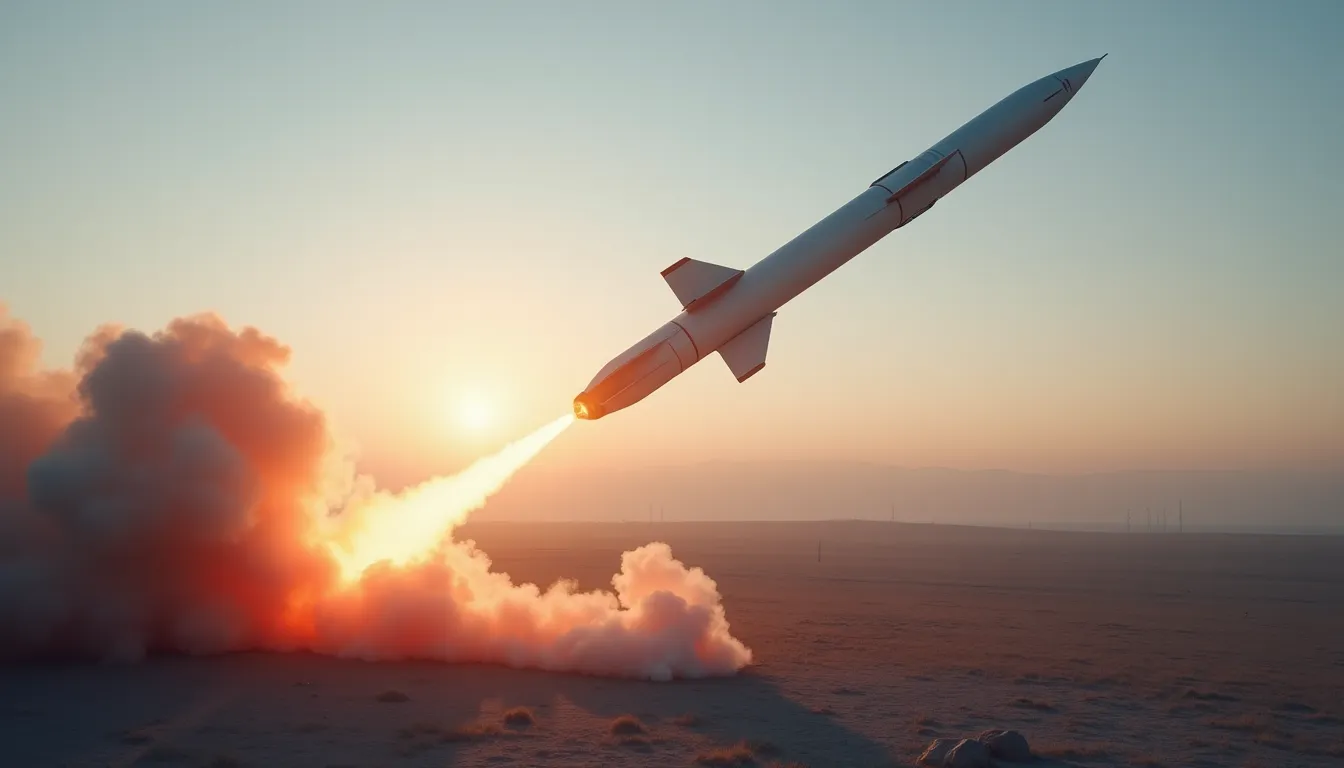
In early 2026, the United States has witnessed a dramatic increase in missile production, a strategic response to evolving global threats in the Indo-Pacific region. Major defense contractors, including Lockheed Martin and RTX, are ramping up output for vital missile systems, driven by the urgent need for enhanced deterrence capabilities. This article delves into the specifics of this acceleration, the technological advancements in hypersonic weapons, and the implications of the recent shifts in national defense strategy.
Accelerated Missile Production
The impetus for increased missile production comes from heightened geopolitical tensions, particularly in the Indo-Pacific. Lockheed Martin recently signed a seven-year contract to boost the production of the PAC-3 MSE interceptor from 600 to 2,000 units annually. Similarly, RTX has secured Department of Defense (DoD) agreements enabling the production of over 1,000 Tomahawk missiles, at least 1,900 AMRAAM missiles, and an increased rate of SM-3 and SM-6 missiles, with the latter potentially quadrupling its current output.
These efforts underscore a commitment to sustain layered air and missile defense capabilities, particularly in response to threats posed by North Korea and other rogue states. As defense analyst John Smith from the Brookings Institution notes, “The production surge is not merely about numbers; it’s about maintaining strategic superiority in a rapidly changing environment.”
Advancements in Hypersonic Weapons
In parallel with increased missile production, advancements in hypersonic weaponry are gaining traction. The Office of Technology Assessment (OTA) is funding several projects aimed at enhancing the U.S. hypersonic capabilities. One notable initiative is MACH-TB 2.0, which focuses on low-to-high Technology Readiness Level (TRL) testing for hypersonic systems capable of surpassing Mach 5 speeds. This includes innovations in propulsion, materials, and guidance systems that are critical for operational success.
As part of these advancements, the development of precision accelerometers and quartz MEMS gyroscopes plays a pivotal role in ensuring stability and accuracy in hypersonic flight. Such technologies are fundamental in maintaining the trajectory of missiles traveling at extreme velocities, thus enhancing their effectiveness in combat scenarios.
The 2026 National Defense Strategy and the Golden Dome Initiative
The 2026 National Defense Strategy (NDS) introduces the Golden Dome initiative, a significant expansion of missile defense capabilities aimed at countering large-scale barrages, advanced aerial threats, and unmanned aerial vehicles (UAVs). This initiative highlights the U.S. commitment to maintaining an effective defense posture against a spectrum of threats, particularly from state actors like China and Russia.
The Golden Dome initiative is estimated to require more than $500 billion in investment, focusing on the development of space-based interceptors and advanced defense systems. According to a report from the Center for Strategic and International Studies (CSIS), “The Golden Dome represents a shift towards a more integrated defense architecture that leverages space capabilities for missile interception.”
Implications of New START Treaty Expiry
Compounding the urgency of missile production and defense initiatives is the recent expiration of the New START treaty on February 5, 2026. This treaty, which monitored intercontinental ballistic missiles (ICBMs) and submarine-launched ballistic missiles (SLBMs), has lapsed, prompting discussions on future arms control frameworks involving the U.S., Russia, and China.
The lapse necessitates a reevaluation of strategic deterrence policies, particularly as the U.S. looks to modernize its nuclear triad, including the Columbia-class submarines and the Sentinel ICBM program. “The expiration of New START opens a Pandora’s box of challenges and opportunities in arms control,” states defense expert Sarah Johnson from the Arms Control Association.
DARPA’s Technological Innovations
Amid these developments, the Defense Advanced Research Projects Agency (DARPA) is making strides with the X-68A, an air-launched uninhabited vehicle that has recently achieved significant milestones toward flight testing. This technology is expected to play a crucial role in future missile systems, integrating advanced navigation systems and high-performance CMOS imaging capabilities for enhanced targeting and operational flexibility.
Conclusion
The current landscape of missile production and technological advancement in the U.S. defense sector reflects a proactive approach to emerging global threats. As the U.S. ramps up missile capabilities and embraces hypersonic technologies, the implications for national security are profound. With initiatives like the Golden Dome and ongoing innovations from DARPA, the U.S. is positioning itself to maintain strategic superiority in an increasingly complex geopolitical arena. Looking ahead, the focus on advanced missile systems and defense strategies will be critical in shaping the future of U.S. defense policy and global security.
References
-
What comes after New START? | Brookings (www.brookings.edu) - 2/19/2026 The New Strategic Arms Reduction Treaty lapsed on February 5, 2026. U.S. President Donald Trump has said he will seek a better agreement, …
-
Accelerating U.S. Missile Development and Naval Posture in the … (dsm.forecastinternational.com) - 2/17/2026 U.S. missile production has accelerated sharply at the start of 2026, with major defense contractors expanding output across several high-demand …
-
Defense Tech Trends for 2026: Innovation in Action - NSTXL (nstxl.org) - 2/6/2026 February 6, 2026. Every passing year, technology innovations in the defense industry grow more sophisticated. … Missile Warning satellite command and control, including mission management, ground …
-
The 2026 National Defense Strategy by the Numbers - CSIS (www.csis.org) - 1/27/2026 Moderate changes: Missile defense expands with the new concept of Golden Dome. North Korea is seen as a threat but mainly to South Korea and …
-
New START at a Glance - Arms Control Association (www.armscontrol.org) - 3/28/2025 The United States and Russia agreed on Feb. 3, 2021, to extend New START by five years, as allowed by the treaty text, until Feb. 5, 2026. On Feb. 21, 2023 …
-
Not such a long shot - DARPA (www.darpa.mil) - 11/1/2024 The X‑68A completed a series of technical milestones, moving its air-launched uninhabited vehicle closer to flight test.