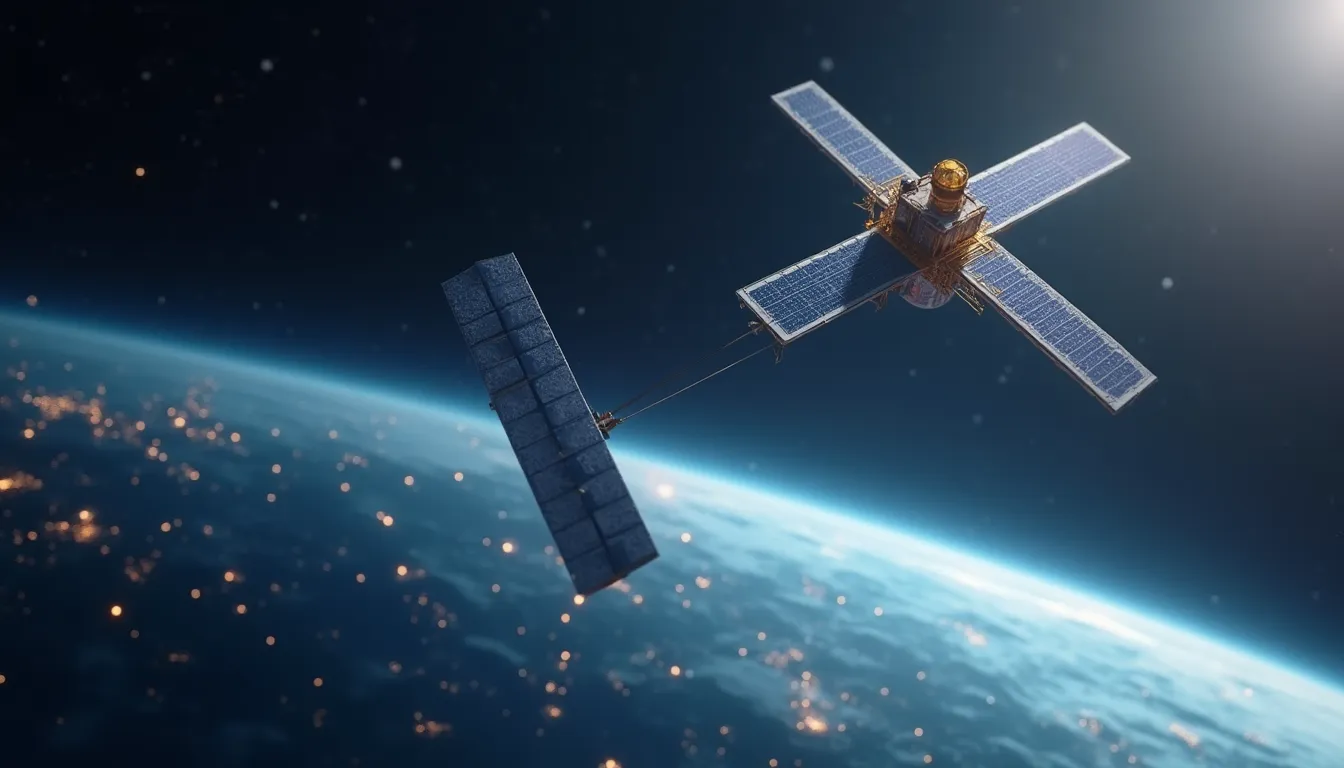
The aerospace and defense sectors are witnessing a transformative era, driven by significant advancements in satellite technology and mission planning. From planetary defense initiatives to enhanced space situational awareness, the developments in this field are reshaping how we understand and interact with our cosmic environment.
ESA’s Ramses Mission to Asteroid Apophis
On February 10, 2026, the European Space Agency (ESA) awarded a contract to OHB Italia for the Rapid Apophis Mission for Space Safety (Ramses). Scheduled to launch in 2028, this mission will rendezvous with the near-Earth asteroid Apophis just before its notable close approach to Earth, which is anticipated in 2029. The primary objective is to gather crucial data regarding the physical properties of Apophis, enhancing our planetary defense capabilities against potential threats from near-Earth objects.
The mission will incorporate two deployable CubeSats developed by European industry, which will extend the scientific reach and provide real-time data as they approach the asteroid. This innovative approach underlines ESA’s commitment to enhancing our understanding of celestial bodies that could pose risks to Earth.
U.S. Space Force Launch Operations
In parallel, the United States is ramping up its satellite launch capabilities. United Launch Alliance (ULA) is set to conduct between 18 and 22 flights in 2026, including at least seven missions for the U.S. Space Force and National Reconnaissance Office. The first mission, USSF-87, is scheduled for February 12 from Cape Canaveral and will deploy advanced payloads, including a Geosynchronous Space Situational Awareness Program spacecraft. This spacecraft is designed to monitor and track activities in geosynchronous orbit, a critical area for national security and commercial activities.
As the demand for satellite services increases, ULA’s commitment to maintaining a robust launch schedule highlights the evolving dynamics of aerospace operations, where both governmental and commercial interests converge.
Embracing Technological Innovations
The aerospace sector is undergoing a paradigm shift, transitioning from traditional hardware-centric designs to software-defined satellite architectures. This transformation allows for on-orbit capability updates, enabling real-time vulnerability patching and AI-driven decision-making capabilities. Such advancements are essential for the Pentagon’s Golden Dome missile defense architecture, which benefits from a $175 billion investment over three years aimed at enhancing missile defense systems’ responsiveness to modern threats.
The integration of precision accelerometers and advanced sensor modules, such as the Advanced 9-DOF MEMS IMU, is pivotal in this new paradigm. These technologies provide exceptional stability and comprehensive motion sensing capabilities that are critical for the success of sophisticated defense systems.
Consolidation in Defense Technology
In a notable consolidation move, Qualis, InTrack Radar Technologies, and Tektonux have formed a new venture focused on space and missile defense programs. This collaboration aims to leverage their combined expertise in modeling and simulation services, ground-based radar, and electro-optical products. The integration of AI-powered command-and-control systems further enhances the capabilities of this new entity, positioning it as a significant player in the defense technology landscape.
International Space Safety Coordination
As the space environment becomes increasingly congested, international collaboration is vital for ensuring satellite safety. A new United Nations forum is addressing barriers to space traffic cooperation, with the U.S. advocating for greater transparency from China regarding its satellite operations. The Pentagon has established cross-agency guidelines to improve communication about space situational awareness, designating the Beijing Institute of Telecommunications and Tracking Technology (BITTT) as the primary channel for coordinating efforts to prevent satellite collisions.
In a landmark development, China reached out to NASA in October 2025 to discuss potential satellite collision avoidance for the first time, indicating a willingness to collaborate on space safety issues. This cooperation is a crucial step in establishing a more regulated and safer environment for satellites operating in Earth’s orbit.
Additional Aerospace Developments
Recent advancements extend beyond satellite missions and defense collaborations. Innovations such as plasma surface activation for carbon fiber reinforced polymer (CFRP) bonding and aerospace aluminum laser welding techniques are revolutionizing manufacturing processes in aerospace applications. Moreover, the U.S. Army’s Aerophysics Research Facility has successfully tested a new rainfield simulator for hypersonic testing, while Auburn University’s Applied Research Institute is pushing the boundaries of 3D printing technology for next-generation carbon fiber composites.
These technological strides are not only enhancing the capabilities of defense systems but are also paving the way for future aerospace applications, including eVTOL systems and hypersonic vehicles.
Conclusion
The rapid advancements in satellite technology and mission planning underscore the importance of collaboration and innovation in addressing the challenges of modern aerospace and defense. As we look to the future, missions like ESA’s Ramses and the U.S. Space Force’s launch operations will play a critical role in enhancing our understanding of space and ensuring national security. The ongoing evolution towards software-defined architectures and collaborative international efforts will be essential in navigating the complexities of space traffic and planetary defense.
References
-
ULA’s Interim Leader Focused on Increasing Launch Rate in 2026 (www.airandspaceforces.com) - 2/11/2026 United Launch Alliance’s interim CEO said ULA is “laser focused” on increasing its launch rate after a lackluster 2025 performance.
-
Silicon Valley to Aerospace: Code is the New Steel - SatNews (news.satnews.com) - 2/11/2026 Research briefings reveal a staggering $175 billion earmarked for missile defense over the next three years. Yet money alone can’t buy speed.
-
Aerospace Daily & Defense Report, February 11, 2026 (aviationweek.com) - 2/11/2026 Swedish space company AAC Clyde Space plans to double the satellite fleet for ship tracking, while still mulling growth for its Earth- …
-
Forest fire detection technology could also help security authorities (table.media) - 2/11/2026 Infrared satellites: Forest fire detection technology could also help security authorities. The Munich-based company OroraTech supplies forestry …
-
New UN forum seeks busting space traffic cooperation barriers (breakingdefense.com) - 2/10/2026 US officials say they hope the talks spur greater transparency from China in particular about satellite operations.
-
Qualis Joins Two Other Firms To Form Defense Technology Company (huntsvillebusinessjournal.com) - 2/10/2026 According to a news release, Qualis is joined by InTrack Radar Technologies and Tektonux in the new venture. Tektonux of Madison incorporates …
-
26AERP02: Aerospace & Defense Technology: February 2026 (saemobilus.sae.org) - 2/5/2026 Plasma Surface Activation for Stronger, More Durable CFRP Bonds in Aerospace · Smarter Pyrovalve Alternatives for Modern Missile and Munition …
-
GAO Report on Missile Warning Satellites - USNI News (news.usni.org) - 2/3/2026 The following is the Government Accountability Office’s report, published Jan. 28, 2026, and revised Feb. 2, 2026, Missile Warning …
-
Integrated Aerospace Systems | Karman Space & Defense (karman-sd.com) - 1/13/2026 Latest News ; News Release. February 06, 2026. Karman Space & Defense Systima Facility Awarded MDA Contract under $151 Billion SHIELD IDIQ ; News Release. January …
-
ESA awards contracts for Ramses mission to Apophis (www.esa.int) - 12/1/2025 On 10 February 2026, the European Space Agency (ESA) signed a contract with OHB Italia for the development of the Rapid Apophis Mission for …