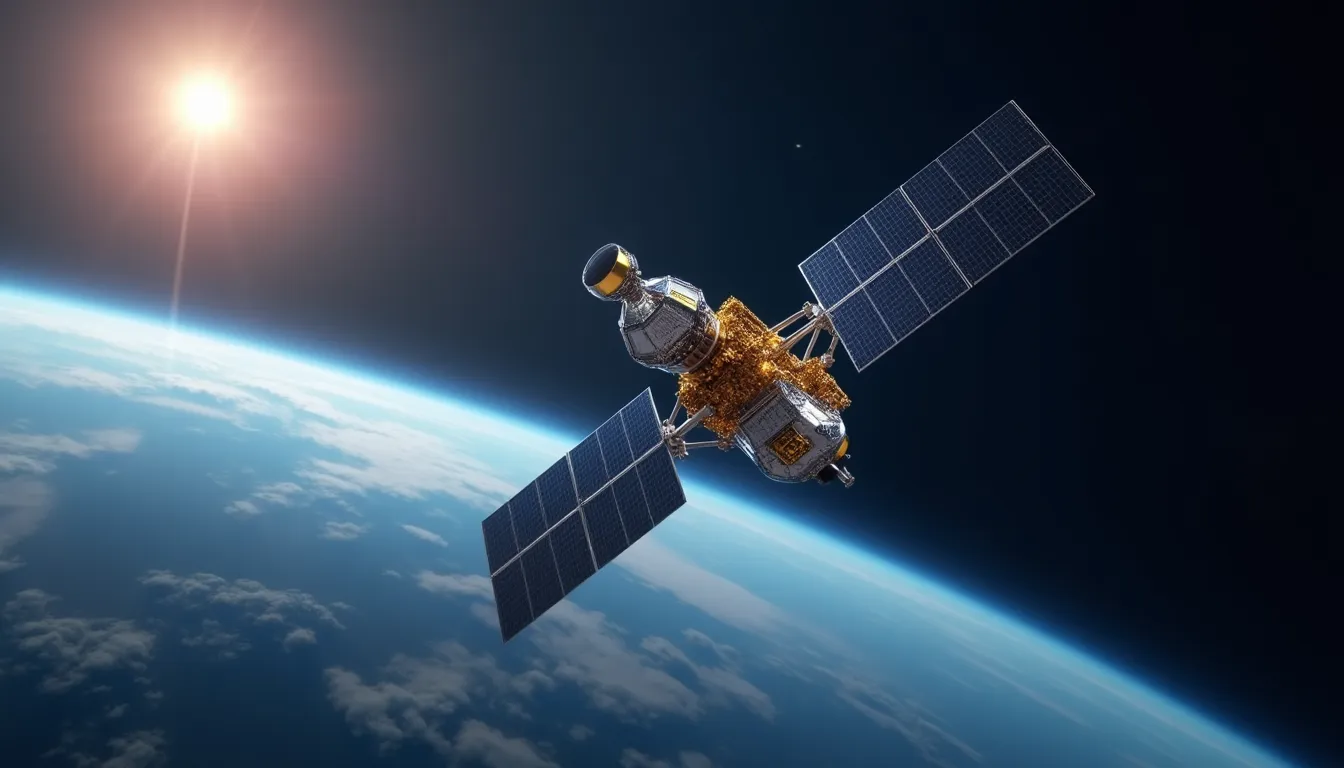
The aerospace and defense industries are experiencing rapid advancements in satellite technology, as evidenced by recent developments that enhance navigation, missile defense, and commercial payload capabilities. As of early February 2026, key launches and contracts highlight improvements in GPS systems, sophisticated infrared sensors for missile tracking, and innovative commercial satellite integrations. These advancements are pivotal for the U.S. Space Force and global defense capabilities in increasingly contested environments.
GPS III SV09 Launch: A Leap Forward in Navigation Technology
On January 27-28, 2026, Lockheed Martin successfully launched the GPS III Space Vehicle 09 (SV09) aboard a SpaceX Falcon 9 rocket from Cape Canaveral. This launch is a significant milestone, as it bolsters the GPS constellation to 32 satellites, offering three times better accuracy, eight times improved anti-jamming capabilities, and advanced M-code signals designed specifically for military warfighters.
Equipped with a laser retroreflector array, the SV09 enhances Earth orientation measurements, thereby improving positioning accuracy. The satellite also carries a demonstration payload aimed at fortifying future resilience in navigation technology. Notably, the production of SV01 through SV10 is now complete, with the next generation, GPS IIIF satellites, already in manufacturing stages. These upcoming satellites promise to deliver 60 times greater anti-jam power through spot beams, alongside optical crosslinks for enhanced data communication.
Strategic Implications: The enhanced GPS capabilities are crucial for maintaining navigation in denied environments where traditional signals may be compromised. However, the Space Force currently lacks a comprehensive long-term Positioning, Navigation, and Timing (PNT) strategy, raising concerns about future operational readiness.
Advancements in Missile Defense: Infrared Sensors
In a related development, Leonardo DRS has secured a subcontract to provide advanced infrared sensor payloads for the Space Development Agency’s (SDA) Tracking Layer Tranche 3 satellites. These satellites are designed to detect and track ballistic and hypersonic missiles from launch through interception. This initiative is part of a broader $3.5 billion contract awarded in December 2025 for the development of 72 satellites, incorporating efforts from major industry players like Lockheed Martin, Rocket Lab, Northrop Grumman, and L3Harris, with launches scheduled from FY2029.
The integration of these infrared sensors with the Transport Layer will facilitate rapid data relay and enable a two-year refresh cycle for the satellite fleet, significantly enhancing missile defense capabilities. The sophisticated payloads ensure timely detection and response to emerging threats, underscoring the importance of real-time data in modern defense strategies.
Commercial Satellite Integration: Pioneering New Technologies
Commercial advancements are also noteworthy, as Sidus Space and Maris-Tech achieved a significant integration milestone for the LizzieSat-4 mission, slated for launch later in 2026. This integration involves testing Maris-Tech’s edge computing and video processing payload, designed for real-time defense analytics utilizing the modular LizzieSat architecture.
The collaboration highlights the increasing convergence of commercial technologies with military applications, emphasizing the role of advanced sensor modules and edge computing in enhancing situational awareness and operational effectiveness in defense operations.
Broader Trends in the Satellite Industry
According to a recent report from Novaspace, the global space economy is projected to surpass $1 trillion by 2034, driven largely by advancements in satellite technology. The report emphasizes the increasing military funding towards space initiatives, integration of artificial intelligence in satellite operations, and the necessity for sustainable satellite disposal contracts. As the industry evolves, technologies such as precision accelerometers and high-performance CMOS imaging systems will play crucial roles in the development of next-generation satellite systems.
Conclusion
In summary, the latest advancements in satellite technology signify a transformative period for the aerospace and defense sectors. With enhancements in GPS capabilities, sophisticated missile defense systems, and innovative commercial integrations, the landscape is rapidly evolving. As the U.S. Space Force and other global entities continue to invest in these technologies, the future of satellite operations looks promising, underscoring the critical role of advanced satellites in national security and commercial applications alike. The continued integration of cutting-edge technologies, such as quartz MEMS gyroscopes and the ZQXXSGDSS System, will further enhance operational capabilities, ensuring readiness in an increasingly complex global environment.
References
-
Leonardo to Supply Infrared Sensors for US Space-Based Missile … (thedefensepost.com) - 1/30/2026 Leonardo DRS has won a subcontract to provide advanced infrared sensor payloads for the Space Development Agency’s Tracking Layer Tranche 3.
-
USSF field commands successfully launch GPS III Space Vehicle 09 … (www.spaceforce.mil) - 1/30/2026 USSF field commands successfully launch GPS III Space Vehicle 09 into orbit · Published Jan. 29, 2026 · Space Systems Command Public Affairs.
-
Novaspace Report Predicts Global Space Economy Market Could … (www.satellitetoday.com) - 1/30/2026 The global space economy could be worth over $1 trillion by 2034, according to Novaspace’s latest edition of its Space Economy Report.
-
Space Force Launches Ninth GPS III Satellite amid Push for … (www.airandspaceforces.com) - 1/29/2026 The Space Force’s newest GPS satellite will boost the resiliency of the current constellation, but the service lacks a long-term strategy.
-
Aerospace Daily & Defense Report, January 29, 2026 - Aviation Week (aviationweek.com) - 1/29/2026 The U.S. Space Force and SpaceX launched the latest GPS III satellite on Jan. 27, on a Falcon 9 rocket from Space Launch Complex 40 at Cape …
-
Lockheed Martin’s newest GPS satellite reaches orbit, strengthening … (news.lockheedmartin.com) - 1/28/2026 Lockheed Martin’s GPS III SV09 Hosts New Demonstration Payload Aimed at Strengthening Capabilities and Constellation Resilience.
-
Sidus Space and Maris‑Tech Achieve Integration Milestone for … (investors.sidusspace.com) - 1/26/2026 In the News. Sidus Space and Maris‑Tech Achieve Integration Milestone for LizzieSat‑4 Mission. January 26, 2026 8:30am EST Download as PDF.
-
Space Brief 22 Jan 2026 - KeepTrack (keeptrack.space) - 1/22/2026 Today’s brief covers the latest in military space funding, groundbreaking contracts for satellite disposals, and the integration of AI in …