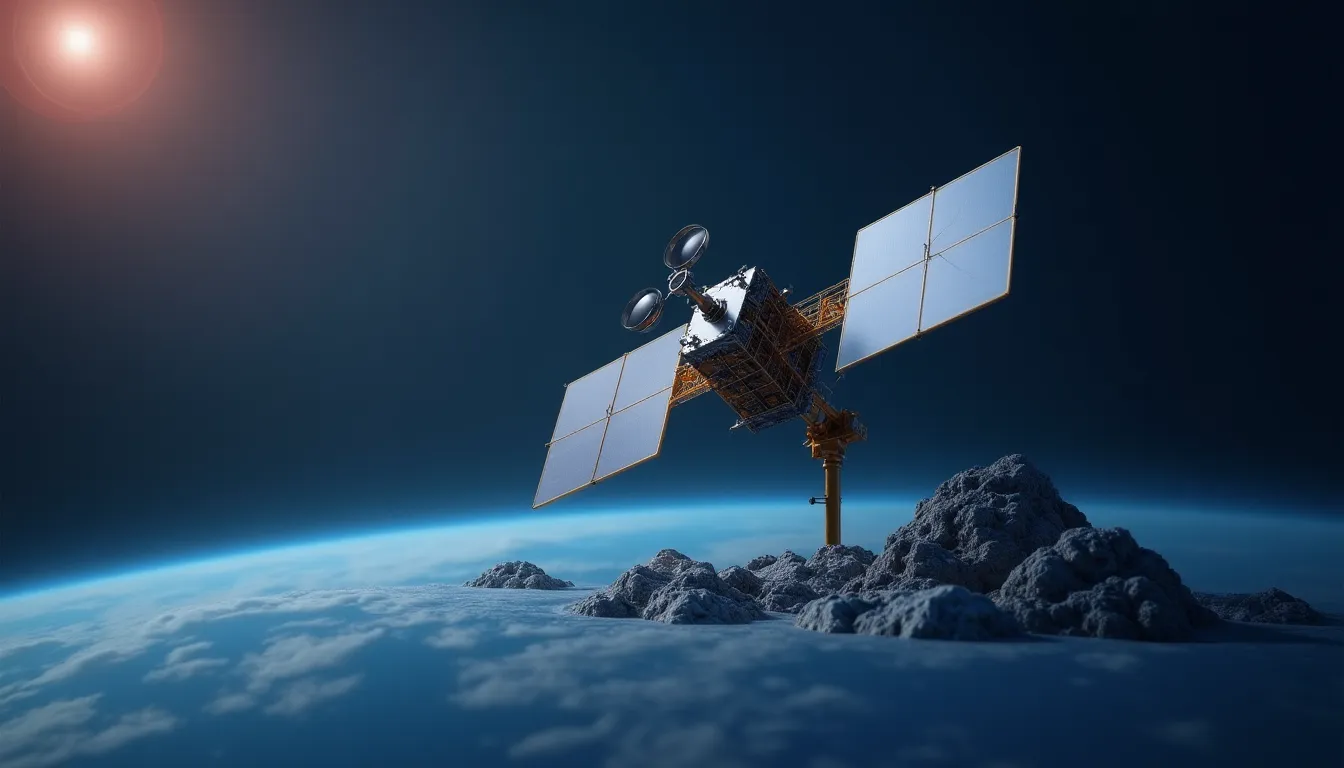
In a landmark achievement for the U.S. aerospace and defense sectors, the U.S. Space Force successfully launched the GPS III SV09 satellite on January 27, 2026. This launch not only enhances the resilience of the GPS constellation but also marks a significant step forward in satellite technology, with advanced capabilities that redefine modern navigation systems. As the global space economy continues to expand, with projections exceeding $1 trillion by 2034, the implications for defense and commercial applications are profound.
GPS III SV09 Launch: A New Era of Precision and Resilience
The GPS III SV09 satellite was launched aboard a SpaceX Falcon 9 rocket from Cape Canaveral at 11:53 p.m. EST, symbolizing the ninth addition to the GPS III series. This satellite is named after Col. Ellison Onizuka, honoring the 40th anniversary of the Challenger disaster, a poignant reminder of the risks and achievements of space exploration.
Technical Enhancements
The GPS III SV09 introduces several key enhancements over its predecessors:
| Feature | Improvement Over Prior GPS Satellites | Details |
|---|---|---|
| Accuracy | 3x better | Enables precise navigation in contested environments, crucial for both military and civilian use. |
| Anti-Jamming | 8x improved (60x in upcoming GPS IIIF) | Incorporates advanced M-code signals aimed at warfighters, offering regional spot beams with a 1,200 km diameter. |
| New Payloads | Laser retroreflector array; optical crosslink demo (on SV10) | Enhances Earth’s orientation measurements and establishes jam-resistant communications. |
These improvements are instrumental in bolstering positioning, navigation, and timing (PNT) resilience for defense missions. Lockheed Martin, the satellite’s manufacturer, has completed the production of the first ten GPS III satellites and is now progressing with the GPS IIIF series, which promises further enhancements.
Strategic Impact on Defense Operations
The enhanced capabilities of GPS III SV09 significantly bolster U.S. military operations by ensuring reliable navigation and communication, especially in contested environments. As defense strategies increasingly rely on accurate satellite data, this new satellite is poised to play a critical role in future military operations.
According to Lockheed Martin’s press release, “The GPS III SV09 satellite represents our commitment to delivering robust and resilient capabilities for our warfighters.” This sentiment reflects the broader trend of integrating advanced satellite technology into national defense frameworks.
LizzieSat-4: Edge Computing in Orbit
In addition to the significant advancements represented by the GPS III SV09, Sidus Space has achieved a critical milestone with the integration of a Maris-Tech edge computing payload for the upcoming LizzieSat-4 mission. Announced on January 26, 2026, this integration marks a shift towards high-performance computing capabilities in orbit, enabling real-time data processing and analytics for both space and defense applications.
Applications and Future Prospects
The LizzieSat architecture is designed to leverage modular components, significantly enhancing the versatility and effectiveness of satellite operations. This capability is essential for applications requiring swift decision-making based on compressive real-time data. As Sidus Space transitions to payload testing, the implications for surveillance, reconnaissance, and communication capabilities are substantial.
Global Space Economy Projections
Recent reports from Novaspace highlight the exponential growth of the global space economy, which is expected to surge from $625 billion in 2025 to over $1 trillion by 2034. This growth is largely driven by increased government spending on defense and sovereignty, with an estimated $138 billion allocated in 2025 alone.
Key Drivers of Growth
Several factors are propelling this growth:
- Defense Programs: Enhanced security measures and the need for resilient satellite infrastructure are driving investments.
- Commercial Activities: The burgeoning satellite industries are fostering new business models and opportunities.
- AI and Softwarization: The integration of AI technologies into satellite operations is revolutionizing data analysis and operational efficiency.
As the satellite market matures, the demand for advanced technologies such as high-performance MEMS accelerometers and advanced sensor modules will continue to rise, enabling the development of more sophisticated satellite systems.
Conclusion
The advancements heralded by the GPS III SV09 launch and the developments surrounding the LizzieSat-4 mission represent a significant leap forward in satellite technology. With the global space economy on the verge of surpassing $1 trillion, the implications for defense, navigation, and commercial applications are profound. As the aerospace industry continues to innovate, the integration of cutting-edge technologies such as precision accelerometers and advanced sensor modules will be crucial in shaping the future landscape of satellite capabilities.
The ongoing innovations in satellite technologies are set to redefine how we navigate and connect in an increasingly complex world, ensuring that both military and civilian users benefit from unprecedented levels of accuracy and resilience.
References
-
USSF field commands successfully launch GPS III Space Vehicle 09 … (www.spaceforce.mil) - 1/30/2026 USSF field commands successfully launch GPS III Space Vehicle 09 into orbit · Published Jan. 29, 2026 · Space Systems Command Public Affairs.
-
Novaspace Report Predicts Global Space Economy Market Could … (www.satellitetoday.com) - 1/30/2026 The global space economy could be worth over $1 trillion by 2034, according to Novaspace’s latest edition of its Space Economy Report.
-
Space Force Launches Ninth GPS III Satellite amid Push for … (www.airandspaceforces.com) - 1/29/2026 The Space Force’s newest GPS satellite will boost the resiliency of the current constellation, but the service lacks a long-term strategy.
-
Aerospace Daily & Defense Report, January 29, 2026 - Aviation Week (aviationweek.com) - 1/29/2026 The U.S. Space Force and SpaceX launched the latest GPS III satellite on Jan. 27, on a Falcon 9 rocket from Space Launch Complex 40 at Cape …
-
Lockheed Martin’s newest GPS satellite reaches orbit, strengthening … (news.lockheedmartin.com) - 1/28/2026 Lockheed Martin’s GPS III SV09 Hosts New Demonstration Payload Aimed at Strengthening Capabilities and Constellation Resilience.
-
Sidus Space and Maris‑Tech Achieve Integration Milestone for … (investors.sidusspace.com) - 1/26/2026 In the News. Sidus Space and Maris‑Tech Achieve Integration Milestone for LizzieSat‑4 Mission. January 26, 2026 8:30am EST Download as PDF.
-
Space Brief 22 Jan 2026 - KeepTrack (keeptrack.space) - 1/22/2026 Today’s brief covers the latest in military space funding, groundbreaking contracts for satellite disposals, and the integration of AI in …