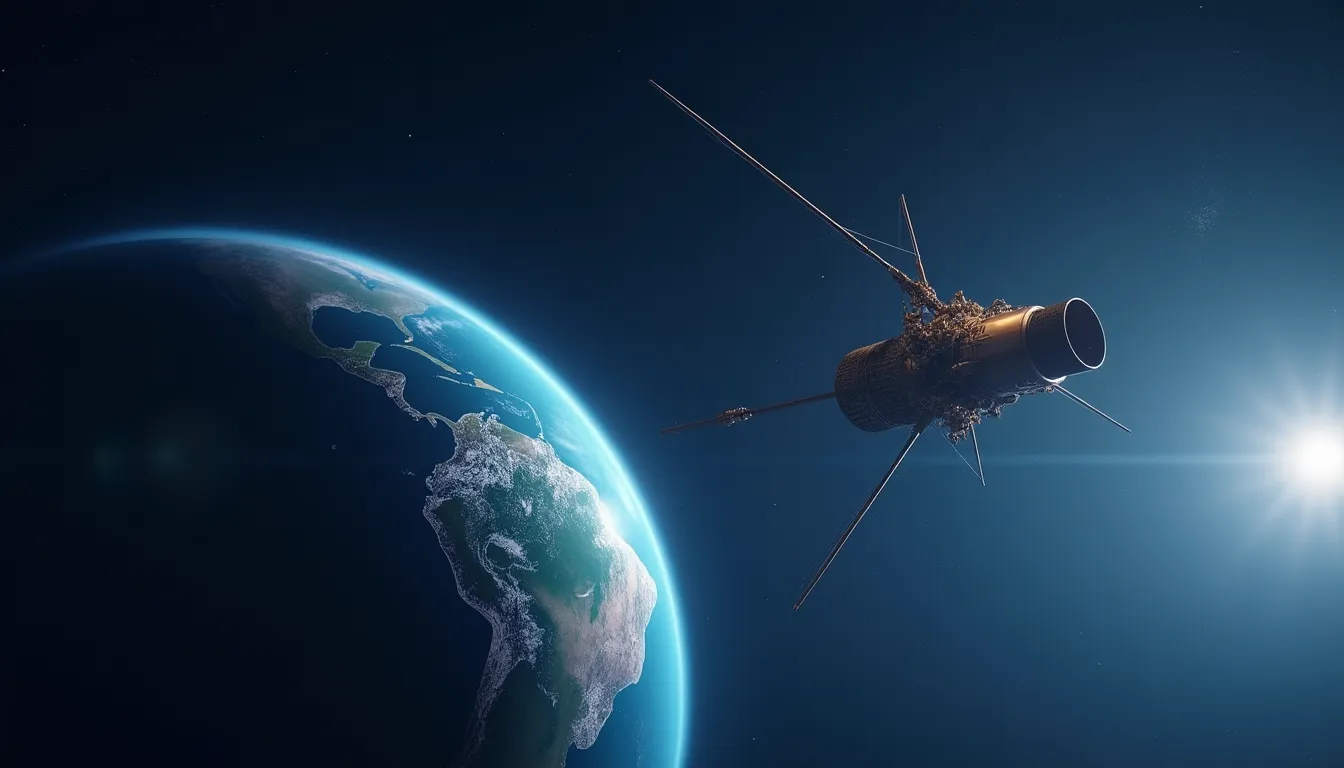
The aerospace sector is witnessing transformative developments as we enter 2026. Notably, SpaceX has unveiled a strategic plan to address the mounting challenge of space debris by lowering the altitude of approximately 4,400 Starlink satellites. Meanwhile, NASA is gearing up for critical operations aboard the International Space Station (ISS) and experiencing a leadership transition that could shape the agency’s future endeavors.
SpaceX’s Innovative Starlink Deorbit Plan
In a significant move aimed at curbing the risks associated with space debris, SpaceX announced plans to lower the operational altitude of its Starlink satellites from 550 km to 480 km throughout 2026. This decision is projected to reduce the orbital lifetime of the satellites by over 80%, thereby mitigating the risks posed by potential collisions with other objects in low Earth orbit (LEO).
According to SpaceX, this initiative follows a December 2025 incident where a Starlink satellite at 418 km altitude generated debris and lost communication. To counter these challenges, SpaceX executed 144,404 conjunction avoidance maneuvers between December 2024 and May 2025—an increase of over 200% compared to previous periods. The European Space Agency (ESA) reports alarming statistics, with more than 1.2 million objects larger than 1 cm currently in orbit, which could inflict catastrophic damage on operational satellites.
NASA’s Upcoming Spacewalks and Leadership Change
As SpaceX works to enhance satellite safety, NASA is preparing for two critical spacewalks scheduled for January 2026. These missions will focus on the installation of new solar arrays and other essential maintenance tasks aboard the ISS. Astronaut Brig. Gen. Nick Hague, a veteran of 374 days in space, officially retired in late December 2025, leaving behind a legacy of multiple extravehicular activities (EVAs).
In an important leadership transition, Jared Isaacman was sworn in as the 15th administrator of NASA in late December 2025. Isaacman is expected to steer the agency towards innovative projects, with the upcoming Crew-12 mission set to launch no earlier than February 15, 2026, featuring NASA astronauts Jessica Meir and Jack Hathaway among others.
Recent SpaceX Launches and Their Implications
SpaceX continues to expand its influence in the aerospace sector with recent launches that underscore its commitment to Earth observation and satellite deployment. In early January 2026, the Falcon 9 rocket successfully launched Italy’s Cosmo-SkyMed Earth observation satellite from Cape Canaveral. Additionally, the Starlink 6-88 mission added 29 satellites to its constellation, bringing the total to over 9,300 operational units, further enhancing global internet coverage.
The ongoing launches reflect SpaceX’s ability to rapidly scale operations while addressing the complexities of satellite traffic management and collision avoidance.
The End of the Akatsuki Venus Probe Mission
On a different front, Japan’s Akatsuki Venus probe mission has been officially declared over as of December 2025. Launched in 2010 and notable for being the first interplanetary mission equipped with solar sail propulsion, Akatsuki significantly advanced our understanding of Venus’s atmosphere. The probe lost communication in 2024, and while it provided invaluable data, no active orbiters remain to continue this line of inquiry.
Looking Ahead: The 2026 Outlook
As we progress through 2026, the aerospace industry is poised for a series of ambitious missions, including lunar flybys and new telescope launches by both governmental bodies and private enterprises. The evolving landscape of space exploration necessitates advanced technologies and systems, such as precision accelerometers and thermal battery systems, to ensure mission success and safety.
Innovations like the YWJ01ZB150 System, a professional gyro theodolite series, and the DBY021550M System, a mini lithium niobate optical chip, will play critical roles in navigation and data acquisition for upcoming space missions.
Conclusion
The recent developments in the aerospace and defense sectors signify a pivotal moment as both SpaceX and NASA adapt to the growing complexities of space management. With initiatives aimed at reducing space debris and preparing for groundbreaking missions, the future of space exploration is not only promising but also increasingly collaborative. As the industry navigates these changes, the integration of advanced technologies will be vital in ensuring the sustainability and safety of space activities.
References
-
SpaceX to lower thousands of Starlink satellites in 2026 as collisions rise, company says (www.euronews.com) - 1/4/2026 Starlink is going to gradually lower thousands of its satellites in 2026 due to space safety concerns, the company said. Approximately 4,400 …
-
Space Notes January 2026 - The Orkney News (theorkneynews.scot) - 1/4/2026 In a month when the heavyweight players in space have been relatively quiet, this is a good moment to take note of two important spacecraft …
-
Flying around the moon and launching telescopes. What will happen in the space industry in 2026? (en.ain.ua) - 1/4/2026 In 2026, global government agencies and private companies are preparing dozens of missions — from astronauts flying around the Moon to …
-
What’s Happening in Space Policy January 4-10, 2026 (spacepolicyonline.com) - 1/4/2026
-
2026 News Releases (www.nasa.gov) - 1/3/2026 2026 NASA News Releases. NASA to Preview US Spacewalks at Space Station in January. 3 min read. NASA astronauts will conduct a pair of …
-
Month: January 2026 (spaceflightnow.com) - 1/3/2026 SpaceX opens 2026 with launch of Cosmo-SkyMed Earth observation satellite for Italy · Launch pad issue delays again Falcon 9 launch of Italian …