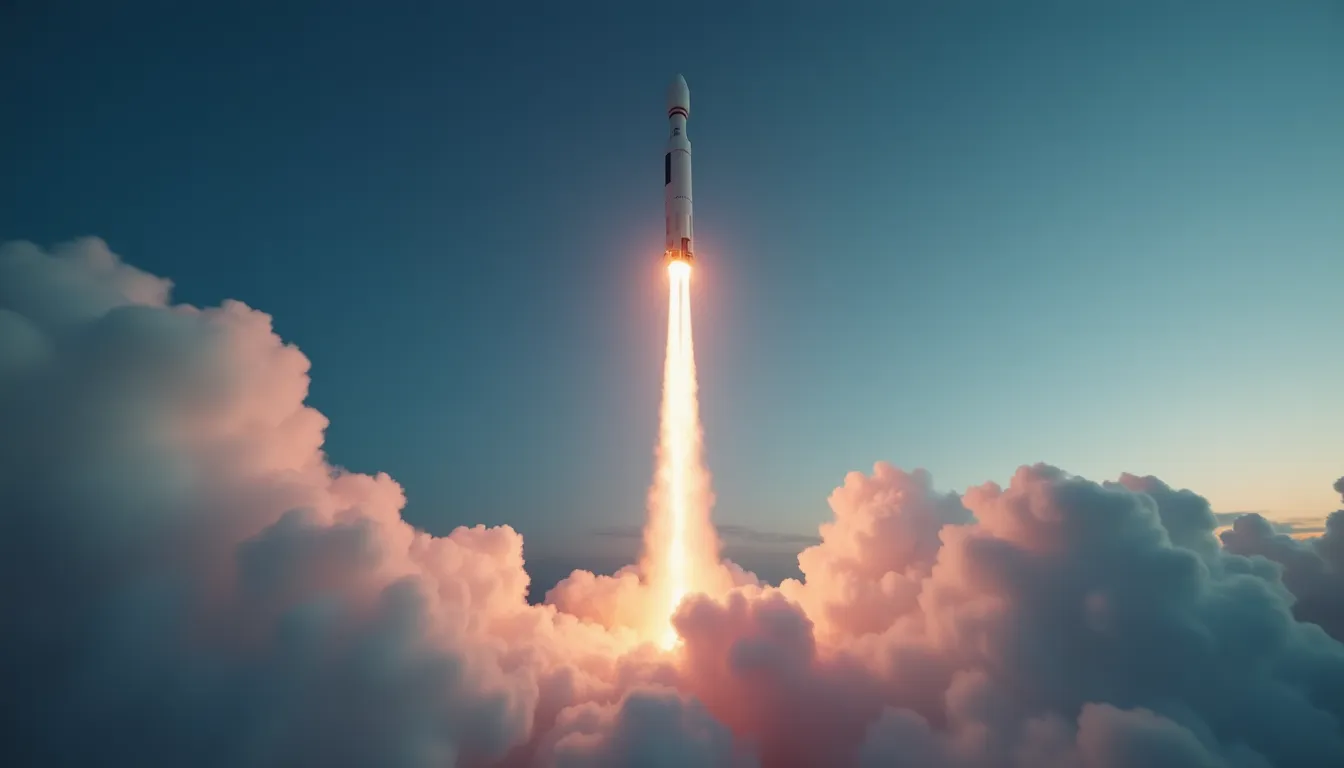
Recent months have witnessed a flurry of activity in the aerospace and defense sectors, particularly in spacecraft technology. With record-setting launches and innovative developments, 2025 is shaping up to be a pivotal year for space exploration. This article delves into the latest advancements, highlighting key launches, emerging technologies, and international collaborations that are paving the way for future missions.
SpaceX Sets New Milestones with Falcon 9
On December 8, 2025, SpaceX achieved a remarkable milestone by launching its 3,000th Starlink satellite aboard the Falcon 9 rocket during its 32nd flight. This mission not only saw the deployment of 28 additional satellites into low Earth orbit (LEO) but also marked the 575th overall launch of the Falcon 9 system. The rapid cadence of SpaceX’s satellite internet constellation deployment illustrates the company’s commitment to expanding global connectivity through advanced navigation systems.
The Maiden Voyage of Japan’s H3 Rocket
In late November 2025, Japan’s new H3 rocket, developed by Mitsubishi Heavy Industries in collaboration with the Japan Aerospace Exploration Agency (JAXA), successfully completed its maiden flight. This significant launch carried the first HTV-X cargo resupply mission to the International Space Station (ISS), marking the 300th mission to the station. In addition to resupplying the ISS, the H3 rocket deployed multiple small satellites, including CORAL, Gxiba-1, and KNACKSAT-2, demonstrating the rocket’s versatility for various payload types.
Russian Advancements with Soyuz-2.1a
On December 11, 2025, Roscosmos successfully launched the Soyuz-2.1a rocket, deploying the Obzor-R №1 Earth observation satellite into a sun-synchronous orbit (SSO). This launch underscores Russia’s ongoing commitment to monitoring Earth’s environment and resources, utilizing advanced satellite technologies to contribute to global data accessibility.
Pioneering New Rocket Technologies
Several companies are making strides in rocket technology, promising to reshape the future of space missions:
- Blue Origin: The New Glenn rocket, a two-stage heavy-lift launch vehicle, had its inaugural flight in January 2025. This reusable rocket is designed to support a variety of missions, including potential Mars-bound payloads, underscoring the shift toward sustainable space travel.
- Rocket Lab: The upcoming Neutron rocket is set to make its debut from Wallops, Virginia in 2025. This two-stage rocket aims to enhance payload capacity for small satellite launches.
- Rocket Factory Augsburg: The RFA One rocket is poised to launch from the SaxaVord Space Port, designed to deliver payloads to lunar transfer orbits, reflecting the growing interest in lunar exploration.
- European Space Agency (ESA): ESA is testing the Space Rider system, a recoverable orbital platform for long-term experiments in LEO, which could play a crucial role in future scientific research missions.
International Collaboration in Space Science
NASA and its international partners continue to advance planetary science missions. Notably, the Sentinel-6B ocean topography satellite was launched by SpaceX, contributing valuable data on sea level rise and climate change. Meanwhile, the Juno mission to Jupiter is scheduled to conclude in 2025 by entering the gas giant’s atmosphere, marking a significant milestone in our understanding of the solar system.
In India, the Indian Space Research Organisation (ISRO) is preparing for its first uncrewed Gaganyaan capsule demonstration flight with the LVM 3 rocket, paving the way for a crewed mission by 2026. This initiative highlights India’s growing capabilities in human spaceflight.
Future Space Stations and Policy Developments
As the geopolitical landscape in space evolves, all ISS partners except Russia are collaborating on the development of a new, smaller international space station intended to orbit the Moon. This initiative reflects a shift in priorities and partnerships, aiming to enhance international cooperation in lunar exploration.
Conclusion
The advancements in spacecraft technology and the collaborative efforts seen in the aerospace sector represent a new era of exploration and innovation. As we look forward to 2025 and beyond, the integration of emerging technologies such as high-performance MEMS accelerometers and precision navigation systems will play a critical role in ensuring the success of upcoming missions. The commitment to developing sustainable and advanced spacecraft systems promises to unlock new possibilities for scientific discovery and international collaboration in space.
With the rapid pace of development, the future of space exploration appears brighter than ever, with fresh opportunities on the horizon for both governmental and private space endeavors.
References
-
December 2025 - Spaceflight Now (spaceflightnow.com) - 12/9/2025 SpaceX launches 3,000th Starlink satellite in 2025 on record-setting 32nd flight of Falcon 9 booster · SpaceX launches 28 Starlink satellites on Falcon 9 rocket …
-
What’s Happening in Space Policy December 7-13, 2025 (spacepolicyonline.com) - 12/8/2025 All the partners except Russia are now developing a new international space station, much smaller than this one, that will orbit the Moon as …
-
321 Launch: Space news you may have missed over the past week … (www.floridatoday.com) - 12/8/2025 Launch recap: Scroll down to review live updates from the Tuesday, Dec. 2, liftoff of a SpaceX Falcon 9 rocket from Cape Canaveral on the …
-
Space Brief 7 Dec 2025 - KeepTrack (keeptrack.space) - 12/7/2025 Today’s highlights include a record-breaking event at the International Space Station, significant funding for hypersonic missile production …
-
What’s Up: December 2025 Skywatching Tips from NASA (science.nasa.gov) - 12/1/2025 The 3I/ATLAS comet makes its closest approach to Earth, the Geminid meteor shower sparkles across the sky, and the Moon and Jupiter get close …
-
Space calendar 2025: Rocket launches and skywatching dates (www.space.com) - 8/14/2025 December 8, 5:26 p.m. EST (2226 GMT): A SpaceX Falcon 9 rocket will launch a batch of Starlink satellites into low-Earth orbit (LEO), from Launch Complex-39A ( …
-
List of spaceflight launches in October–December 2025 - Wikipedia (en.wikipedia.org) - 5/5/2025 This article lists orbital and suborbital launches planned for the fourth quarter of the year 2025, including launches planned for 2025 without a specific …
-
2025 NASA News Releases (www.nasa.gov) - 4/11/2025 NASA astronaut Chris Williams will launch aboard the Roscosmos Soyuz MS-28 spacecraft to the International Space Station on Thursday, Nov. 27, accompanied by …
-
Space in 2025: What to Expect - SETI Institute (www.seti.org) - 2/11/2025 This year is set to bring many exciting and pivotal moments for space exploration, from private lunar missions to groundbreaking telescopic observations.
-
Space Missions to Watch in 2025 - Sky & Telescope (skyandtelescope.org) - 1/5/2025 Space-weather sentinels, commercial lunar missions, and lots of planetary flybys are on tap this year.