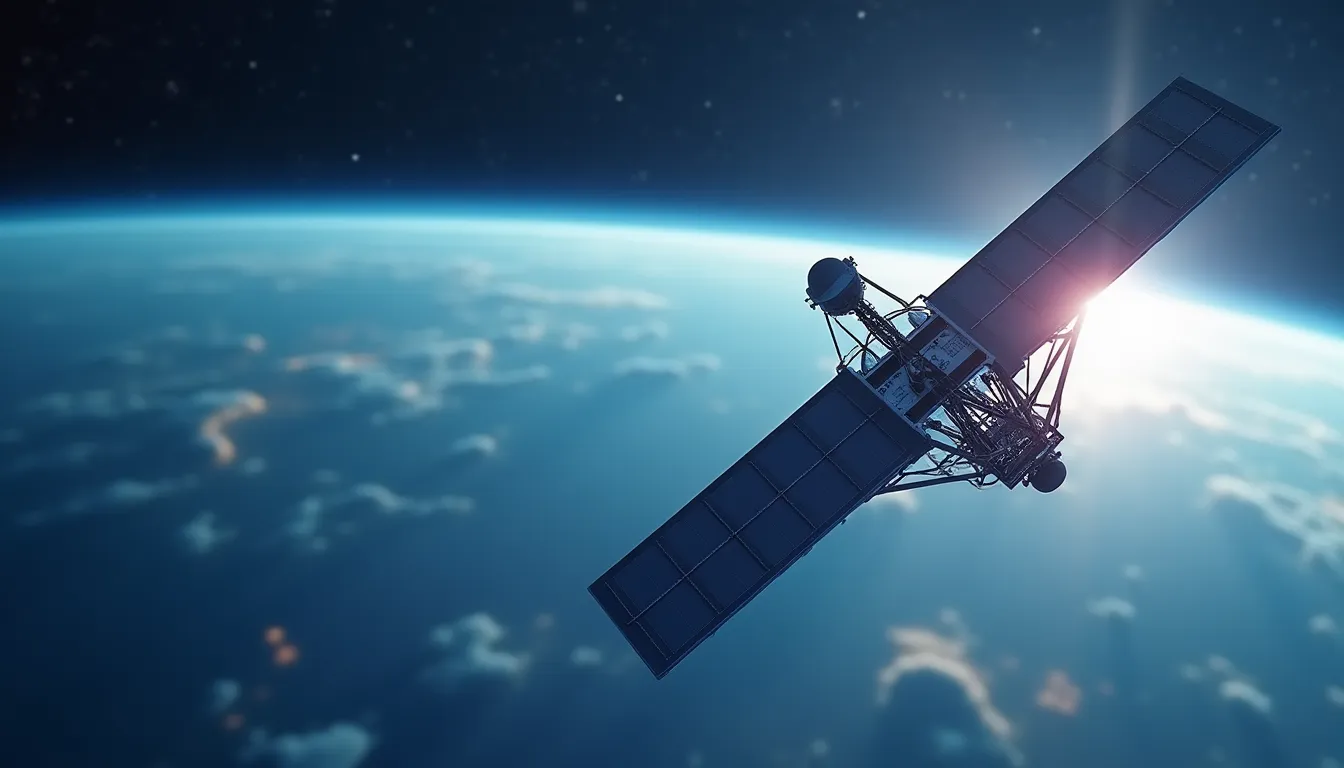
The satellite sector is undergoing a remarkable transformation, driven by innovations in connectivity, deep space communications, and on-orbit servicing technologies. These advancements not only promise to enhance global telecommunications but also pave the way for more robust space exploration initiatives. In this article, we delve into the latest developments reshaping the aerospace and defense industries.
Satellite Direct-to-Device (D2D) Connectivity Progress
One of the most significant strides in the satellite sector is the development of Direct-to-Device (D2D) connectivity technology. Lynk Global has made headlines with successful demonstrations of its patented D2D technology across multiple countries. Most recently, a campaign in Türkiye, in collaboration with Turkcell, showcased the potential to enhance mobile coverage and network resiliency by enabling direct satellite-to-cellphone connections.
This technology is particularly groundbreaking as it allows standard mobile phones to connect directly to satellites without the need for specialized hardware. As noted by Lynk’s CEO, “Our D2D connectivity is a game-changer for remote and underserved areas, where traditional ground infrastructure is lacking.”
In Brazil, Claro completed pilot tests earlier in 2025, expanding direct satellite connections to smartphones as part of a broader initiative to improve connectivity in underserved regions. Similarly, in Portugal, Lynk partnered with MEO, a leading telecom operator, to further demonstrate D2D capabilities. These efforts highlight an emerging trend towards integrating satellite networks directly with consumer mobile devices, bypassing traditional infrastructures altogether.
Breakthroughs in Deep Space Optical Communications
On the frontier of space communication technology, NASA’s Deep Space Optical Communications (DSOC) experiment aboard the Psyche spacecraft has achieved unprecedented success. This groundbreaking experiment has demonstrated the ability to transmit data at broadband internet speeds from over 307 million miles away, setting a new record for optical communication distance.
The DSOC technology utilized laser communication, achieving data rates of 267 Mbps, which is a remarkable improvement compared to conventional radio frequency systems. During its operation, the technology successfully streamed ultra-high-definition video and transmitted 13.6 terabits of data, showcasing its potential for high-bandwidth communication with Mars and future deep space missions. As stated by a NASA engineer, “This technology represents a significant leap forward, making faster and more efficient data transfer over vast distances a reality.”
China’s Satellite Internet Test Launch
In a significant move toward enhancing its satellite internet capabilities, China successfully launched a test satellite for satellite internet technology on September 16, 2025, from the Jiuquan Satellite Launch Center using a Long March-2C rocket. This launch marks the 595th flight in the Long March series, underscoring China’s commitment to advancing its satellite infrastructure.
The test satellite is part of a broader initiative aimed at expanding satellite internet access across the nation, reflecting global trends in the commercialization of space-based internet services. This initiative not only reinforces China’s technological prowess but also aligns with global efforts to bridge the digital divide.
Innovations in On-Orbit Servicing and Rendezvous Proximity Operations (RPO)
As the demand for satellite servicing and debris management grows, companies like Anduril and Impulse Space are leading the charge with their plans for Rendezvous Proximity Operations (RPO) missions in geosynchronous orbit (GEO) slated for 2026. These missions will leverage autonomous software and edge processing to overcome typical communication challenges in GEO, such as radiation exposure and signal latency.
The centerpiece of these missions will be Impulse Space’s Mira spacecraft, which was first launched in 2023. The spacecraft will utilize advanced software platforms for rapid data sharing and autonomous management, making it a pivotal player in the future of satellite servicing. As highlighted by an Impulse Space representative, “Our approach to RPO reflects a growing industry focus on extending the life cycle of satellites and managing orbital debris effectively.”
Commercial and Research Satellite Initiatives
In the commercial space sector, Axiom Space has announced the formation of a Global Space Research Alliance aimed at promoting scientific research in orbit. This initiative marks a significant shift from government-led space exploration to a more commercial approach. Axiom intends to deploy a 60-satellite constellation by 2028, bolstered by a funding commitment of $100 million.
This constellation will support microgravity research and commercial space station activities, indicating a robust investment in orbital research infrastructure. As Axiom’s CEO stated, “We are on the cusp of a new era in space research, where collaboration between commercial entities and scientific communities will drive innovation.”
Conclusion
The advancements in satellite technology reflect a broader trend toward enhanced connectivity, efficient space communications, and innovative servicing solutions. As companies and governments invest in these technologies, the satellite landscape will continue to evolve, opening new avenues for exploration and connectivity. The future of satellite communications not only holds promise for global telecommunications but also for the ambitious goals of space exploration, ensuring that humanity remains connected, no matter how far we venture into the cosmos.
References
-
September 2025 - Spaceflight Now (spaceflightnow.com) - 9/19/2025 SpaceX scrubs launch of 24 Starlink satellites from Vandenberg SFB for a second day · September 16, 2025 Will Robinson-Smith.
-
NASA’s Deep Space Communications Demo Exceeds Project … (www.jpl.nasa.gov) - 9/18/2025 NASA’s Deep Space Communications Demo Exceeds Project Expectations. Jet Propulsion Laboratory https://www.jpl.nasa.gov/ Sept. 18, 2025.
-
Anduril and Impulse Space Plan to Run RPO in Geosynchronous … (www.satellitetoday.com) - 9/18/2025 Anduril and Impulse Space Plan to Run RPO in Geosynchronous Orbit Next Year. By Frank Wolfe | September 18, 2025. Facebook …
-
The Space Advocate Newsletter, September 2025 (www.planetary.org) - 9/17/2025 The Space Advocate Newsletter, September 2025. This month. Space advocate cover capitol stars. Who’s in charge of space policy?
-
Same-day delivery comes to space, as Impulse promises satellite … (techcrunch.com) - 9/17/2025 Amazon made same-day delivery the benchmark on Earth. Impulse Space is pitching a similar concept for satellites bound for geostationary …
-
China successfully launches test satellite for satellite internet … (english.www.gov.cn) - 9/16/2025 China successfully sent a test satellite for satellite internet technology into space from the Jiuquan Satellite Launch Center, located in the country’s northwest, on Tuesday. … Updated: September 16, 2025 16:20 Xinhua. A Long …
-
What’s Happening in Space Policy September 14-20, 2025 (spacepolicyonline.com) - 9/15/2025 Here is SpacePolicyOnline.com’s list of space policy events for the week of September 14-20, 2025 and any insight we can offer about them.
-
2025 NASA News Releases (www.nasa.gov) - 4/11/2025 NASA, Northrop Grumman, and SpaceX are targeting no earlier than 6:11 p.m. EDT, Sunday, Sept. 14, for the next launch to deliver science investigations, …
-
News - Lynk Global (lynk.world) - 2/9/2023 September 14, 2025. Lynk Global CEO Ramu Potarazu on life after SPAC. Lynk Global. Only a bold satellite operator takes on SpaceX, especially in the nascent …
-
News - Payload Space (payloadspace.com) - 10/24/2021 The round brings Hubble’s total funding to $100M, which will fund the deployment of a 60-sat constellation by 2028. September 17, 2025 September 17, 2025.