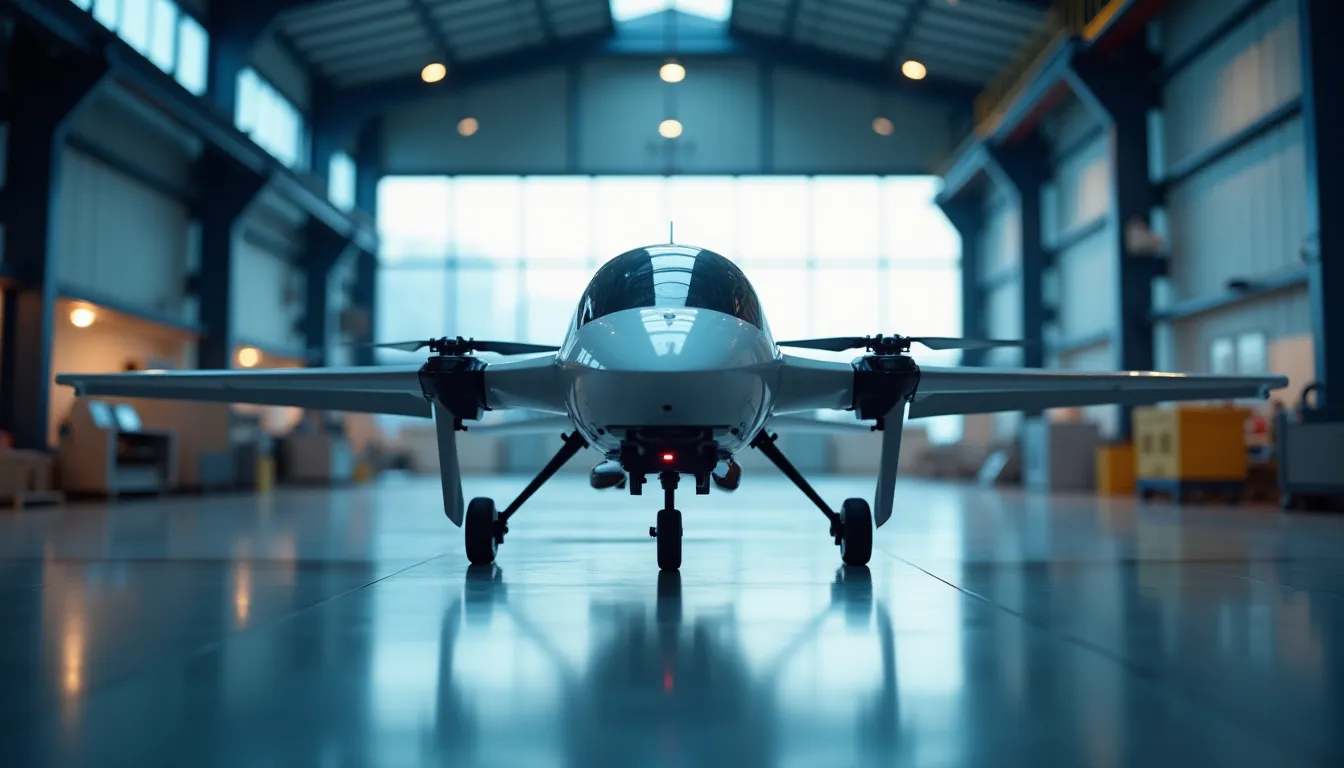
The aerospace industry is undergoing a seismic shift towards sustainability, driven by innovations in electric and hybrid-electric aircraft technology. With a focus on reducing carbon emissions and improving fuel efficiency, several key projects are emerging from the aerospace, defense, and technology sectors, marking significant milestones in aviation history.
Recent Developments in Electric Aircraft
Recent advancements reflect a robust commitment to cleaner aviation. From RTX’s hybrid-electric demonstrator targeting improved fuel efficiency to the U.S. Air Force’s testing of Beta Technologies’ Alia electric aircraft, the momentum towards sustainable aviation is palpable.
RTX Hybrid-Electric Flight Demonstrator
RTX is leading the charge with its hybrid-electric flight demonstrator designed to achieve up to 30% fuel savings compared to conventional regional turboprop aircraft. Utilizing a combination of a thermal engine and a 250-kilowatt electric motor, this innovative aircraft is based on the modified De Havilland Canada Dash 8-100. The ground testing phase has seen the propulsion system and batteries successfully operate at full power for the first time, a crucial step forward in the development timeline.
This project is backed by significant funding from the Canadian federal government, the Quebec provincial government, and key industry partners, including Pratt & Whitney Canada and Collins Aerospace. As the project continues, hardware installation will commence in collaboration with AeroTEC in Moses Lake, Washington, in the coming year.
U.S. Air Force’s Alia Electric Aircraft
In a pivotal move towards sustainable military operations, the U.S. Air Force has begun testing Beta Technologies’ Alia electric aircraft. This zero-emission aircraft aims to assess endurance, payload capacity, and reliability in diverse operational conditions. Such testing is integral to exploring sustainable alternatives for military aviation, aligning with global efforts to reduce carbon footprints in defense operations.
DARPA’s XRQ-73 Hybrid-Electric Demonstration
Another noteworthy achievement is DARPA’s successful demonstration of the hybrid-electric XRQ-73 aircraft. This project validates the military utility of hybrid-electric propulsion systems, showcasing their potential for future defense applications. By integrating both thermal and electric power sources, the XRQ-73 enhances versatility and operational efficiency, setting a precedent for the evolution of military aircraft.
Innovative Technologies Shaping the Future
The trajectory of electric and hybrid-electric aircraft is supported by cutting-edge technology, enhancing performance and operational capabilities.
Heart Aerospace ES-30
Air Canada has placed a significant order for 30 hybrid-electric ES-30 aircraft, anticipated to replace the earlier 19-seat ES-19 model. This 30-passenger electric aircraft is on track for full-scale testing in 2024, with actual flight trials scheduled for 2026. Notably, the ES-30’s charging time is remarkably efficient, requiring only 30–50 minutes to recharge, which is crucial for commercial viability.
Electra Hybrid Aircraft
The Electra hybrid aircraft, undergoing testing at the Marine Corps Air Station Quantico, showcases the integration of chemical and electrical energy sources. This innovative design not only optimizes efficiency but also offers the capability to serve as a portable power source in various operational contexts.
Advancements in Propulsion and Efficiency
The evolution of electric aircraft also hinges on significant advancements in propulsion technologies. The emergence of permanent magnet synchronous motors (PMSM) and superconducting materials is paving the way for higher power density and greater efficiency in aviation systems.
For instance, the ZeroAvia hydrogen-electric engine, which had its first flight on the Dorne 228 test aircraft, emphasizes the feasibility of hydrogen-electric propulsion. This technology could revolutionize the industry by providing an alternative to traditional fossil fuel reliance.
Key Benefits of Electric Aircraft
- Fuel Efficiency: RTX’s goal of a 30% improvement in fuel efficiency highlights the potential reductions in operational costs.
- Noise Reduction: Hybrid-electric aircraft are substantially quieter during takeoff and landing, addressing noise pollution concerns in urban areas.
- CO₂ Reduction: The adoption of electric powertrains and higher battery density technologies could lead to lifecycle CO₂ reductions of approximately 50%.
The Road Ahead
As electric and hybrid-electric aircraft technologies continue to evolve, the aerospace industry stands on the brink of a new era. With projected timelines for 6–9 seat electric options emerging between 2022 and 2025, and regional aircraft anticipated by 2030–2035, the future of aviation is decidedly green.
Conclusion
The advancements in electric and hybrid-electric aircraft technology signify a transformative period in aviation, aiming for reduced environmental impact while enhancing operational efficiencies. As industries and governments invest in these innovations, the potential for sustainable aviation appears promising. The integration of advanced navigation systems, precision accelerometers, and high-performance control systems will further bolster the operational capabilities of these next-generation aircraft, ensuring that the skies are not only revolutionized but also made cleaner for future generations.
References
-
Electrified Aircraft Propulsion - NASA (www.nasa.gov) - 6/10/2026 Electrified Aircraft Propulsion (EAP) offers new possibilities for improving efficiency and reducing energy consumption in aviation.
-
DARPA XRQ-73 demonstrates hybrid-electric flight (www.darpa.mil) - 5/6/2026 This flight is a step forward in demonstrating the military utility of hybrid-electric propulsion. Hybrid electric propulsion architectures will …
-
The Future of Hybrid Electric Aircraft | Amprius Technologies (amprius.com) - 5/3/2026 Advances in battery technology can increase HEAs’ range and allow longer flights without refueling. Other aspects of HEAs are evolving too. In September 2022, Air Canada placed a purchase order for 30 hybrid-electric aircraft from Swedish manufacturer Heart Aerospace. Those planes are expected to take 30 to 50 minutes to charge. … The previously mentioned Heart ES-30 is a 30-passenger electric aircraft, replacing the company’s earlier 19-seat design, the ES-19. However, it has yet to be thoroughly tested. … As for the ES-30, a full-scale integrated test facility with a full-flight simulator of the ES-30 has been built. A proof-of-concept aircraft is expected to be rolled out in 2024, with flight testing planned to start in 2026. … Researchers are developing more efficient electric motors, optimizing the integration of electric and traditional propulsion systems, and creating aerodynamic designs that can reduce drag and improve efficiency. … Many experts believe that hybrid and electric aircraft will eventually be a reality. And they think that we will first see HEAs in use in smaller settings. Airline leaders are first planning to use early hybrid or electric-only planes for short, urban commuter routes as an important first step toward scalable technologies. Aerospace engineer and assistant professor Gökçin Çınar spoke to The Conversation about the future of electric planes, noting there are fuel burn benefits from batteries in larger jets by using hybrid propulsion systems. She mentions a 2030-2035 target for smaller regional aircraft. She adds that using batteries as a power assist during takeoff and climb is a promising option. She sees hybridization as a mid-term option for larger jets but a near-term solution for regional aircraft. … Finally, HEAs are quieter than conventional aircraft, especially on takeoff and landing with battery assist, which could reduce noise pollution in and around airports.
-
RTX’s hybrid-electric plane is one step closer to the sky (www.rtx.com) - 3/3/2026 The RTX Hybrid-Electric Flight Demonstrator aims to improve fuel efficiency by up to 30%. Aerospace 250-kilowatt electric motors and … That creation was an early version of the RTX Hybrid-Electric Flight Demonstrator’s experimental propulsion system for a regional aircraft. It will pair a thermal engine with an electric motor – and, the team hopes, tap into a new era of fuel efficiency for aviation. The project is supported by the Canadian federal government and provincial government of Quebec along with a range of partners across industry and academia. … The goal of the project is to show a 30% improvement in fuel efficiency compared to today’s most advanced regional turboprops. The team also hopes the project will show what’s possible in designing future aircraft. … The RTX Hybrid-Electric Flight Demonstrator is a collaboration between Pratt & Whitney Canada, Collins Aerospace and industry partners that aims to improve fuel efficiency by up to 30%. The hybrid-electric propulsion system will fly on a modified De Havilland Canada Dash 8-100 regional turboprop aircraft. The project recently passed a significant milestone when it successfully operated the propulsion system and batteries at full power for the first time. … This hybrid-electric propulsion system, part of an EU Clean Aviation project led by Pratt & Whitney Canada with support from Collins Aerospace, has a goal of improving fuel efficiency by 20% on regional flights. … Over the next year, the RTX Hybrid-Electric Demonstrator team will continue ground testing and begin working with AeroTEC in Moses Lake, Washington, to install hardware on the aircraft.
-
US Air Force Testing New Futuristic Hybrid-Electric Aircraft for The … (www.youtube.com) - 12/21/2025 Welcome back to the Fluctus Channel, as we explore the rise of electric, hybrid, and hydrogen powered aircraft shaping the future of both … {ts:83} lineup of four aircraft models to include an electric option. … As part of a pioneering effort to {ts:178} advance [music] environmentally responsible aviation, the United States Air Force began testing the Beta {ts:184} Technologies Alia electric aircraft. [music] Beta Technologies, [music] renowned for {ts:192} its commitment to innovative electric aviation solutions, developed the Aliia with a primary [music] focus on zero {ts:199} emission operations. [music] Delivering the Aliyia to the USAF {ts:210} represents a milestone [music] in exploring sustainable military aircraft alternatives. … {ts:240} The USAF testing program will assess its endurance, payload, and reliability across diverse conditions. … {ts:425} Alongside purely electric aircraft, hybrid designs are also emerging. Electra is a sophisticated hybrid {ts:434} aircraft undergoing trials at Marine Corps Air Station Quantico. It integrates chemical and electrical {ts:442} energy sources, optimizing efficiency and environmental performance. Its dual power systems allow operation … Notably, Electra can serve as a portable … On January 19, 2023, [music] {ts:645} Zerowavia successfully conducted the first flight of its Dorne 228 test aircraft equipped with a prototype ZA600 {ts:654} hydrogen electric engine on the left side. This milestone demonstrates the [music] {ts:662} practical feasibility of hydrogen electric propulsion in aviation, marking a key step toward zero emission … … {ts:916} The rapid development of [music] electric, hybrid, and hydrogen-powered aviation signifies a pivotal moment in {ts:924} aerospace [music] history. Starting with light trainers like the Pipistral Vellis Electro, [music] {ts:933} innovation has expanded to ambitious military testing, sophisticated hybrid aircraft, and hydrogen [music]
-
Advancements in Electric Aircraft Propulsion Technology - ZeroAvia (zeroavia.com) - 4/29/2025 *Electric aircraft engines can deliver cleaner and quieter flight, reduced dependency on fossil fuels and enhanced operational efficiency and …
Electric aircraft use electricity as their source of propulsion, often using an electric motor combined with a power source, such as hydrogen fuel cells or batteries.
Electric aircraft engines can deliver cleaner and quieter flight, reduced dependency on fossil fuels and enhanced operational efficiency and cost savings. Advancements in electric propulsion technology will enable applications for electric fixed wing aircraft, rotorcraft, Unmanned Aerial Vehicles, eVTOLs and clean sheet designs. … The latest permanent magnet synchronous electric motor (PMSM) technologies deployed in automotive and other sectors are being pushed even further to deliver aerospace level capability. PMSMs offer numerous advantages, as they deliver greater efficiency and heat transfer, higher specific power and speed, reduced noise, greater compactness and increased life spans. …
A key feature of emerging electric motor technologies for aviation is their scalability, such that many motors can be used in tandem to enable a higher total power output, ultimately enabling the electrification of larger commercial aircraft.
… Developments using superconducting material or high purity metals are other avenues that may allow increases in specific power – super conducting materials exhibit zero electrical resistance below a critical temperature. When superconducting materials are used in the rotor or stator components, they have virtually no electrical resistance to steady current, meaning they can carry up to 100x more current density that copper conductors at room temperature. … It’s clear that electric aviation will bring many advantages for a new era of flight, yet advancements in several areas will be necessary for their widespread commercial adoption. These include: infrastructure development i.e., battery charging, hydrogen production or grid integration; policy and regulatory advancements and technological developments in energy and fuel storage and electric motor technology.*
-
Pushing the envelope on electric aircraft technologies (aerospaceamerica.aiaa.org) - 12/1/2024 The year’s milestones in electrified aviation technologies included advances in high-power electrical systems, first flights of various novel … The year’s milestones in electrified aviation technologies included advances in high-power electrical systems, first flights of various novel aircraft concepts and committed support from industry and government stakeholders to continue developing electric flight technologies. … May marked the first flight of a distributed electric propulsion demonstrator developed under the* European Union Clean Sky 2** research program. … This year also saw the introduction of several new** fully electric aircraft concepts ** configured to serve commercial markets. … In March, Whisper Aero of Tennessee revealed its Whisper Jetliner, a 100-passenger aircraft intended to serve markets up to 769 miles (1,238 km).*
-
When will commercial electric aircraft become a reality? (aviationbenefits.org) *Electric aircraft are already flying on a small scale, in training flights and two-person operations. It is a rapidly developing area of research. Small electric planes are already flying, but more research is needed to make the technology available for commercial flight. The challenge for passenger planes is creating electric batteries which are energy dense, yet light enough to be carried onboard. In the meantime, hybrid-electric planes, which use both electric power and liquid fuel, offer a viable solution. … While fully electric commercial aircraft are still some way off, hybrid-electric aircraft, which pairs electrification with traditional jet fuel, are currently being prototyped by some of the biggest players in the aerospace industry
- Small battery-powered electric aircraft already exist and are used in training flights and two-person operations … As next-generation planes become lighter and more aerodynamic, and as battery energy density improves, battery-powered flights could be a not-so-distant reality. … Electric aircraft are already flying on a small scale, in training flights and two-person operations. It is a rapidly developing area of research, with over 100 projects underway in different parts of the world to explore options for using either electric or hybrid-electric propulsion. … We can expect to see six- to nine-seat electric options introduced between 2022 and 2025, and up to 19-seat options emerge around 2030. … While these fully electric commercial aircraft are still some way off from widespread commercial use, hybrid-electric aircraft, which pairs electrification with traditional jet fuel, are currently being prototyped by some of the biggest players in the aerospace industry. … In simple terms, hybrid-electric aeroplanes are powered by liquid jet fuel combined with an electric battery. … A recent study from the Department of Aerospace Engineering at the University of Illinois’ College of Engineering found that a propulsion system that uses a 50% electrical-power drivetrain and has a battery energy density of 1,000 watt-hours per kilogram would produce almost 50% less lifecycle CO2 emissions than a modern conventional aircraft with a maximum range equivalent to that of the average of all global flights. This makes it a viable option for low carbon aviation.*
-
Home | Electra (electra.aero) Electra is building a new category of aircraft that can take off and land in just 150 feet. It’s a whole new way to travel – simpler, faster, and without the … Contact (703) 479-7870 Contact Us … 10761 James Payne Court, Manassas, VA, 20110
-
List of electric aircraft - Wikipedia (en.wikipedia.org) - 12/30/2016 This is a list of electric aircraft, 2024 Prototype. Aerospace eFlyer 2 United States Fixed Wing Battery 2016 Project Cessna 172 electric United States. Alice …