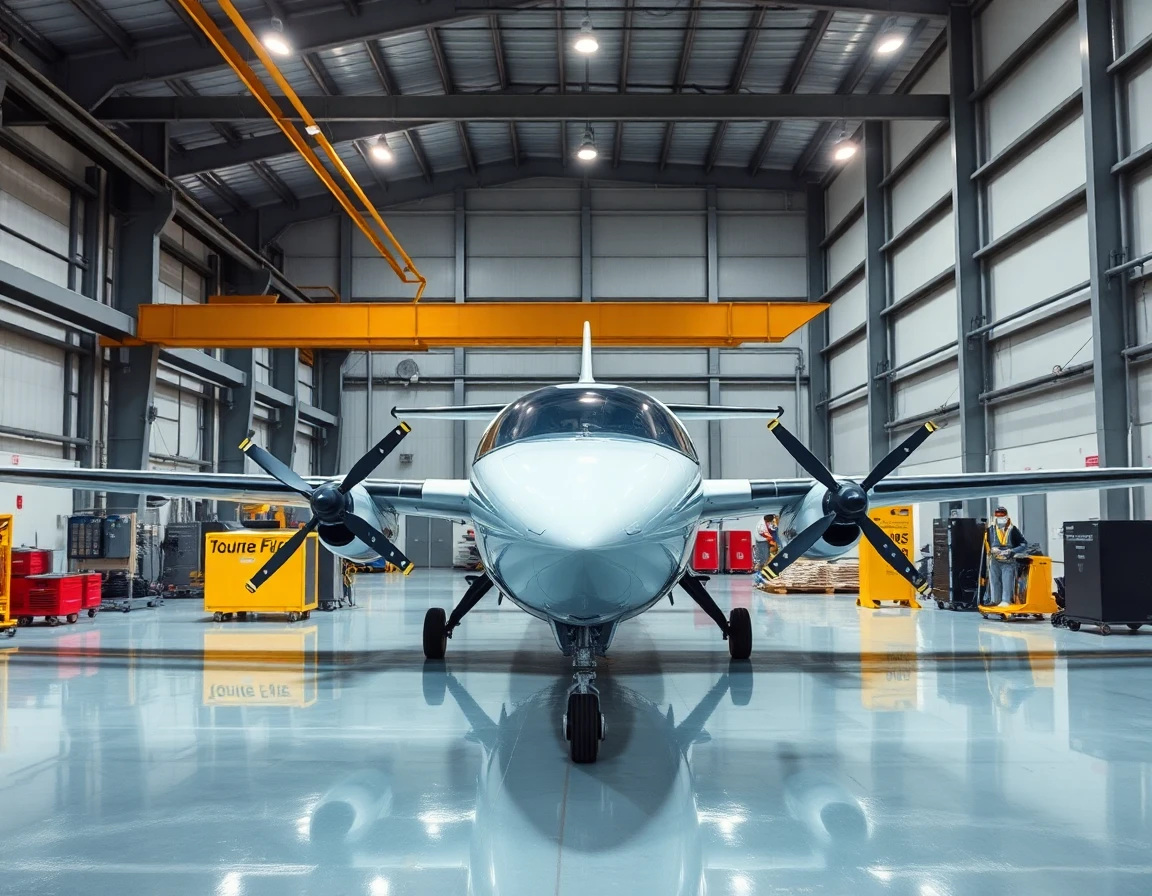
The aerospace industry is stepping into a transformative phase as hybrid-electric aircraft gain traction, and RTX (formerly Raytheon Technologies) has recently made significant strides in this domain. With the successful operation of its full-power propulsion system and battery pack, RTX is poised to enhance fuel efficiency in regional aviation by up to 30%, potentially revolutionizing the sector.
RTX Hybrid-Electric Flight Demonstrator
The Hybrid-Electric Flight Demonstrator, a project backed by the Canadian federal government and Quebec provincial government, highlights RTX’s commitment to advancing aviation technology. This ambitious initiative integrates a thermal engine from Pratt & Whitney Canada with a cutting-edge 1-megawatt electric motor from Collins Aerospace, alongside a 200-kilowatt-hour battery system developed by startup H55, supported by RTX Ventures.
Milestone Achievement
Recently, RTX achieved a critical milestone by operating this innovative propulsion system and its associated batteries at full power for the first time. This accomplishment validates the experimental propulsion system’s viability for regional aircraft and sets the stage for further developments. The next phase will involve extensive ground testing and the installation of the hardware on a modified De Havilland Canada Dash 8-100, facilitated by AeroTEC in Moses Lake, Washington. This project aims to demonstrate a substantial 30% improvement in fuel efficiency compared to current advanced regional turboprops, marking a significant leap in aviation fuel economy.
Implications for the Military Sector
Meanwhile, the defense and military aviation sectors are increasingly pivoting toward hybrid-electric concepts. Unlike fully electric designs, hybrid systems offer a blend of traditional fuel efficiency and the stealth benefits of electric propulsion. These innovations are particularly appealing for military applications, where quieter operations and enhanced autonomy are critical.
Military Applications and Strategic Goals
Developers are focusing on hybrid and fully electric aircraft—both manned and unmanned—that promise quieter missions and better thermal signature management, making them less detectable by enemy forces. One notable example is the Nuuva V300, a long-range hybrid-electric aircraft that is moving away from all-electric designs due to the limitations imposed by battery energy density in expansive military operations.
Key Technical Innovations
Several technical innovations are driving the hybrid-electric aviation sector:
- Distributed Electric Propulsion (DEP): This technology allows for multiple smaller propulsors to be distributed across the aircraft’s wings and airframe, replacing the need for one or two large engines. This configuration can significantly enhance lift and runway performance.
- Scalable Motors: The development of Permanent Magnet Synchronous Motors (PMSM) is crucial, as these motors are more efficient and compact, paving the way for the electrification of larger commercial aircraft.
- Energy Recovery Systems: Electric propulsion can enable propellers to act as generators during descent, thereby recovering energy and extending the aircraft’s endurance.
- Coaxial Rotor Technology: Used in eVTOL aircraft, this design maximizes thrust while minimizing footprint, increasing thrust density by up to 20% and simplifying mechanical linkages through electronic RPM control.
Future Outlook and Industry Trends
The shift towards hybrid-electric systems is becoming increasingly prominent, especially in the context of regional aviation where short urban commuter routes demand quick turnaround times. For instance, Heart Aerospace’s ES-30, a 30-passenger aircraft targeting 2026 for flight testing, exemplifies the growing momentum in this sector. The viability of charging times as short as 30 to 50 minutes is becoming a reality, thanks to advancements in thermal battery systems and innovative electric propulsion technologies.
Challenges and Opportunities
Despite the promising advancements, challenges remain, particularly concerning energy density and battery technology. As hybrid systems are prioritized for larger aircraft, the industry must continue to explore breakthroughs in battery efficiency and superconducting materials to facilitate future all-electric flights. Integrating technologies such as blown-lift and distributed propulsion will be critical in achieving ultra-short takeoff and landing capabilities, which can redefine the urban air mobility landscape.
Conclusion
The recent achievements by RTX in hybrid-electric aviation signify not just a technical milestone but a shift towards a more sustainable and efficient future for regional air travel. As the industry embraces these innovations, the potential for enhanced fuel efficiency and reduced environmental impact becomes increasingly attainable. With ongoing developments in hybrid-electric propulsion and military applications, the coming years promise to reshape the aviation landscape significantly. The journey towards an electrified aviation future is just beginning, and industry stakeholders must remain vigilant and adaptive to navigate the challenges and opportunities that lie ahead.
References
-
10 Electric Aviation Technologies that make electric aircraft efficient (www.youtube.com) - 6/15/2026 In this video, we look at how each technology improves aircraft … New. 67K views · 9:55. Go to channel Electric Aviation · Small Airship … Discover 10 aviation technologies being revived or enabled by electric aviation — from solar power and distributed propulsion to wingtip propellers, boundary-layer ingestion, descent energy recovery, and coaxial rotors. … Electric aviation has made it possible for some aircraft to {ts:39} generate part or even all of their own energy in flight. … {ts:287} technology is distributed electric propulsion. … {ts:295} Instead of using one or two large engines, electric aircraft can distribute many smaller propulsors {ts:301} across the wing or airframe. … The ninth technology is descent energy recovery. Electric propulsion allows the propeller and {ts:592} motor to work in reverse as a generator. … The 10th and final technology {ts:647} is coaxial rotors. Coaxial rotors existed long before electric aviation. Their main advantage is packaging. By {ts:655} placing two counter-rotating rotors on the same axis, an aircraft can produce high thrust in a compact footprint while … {ts:719} increases the thrust density by up to 20% within a compact footprint, while substituting complex mechanical linkages {ts:728} with electronic RPM control. So, those are the 10 aviation technologies that have been revived, accelerated, or {ts:735} enabled by electric aviation. Some improve endurance, like solar power. Some reduce drag, like box wings, {ts:744} wingtip propellers, and boundary layer ingestion. Some improve lift and runway performance, like distributed propulsion {ts:751} and fan-in-wing systems. [snorts] Other improve packaging, safety, and
-
Electric & Hybrid-Electric Propulsion - Honeywell Aerospace (www.honeywellaerospace.com) - 6/11/2026 The future of flight is electric, and Honeywell is enabling that future with integrated propulsion systems that make aviation safe, quiet, efficient, and clean.
-
Electrified Aircraft Propulsion - NASA (www.nasa.gov) - 6/10/2026 Electrified Aircraft Propulsion (EAP) offers new possibilities for improving efficiency and reducing energy consumption in aviation.
-
The Future of Hybrid Electric Aircraft | Amprius Technologies (amprius.com) - 5/3/2026 *Advances in battery technology can increase HEAs’ range and allow longer flights without refueling. Other aspects of HEAs are evolving too. In September 2022, Air Canada placed a purchase order for 30 hybrid-electric aircraft from Swedish manufacturer Heart Aerospace. Those planes are expected to take 30 to 50 minutes to charge. … The previously mentioned Heart ES-30 is a 30-passenger electric aircraft, replacing the company’s earlier 19-seat design, the ES-19. However, it has yet to be thoroughly tested. … As for the ES-30, a full-scale integrated test facility with a full-flight simulator of the ES-30 has been built. A proof-of-concept aircraft is expected to be rolled out in 2024, with flight testing planned to start in 2026. … Researchers are developing more efficient electric motors, optimizing the integration of electric and traditional propulsion systems, and creating aerodynamic designs that can reduce drag and improve efficiency. … The project was canceled during the pandemic. …
- Several companies are working on developing HEAs or related technologies, creating new propulsion systems, retrofitting existing aircraft, and developing all-electric aircraft. … Many experts believe that hybrid and electric aircraft will eventually be a reality. And they think that we will first see HEAs in use in smaller settings. Airline leaders are first planning to use early hybrid or electric-only planes for short, urban commuter routes as an important first step toward scalable technologies. Aerospace engineer and assistant professor Gökçin Çınar spoke to The Conversation about the future of electric planes, noting there are fuel burn benefits from batteries in larger jets by using hybrid propulsion systems. She mentions a 2030-2035 target for smaller regional aircraft. She adds that using batteries as a power assist during takeoff and climb is a promising option. She sees hybridization as a mid-term option for larger jets but a near-term solution for regional aircraft. … Finally, HEAs are quieter than conventional aircraft, especially on takeoff and landing with battery assist, which could reduce noise pollution in and around airports.*
- RTX’s hybrid-electric plane is one step closer to the sky (www.rtx.com) - 3/3/2026 *It will pair a thermal engine with an electric motor – and, the team hopes, tap into a new era of fuel efficiency for aviation. The project is … That creation was an early version of the RTX Hybrid-Electric Flight Demonstrator’s experimental propulsion system for a regional aircraft. It will pair a thermal engine with an electric motor – and, the team hopes, tap into a new era of fuel efficiency for aviation. The project is supported by the Canadian federal government and provincial government of Quebec along with a range of partners across industry and academia. It also reflects RTX’s company-wide approach to innovation; it combines an advanced thermal engine from Pratt & Whitney Canada, a 1-megawatt electric motor from Collins Aerospace, and a 200-kilowatt-hour battery system from the startup H55, backed in part by RTX Ventures, the company’s venture capital arm. The goal of the project is to show a 30% improvement in fuel efficiency compared to today’s most advanced regional turboprops. The team also hopes the project will show what’s possible in designing future aircraft. …
At a glanceAtThe RTX Hybrid-Electric Flight Demonstrator is a collaboration between Pratt & Whitney Canada, Collins Aerospace and industry partners that aims to improve fuel efficiency by up to 30%.
The hybrid-electric propulsion system will fly on a modified De Havilland Canada Dash 8-100 regional turboprop aircraft. The project recently passed a significant milestone when it successfully operated the propulsion system and batteries at full power for the first time. … Over the next year, the RTX Hybrid-Electric Demonstrator team will continue ground testing and begin working with AeroTEC in Moses Lake, Washington, to install hardware on the aircraft. … News Across RTX*
-
The 10 in 10 podcast: Electric flight in military and … - YouTube (www.youtube.com) - 2/12/2026 … Technology for Eaton’s Aerospace group, explore how electric and hybrid‑electric aircraft could transform defense aviation while addressing … Electric flight is poised to redefine military and defense operations—delivering quieter missions, enhanced stealth, greater autonomy, and new possibilities for logistics, surveillance and humanitarian response. … {ts:159} making detection by enemy forces much more difficult. And additionally, these vehicles produce a lower thermal signature, emitting less heat {ts:168} and thereby reducing infrared visibility, which much complicates targeted by surveillance systems. … {ts:451} Electrification is accelerating this shift. Hybrid and fully electric aircraft, manned and unmanned, they all offer energy efficiency, {ts:460} better controls, stealth and lower maintenance. … Yeah, I would like to conclude by saying that electrification is definitely reshaping terrestrial and aerial vehicles to cut greenhouse gas {ts:683} emissions. Military operations reliant on energy must adapt, even as traditional fuels outperform batteries {ts:691} in energy density. Advances in batteries, hybrids, and biofuels offer viable solutions. {ts:700} Electric military aircraft reduce emissions, noise, and heat signatures, boosting stealth and safety. Commercial progress accelerates defense adoption. {ts:714} Despite challenges that we have, electric aircraft promise cleaner, quieter, and more efficient operations.
-
Military Aircraft Developers Moving Away From All-Electric Concepts (www.nationaldefensemagazine.org) - 7/29/2025 Hybrid-electric technology can also be employed on a much larger scale, such as the Nuuva V300, a long-range, large-capacity hybrid-electric …
-
Advancements in Electric Aircraft Propulsion Technology - ZeroAvia (zeroavia.com) - 4/29/2025 *Electric aircraft engines can deliver cleaner and quieter flight, enhanced operational efficiency and cost savings, opening up new …
Electric aircraft use electricity as their source of propulsion, often using an electric motor combined with a power source, such as hydrogen fuel cells or batteries.
Electric aircraft engines can deliver cleaner and quieter flight, reduced dependency on fossil fuels and enhanced operational efficiency and cost savings. Advancements in electric propulsion technology will enable applications for electric fixed wing aircraft, rotorcraft, Unmanned Aerial Vehicles, eVTOLs and clean sheet designs. … The latest permanent magnet synchronous electric motor (PMSM) technologies deployed in automotive and other sectors are being pushed even further to deliver aerospace level capability. PMSMs offer numerous advantages, as they deliver greater efficiency and heat transfer, higher specific power and speed, reduced noise, greater compactness and increased life spans. …
A key feature of emerging electric motor technologies for aviation is their scalability, such that many motors can be used in tandem to enable a higher total power output, ultimately enabling the electrification of larger commercial aircraft.
… Developments using superconducting material or high purity metals are other avenues that may allow increases in specific power – super conducting materials exhibit zero electrical resistance below a critical temperature. … Electric aircraft propulsion can enable new urban mobility and regional aviation sectors. A report by the World Economic Forum and McKinsey suggests that by 2050, up to 38% of the global fleet could be replaced by alternative propulsion (including battery, hydrogen-electric and hydrogen combustion). … It’s clear that electric aviation will bring many advantages for a new era of flight, yet advancements in several areas will be necessary for their widespread commercial adoption. These include: infrastructure development i.e., battery charging, hydrogen production or grid integration; policy and regulatory advancements and technological developments in energy and fuel storage and electric motor technology.*
-
Pushing the envelope on electric aircraft technologies (aerospaceamerica.aiaa.org) - 12/1/2024 The year’s milestones in electrified aviation technologies included advances in high-power electrical systems, first flights of various novel … The year’s milestones in electrified aviation technologies included advances in high-power electrical systems, first flights of various novel aircraft concepts and committed support from industry and government stakeholders to continue developing electric flight technologies. … May marked the first flight of a distributed electric propulsion demonstrator developed under the* European Union Clean Sky 2** research program. … In July, Joby Aviation of California conducted the first flight of its hydrogen-electric technology demonstrator. … This year also saw the introduction of several new** fully electric aircraft concepts ** configured to serve commercial markets. In January at AIAA’s SciTech Forum, Dutch startup *Elysian Aircraft ** unveiled its concept for a regional aircraft intended for 90-passenger flights up to 500 miles (805 km). … In March, Whisper Aero of Tennessee revealed its Whisper Jetliner, a 100-passenger aircraft intended to serve markets up to 769 miles (1,238 km).
-
Technology - Electra.aero (electra.aero) Discover Electra’s hybrid-electric propulsion system with blown-lift technology. Advanced flight controls for ultra-short takeoff and landing aircraft. Contact (703) 479-7870 … 10761 James Payne Court, Manassas, VA, 20110