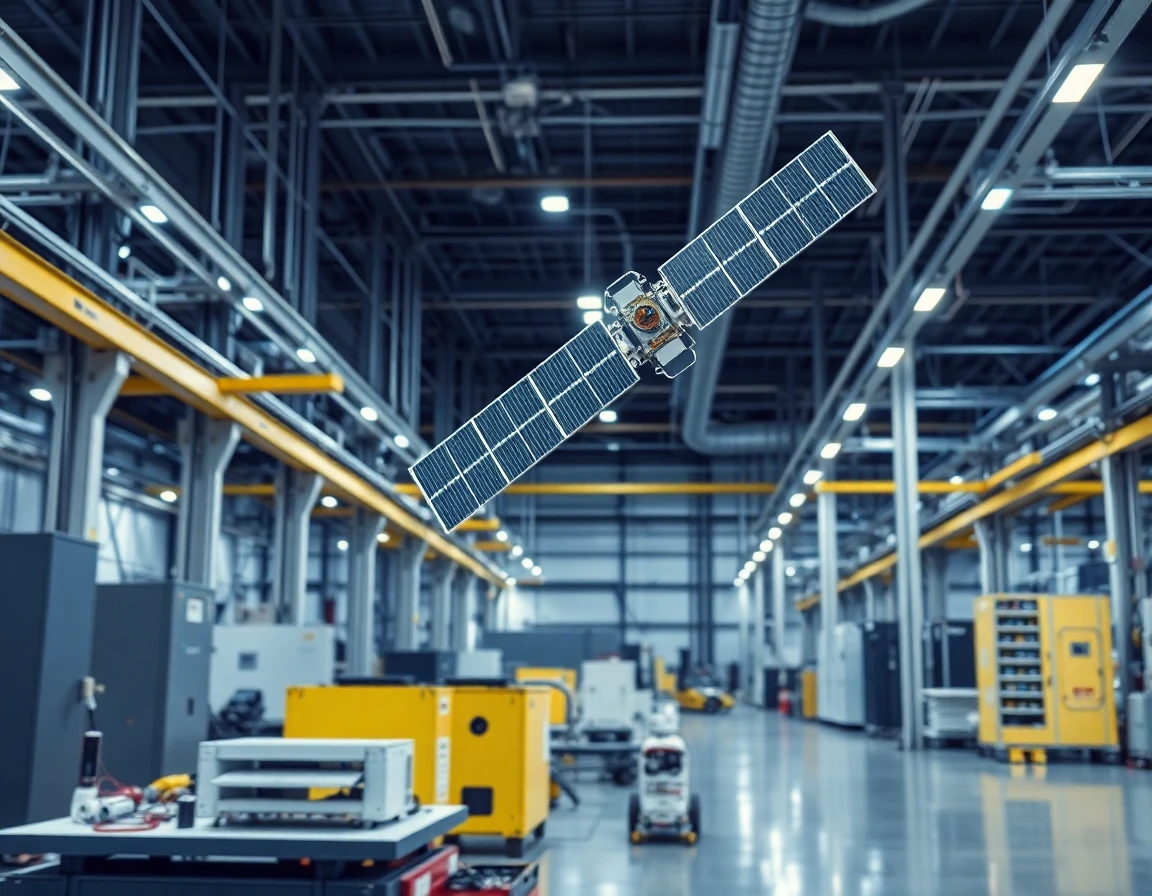
The aerospace industry is witnessing a remarkable transformation in satellite constellations, driven by key players like SpaceX and Amazon. Recent developments over the past month have not only accelerated deployment efforts but also raised crucial questions about orbital congestion and regulatory frameworks. This article delves into the latest advancements, regulatory approvals, and the implications for the future of space operations.
Launches and Deployments: A Competitive Race
SpaceX Starlink Advances
On March 1, 2026, SpaceX continued its aggressive expansion of the Starlink network by launching 29 satellites aboard the Falcon 9 rocket from Cape Canaveral Space Force Station. This mission, designated Starlink 10-41, marked SpaceX’s 22nd mission of 2026, further adding to the 566 Starlink satellites deployed year-to-date. The Falcon 9 booster B1078 achieved its 26th flight, successfully landing on the droneship ‘Just Read the Instructions’ just 8.5 minutes after liftoff.
This relentless pace highlights SpaceX’s commitment to enhancing global broadband connectivity through its low Earth orbit (LEO) constellation. The company’s innovative use of precision accelerometers ensures optimal satellite placement and trajectory management, addressing potential congestion in orbital paths.
Amazon’s Project Kuiper Expansion
In a parallel effort, Amazon’s Project Kuiper made significant strides with a successful launch on February 12, 2026, deploying satellites on Arianespace’s Ariane 64 rocket. This launch expanded the Kuiper constellation to over 200 satellites operating at an altitude of 630 km. Following the initial health checks and orbital raises, Amazon plans additional launches throughout 2026, aiming to create a robust alternative to existing broadband providers.
The integration of advanced sensor modules within these satellites enhances their operational capabilities, enabling comprehensive motion sensing and stability required for maintaining optimal performance in crowded orbital environments.
Regulatory Landscape: Navigating Approvals and Proposals
Logos Space Mega-Constellation Approval
In a significant regulatory development, the Federal Communications Commission (FCC) approved Logos Space’s proposal for a mega-constellation comprising 3,960 non-geostationary satellites on February 5, 2026. This initiative aims to provide enterprise and government connectivity using Ka, Q/V, and E-band frequencies at altitudes between 860 and 925 km. The phased rollout will commence with an initial 1,092 satellites, with the first launch anticipated in 2027.
SpaceX’s Ambitious Proposal
Additionally, SpaceX filed a proposal with the FCC on January 30, 2026, for a megaconstellation that could encompass up to 1 million satellites. Intended to support space-based data centers positioned between 500 and 2,000 km, this ambitious project aims to address growing data demands but raises significant concerns regarding orbital congestion. Public commentary on this proposal is ongoing, reflecting the critical dialogue surrounding sustainable space operations.
Defense and Emerging Partnerships
Mitsubishi Electric’s Tri-Sat Initiative
The defense sector is also adapting to the evolving satellite landscape. On February 20, 2026, Mitsubishi Electric announced the formation of a joint venture to develop Japan’s stand-off defense satellite constellation, known as Tri-Sat. This initiative will leverage high-frequency imagery capabilities via dedicated ground facilities, ensuring that the Japanese Ministry of Defense has access to timely and accurate data for strategic decision-making.
This partnership emphasizes the necessity for high-performance components, such as quartz MEMS gyroscopes and high-precision advanced navigation systems, to ensure reliable satellite functionality in defense applications.
Addressing Orbital Congestion Risks
As the satellite constellation landscape expands, concerns about orbital congestion and the potential for Kessler syndrome—a scenario where collisions generate debris leading to further collisions—are becoming increasingly pressing. With approximately 14,000 active satellites in orbit and over 1.23 million additional satellites proposed, experts warn of a potential collision every 3.8 days without active maneuvers. Current estimates indicate over 50,000 pieces of debris greater than 10 cm orbiting the Earth, necessitating immediate regulatory and operational strategies to mitigate risks.
The Future of Space Science and Commercial Endeavors
In a promising development for commercial space science, February 27, 2026, marked the ‘first light’ from the world’s first commercial space science satellite, which is set to enhance astronomical observations and data collection. This satellite is poised to utilize advanced technologies like the DBY021550M system, featuring a mini lithium niobate optical chip designed for compact systems while ensuring high performance and reliability.
Conclusion
The rapid advancements in satellite constellations underscore a dynamic and competitive aerospace landscape, marked by significant launches, regulatory approvals, and emerging partnerships. As companies like SpaceX and Amazon lead the charge in expanding global connectivity, the industry must also confront the challenges of orbital congestion and debris management. The future of satellite constellations will depend on innovative technologies and collaborative efforts to ensure sustainable and safe operations in the ever-crowded space environment.
References
-
SpaceX launches 29 Starlink satellites on Falcon 9 rocket from Cape … (spaceflightnow.com) - 3/2/2026 This was SpaceX’s 22nd mission of the year supporting its broadband internet satellite constellation in low Earth orbit. … February 27, 2026.
-
‘First light’ from world’s first commercial space science satellite … (www.eurekalert.org) - 2/27/2026 News Release 27-Feb-2026. ‘First light’ from world’s first commercial space science satellite heralds a new era for astronomical data and King’s collaborations … constellation Ursa Major or the Great Bear …
-
10 Hottest Companies in Satellite for 2026 (interactive.satellitetoday.com) - 2/24/2026 In February, ArkEdge Space linked up with SKY Perfect JSAT to accelerate the commercialization of micro-satellite constellations in a major …
-
Too many satellites? Is Earth’s orbit headed for catastrophe? (earthsky.org) - 2/20/2026 As of February 2026, approximately 14,000 active satellites are in orbit. An additional 1.23 million proposed satellite projects are in …
-
Mitsubishi Electric’s JV Tri-Sat Constellation Selected for Satellite … (us.mitsubishielectric.com) - 2/20/2026 Private-sector satellite constellation will support Japan’s stand-off defense capability.
-
Too many satellites? Earth’s orbit is on track for a catastrophe—but … (phys.org) - 2/18/2026 As of February 2026, approximately 14,000 active satellites are in orbit. An additional 1.23 million proposed satellite projects are in …
-
First heavy-lift launch grows constellation to 200+ satellites (www.aboutamazon.com) - 2/17/2026 February 12: Amazon expands satellite constellation with successful LE-01 mission … Launch date/time: Thursday, February 12, 2026, 8:45 a.m. PST | 4:45 p.m. UTC …
-
FCC Authorizes Logos Space to Deploy 3,960-Satellite Mega … (news.satnews.com) - 2/5/2026 FCC Authorizes Logos Space to Deploy 3,960-Satellite Mega-Constellation for Enterprise Connectivity. February 5, 2026. Share. Share on Facebook.