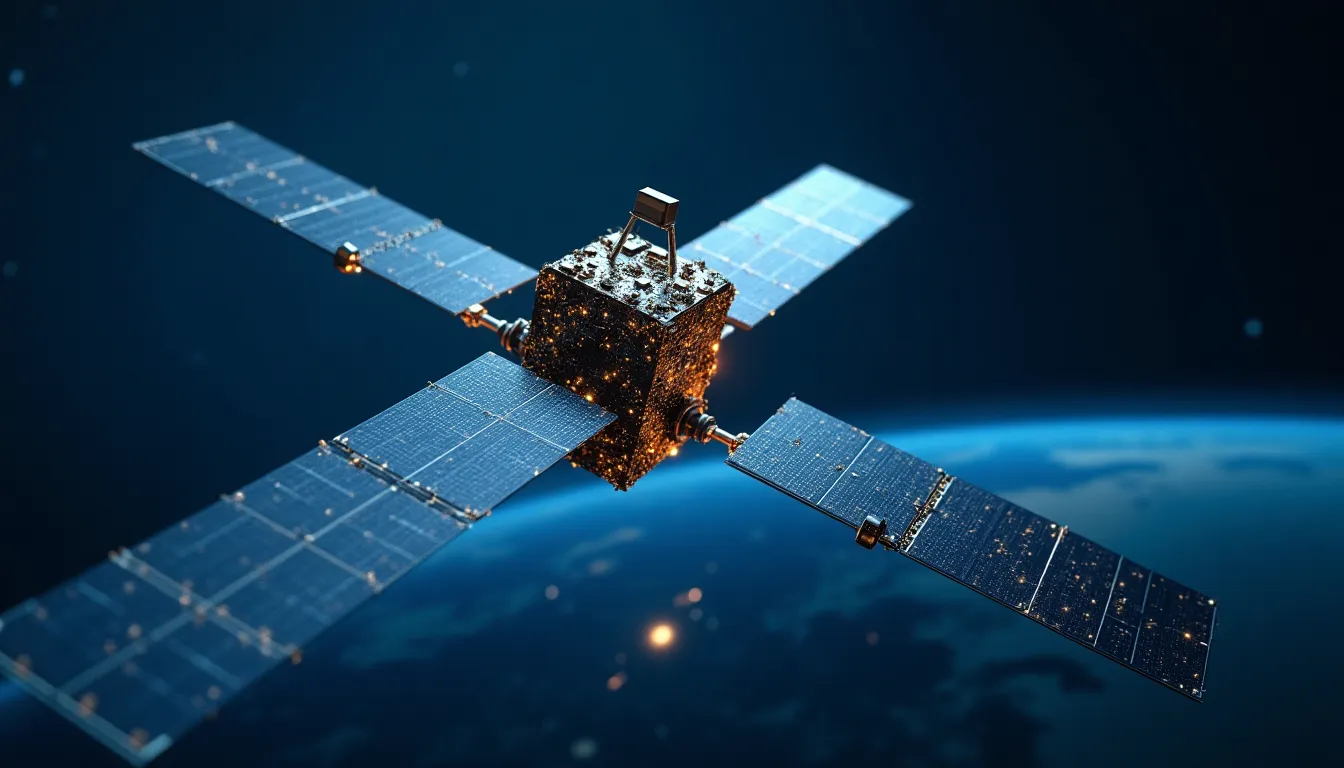
In the fast-evolving landscape of aerospace and communications, satellite constellations are becoming crucial in providing global connectivity and broadband services. Recent developments highlight significant advancements from leading companies such as SpaceX and Amazon, alongside regulatory changes that are set to reshape the industry. This article delves into the latest milestones achieved in satellite technology, the competitive landscape in Low Earth Orbit (LEO), and the implications for the broader telecommunications sector.
SpaceX Starlink Expansion
On February 11, 2026, SpaceX successfully launched 24 additional Starlink satellites using its Falcon 9 rocket from Vandenberg Space Force Base in California. This launch marked another step in SpaceX’s aggressive strategy to expand its satellite constellation, which now encompasses nearly 9,400 satellites. The newly deployed satellites are part of SpaceX’s ongoing efforts to enhance global broadband access and compete with other providers in the rapidly growing LEO broadband market.
“Each launch brings us closer to providing reliable internet access to underserved areas around the world,” said Gwynne Shotwell, President and COO of SpaceX. The company’s focus on delivering high-speed internet to remote regions underscores its commitment to bridging the digital divide.
Amazon’s Leo Initiative Milestone
Just a day after SpaceX’s launch, on February 12, 2026, Amazon’s Leo satellite constellation—previously known as Project Kuiper—celebrated a significant milestone. Utilizing the newly enhanced Ariane 64 rocket, Amazon successfully deployed 32 satellites into a 465 km orbit from the Guiana Space Center in French Guiana. This launch increased the total number of satellites in the Amazon Leo constellation to over 200, with a long-term goal of reaching 3,200 satellites through more than 100 planned missions.
The Ariane 64, which features a four-booster configuration and a 20-meter fairing, was able to carry the largest payload to date for this rocket. This development not only strengthens Amazon’s position in the satellite communications market but also bolsters the European space industry, which is poised to see billions in investments as competition intensifies.
“This successful launch is a testament to our ongoing commitment to providing affordable and high-speed internet access across the globe,” stated Dave Limp, Senior Vice President of Amazon Devices and Services.
Logos Space FCC Authorization
The Federal Communications Commission (FCC) took a significant step on February 5, 2026, by granting Logos Space authorization to deploy a mega-constellation of approximately 3,960 satellites, with some estimates suggesting up to 4,178. These satellites will be positioned in multiple orbital shells at altitudes ranging from 870 to 925 km, featuring a range of operational frequencies across Ka, Q/V, and E-bands.
This constellation is designed to support enterprise and government connectivity, utilizing advanced coherent optical crosslinks to enable high-speed inter-satellite data transfer. The strategic goal is to enhance U.S. competitiveness in the LEO market while addressing concerns related to spectrum interference and space debris management.
Regulatory Progress: SAT Streamlining Act
In conjunction with these technological advancements, the U.S. Senate Commerce Committee approved the SAT Streamlining Act on February 12, 2026. This legislation aims to expedite the licensing process for satellite mega-constellations, establishing essential guardrails to manage interference, debris, spectrum allocation, and national defense concerns.
Key provisions of the SAT Streamlining Act include criteria for expedited applications, a defined 15-day cure period for incomplete submissions, and enhanced interagency coordination. This regulatory framework is expected to facilitate growth in the satellite industry, enabling faster deployment of innovative technologies and services.
The Competitive Landscape
As competition in the LEO broadband sector intensifies, companies are increasingly focusing on advanced technologies to enhance their offerings. Both SpaceX and Amazon are investing heavily in next-generation satellite systems that incorporate sophisticated navigation and tracking systems, such as high-performance MEMS accelerometers and advanced sensor modules. These technologies are critical for ensuring precise positioning and stability, which are essential for maintaining optimal satellite performance in dynamic environments.
Moreover, innovations such as the ZQXXSGDSS System and the DBY011550M System are paving the way for improved optical communication capabilities, enabling seamless data transfer and enhanced connectivity. As the demand for high-speed internet continues to rise, these advancements will play a pivotal role in shaping the future of satellite communications.
Conclusion
The recent developments in satellite constellations signify a transformative period for global connectivity, driven by key players like SpaceX and Amazon. With regulatory changes aimed at facilitating rapid growth and advancements in satellite technologies enhancing service delivery, the future of LEO broadband networks looks promising. As these companies continue to innovate and expand their capabilities, the potential for improved internet access and communication services worldwide is boundless.
References
-
SpaceX Adds 24 Satellites to Starlink Constellation After West Coast … (aiaa.org) - 2/13/2026 A SpaceX Falcon 9 rocket carrying 24 Starlink satellites launched from Vandenberg Space Force Base in California on Wednesday, Feb. 11, 2026 …
-
First Ariane 64 version places 32 Amazon Leo satellites into 465-km … (www.spaceintelreport.com) - 2/13/2026 First Ariane 64 version places 32 Amazon Leo satellites into 465-km orbit, all are healthy; next Ariane 6 launch also for Amazon. by Peter B. de …
-
Arianespace successfully launches 32 Amazon Leo satellites with … (newsroom.arianespace.com) - 2/13/2026 On February 12, 2026 at 1:45 p.m. local time (4:45 p.m. UTC, 5:45 p.m. CET), Arianespace successfully launched 32 Amazon Leo satellites with …
-
FCC greenlights Logos Space’s 4,178-satellite mega … - DCD (www.datacenterdynamics.com) - 2/12/2026 The constellation’s satellites would operate across seven orbital shells ranging 870 kilometers to 925 kilometers with inclinations of 28 to 90 …
-
Commerce Committee Approves Cantwell, Cruz Agreement on … (www.commerce.senate.gov) - 2/12/2026 Commerce Committee Approves Cantwell, Cruz Agreement on Satellite Streamlining Legislation, Addressing Key Cantwell Concerns. February 12, 2026.
-
Europe’s Ariane 6 to launch Amazon constellation satellites into orbit (phys.org) - 2/11/2026 An enhanced version of Europe’s Ariane 6 rocket will blast off Thursday to launch 32 satellites into orbit, forming part of the Amazon Leo …
-
Amazon Leo launches first heavy-lift mission of 2026 with Arianespace (www.aboutamazon.com) - 2/10/2026 The LE-01 mission deployed 32 satellites into low Earth orbit, bringing the total constellation to 200+ satellites. David Cavaillolès, …
-
FCC Authorizes Logos Space to Deploy 3,960-Satellite … - SatNews (news.satnews.com) - 2/5/2026 FCC Authorizes Logos Space to Deploy 3,960-Satellite Mega-Constellation for Enterprise Connectivity. February 5, 2026. Share. Share on Facebook.