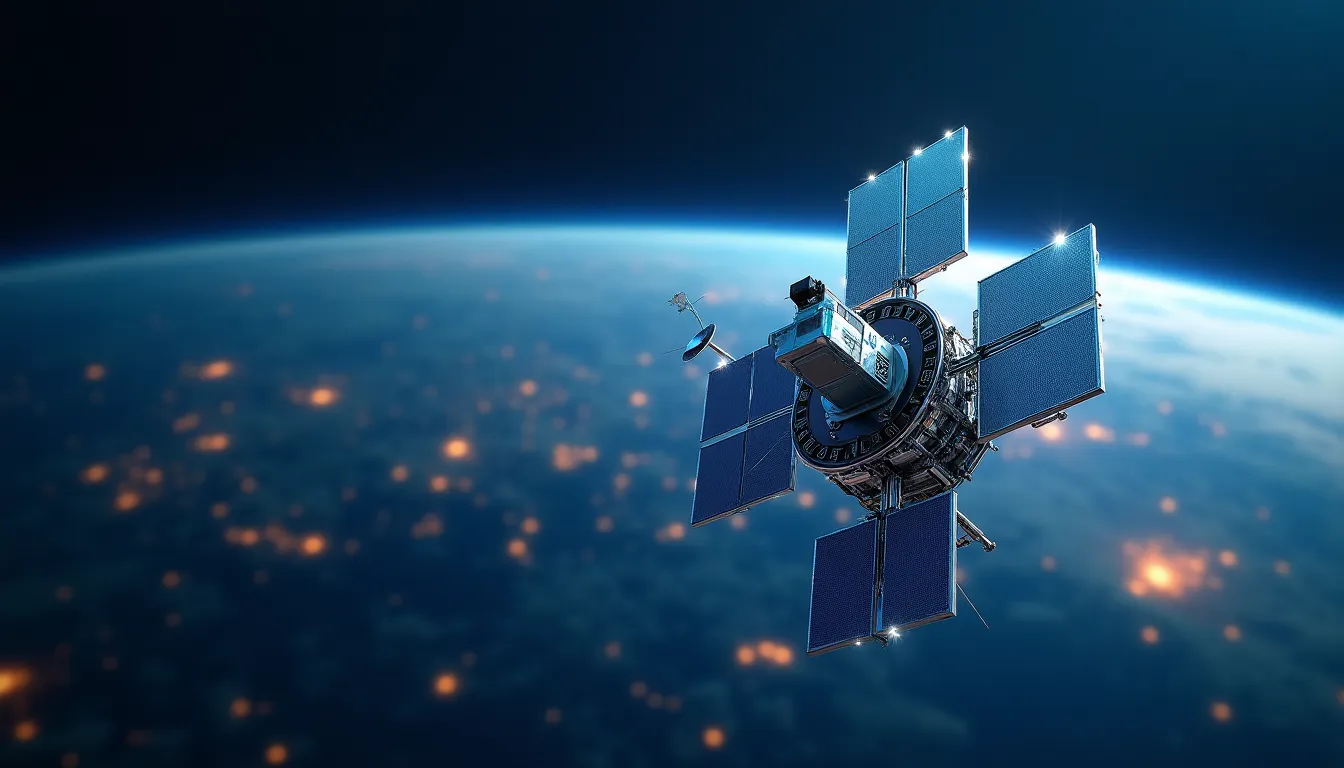
Recent developments in satellite constellations are transforming the aerospace landscape, with a focus on enhancing global connectivity and improving weather observation capabilities. As we enter 2026, significant advancements, particularly in commercial megaconstellations, are set to reshape the way we access data and services from space.
Blue Origin’s TeraWave: A New Era of Connectivity
In a bold move to enter the high-capacity satellite market, Blue Origin has announced its TeraWave constellation, comprising 5,408 satellites. This ambitious project will feature a hybrid architecture with 5,280 low Earth orbit (LEO) satellites operating at altitudes between 520 and 540 km, and 128 medium Earth orbit (MEO) satellites positioned between 8,000 and 24,200 km. The LEO layer will utilize radio frequency (RF) links in Q/V-band, delivering remarkable data rates of up to 144 Gbps per customer, while the MEO layer will enhance global backhaul through optical interlinks, facilitating a staggering total capacity of 6 terabits per second (Tbps).
Blue Origin aims to target enterprise and government users, with a focus on avoiding residential congestion by initially supporting approximately 100,000 high-capacity users. The deployment is expected to commence in Q4 2027 using the New Glenn rocket, marking a significant step forward in commercial space capabilities. This initiative contrasts sharply with the in-house launch strategy of competitors like SpaceX’s Starlink, which currently operates over 9,400 satellites and is expanding rapidly.
EUMETSAT’s EPS-Sterna: Advancements in Weather Monitoring
In parallel with developments in connectivity, the European Organisation for the Exploitation of Meteorological Satellites (EUMETSAT) has received approval for its EPS-Sterna program. This innovative polar-orbiting microsatellite constellation will comprise 20 satellites, with the first six scheduled for launch in 2029. The EPS-Sterna constellation is designed to enhance microwave atmospheric measurements, including temperature, humidity, and cloud observations.
By enabling frequent revisits to the same Earth spot within three hours—compared to the current twice-daily observations—the EPS-Sterna constellation promises to reduce forecast errors by up to 6-9%. The satellites will utilize identical microwave sounders, providing global data in approximately one hour via EUMETCast and EUMETView systems. This initiative is a collaborative effort between the European Space Agency (ESA) for satellite procurement and EUMETSAT for ground operations and launches, ensuring comprehensive support across its 29 member states.
GPS III SV10: Enhancing Navigation Accuracy
On the U.S. front, SpaceX is set to launch the GPS III SV10 satellite, further bolstering the Global Positioning System (GPS) constellation. Scheduled for liftoff on January 26, 2026, from Cape Canaveral Space Force Station, this mission will utilize the Falcon 9 booster B1096, marking its fifth flight. The GPS III program aims to enhance the accuracy and reliability of navigation services globally, continuing the modernization efforts seen with previous satellites like SV08.
Market Trends and Orbital Congestion
The emergence of various satellite constellations is leading to a significant convergence in the market. Key players include:
| Constellation | Operator | Satellites | Key Focus | Status |
|---|---|---|---|---|
| Starlink | SpaceX | 9,400+ | Global broadband, direct-to-device | Operational, expanding |
| TeraWave | Blue Origin | 5,408 | Enterprise connectivity, 6 Tbps | Announced, deploy 2027 |
| EPS-Sterna | EUMETSAT | 20 | Weather microwave measurements | Approved, launch 2029 |
| BlueWalker | AST SpaceMobile | 60 planned | Direct-to-handset | Beta phase in H1 2026 |
| Guowang/Qianfan | China | 13,000+ | LEO broadband | Under construction |
Despite the promising advancements, the increase in satellite deployments raises concerns regarding orbital congestion. Many experts warn that the growing number of satellites could complicate launches, increase observation challenges, and heighten collision risks in space. Mitigation strategies for these issues are lagging behind the rapid pace of deployment.
Conclusion
As satellite constellations evolve, they hold the potential to revolutionize industries ranging from telecommunications to environmental monitoring. Blue Origin’s TeraWave and EUMETSAT’s EPS-Sterna are prime examples of how innovative technologies can enhance global connectivity and improve forecasting accuracy. However, the industry must address the looming challenges of orbital congestion to ensure sustainable growth. As we look to the future, the intersection of advanced navigation systems, such as high-performance MEMS accelerometers and precision sensors, will play a critical role in the successful deployment and operation of these next-generation satellite networks. The race to optimize space utilization while maximizing service offerings is just beginning, and the coming years will be crucial in determining the trajectory of satellite technology.
References
-
SpaceX to launch GPS 3 satellite following switch from ULA Vulcan … (spaceflightnow.com) - 1/26/2026 On January 6, 2026, GPS 3 Space Vehicle 10 was loaded aboard a C-17 Globemaster 3 at Buckley Space Force Base, Colorado. The GPS constellation …
-
Blue Origin is working on its own thousand satellite constellation (spaceexplored.com) - 1/25/2026 Blue Origin announced yet another project it had undertaken for its missions for space domination across all sectors. Called Terrawave, it will be a constellation of over 5,000 satellites designed to bring symmetrical, high-speed internet connections worldwide.
-
TeraWave: Blue Origin Enters the High-Capacity Backbone Market … (news.satnews.com) - 1/25/2026 TeraWave: Blue Origin Enters the High-Capacity Backbone Market with 6 Tbps Constellation. January 25, 2026. Share. Share on Facebook. Share.
-
Reuters Events Launches Exclusive ‘Space and Satellites USA 2026 … (www.spaceintelreport.com) - 1/25/2026 Blue Origin: We’re building a 5,408-satellite constellation in LEO and MEO orbit for corporate, government connectivity · OHB raises 3-year …
-
Jeff Bezos’ Blue Origin plans to build 5,400-satellite megaconstellation (www.space.com) - 1/21/2026 Blue Origin just announced “TeraWave,” a planned satellite megaconstellation designed for customers who need super-high-throughput …
-
Blue Origin Introduces TeraWave, a 6 Tbps Space-Based Network … (www.blueorigin.com) - 1/21/2026 On January 22, 2026, Blue Origin successfully completed the 38th flight for the New Shepard program and first of 2026. Jan 21, 2026. News …
-
Convergence Comes of Age: 2026 Shifts Satellite Promise into … (www.satellitetoday.com) - 1/16/2026 The market for satellite-enabled connectivity is now entering a new phase. With constellations expanding and NTN-compatible devices advancing, …
-
Europe backs transformative polar satellite constellation | EUMETSAT (www.eumetsat.int) - 1/12/2026 Europe backs transformative polar satellite constellation. EPS-Sterna programme will deliver unprecedented atmospheric observations from 2029.
-
Bezos’ Blue Origin readies 6-terabit super satellite constellation (www.lightreading.com) Blue Origin will target enterprises with ‘TeraWave,’ a planned network of LEO and MEO satellites that will support 6 Tbit/s of capacity.