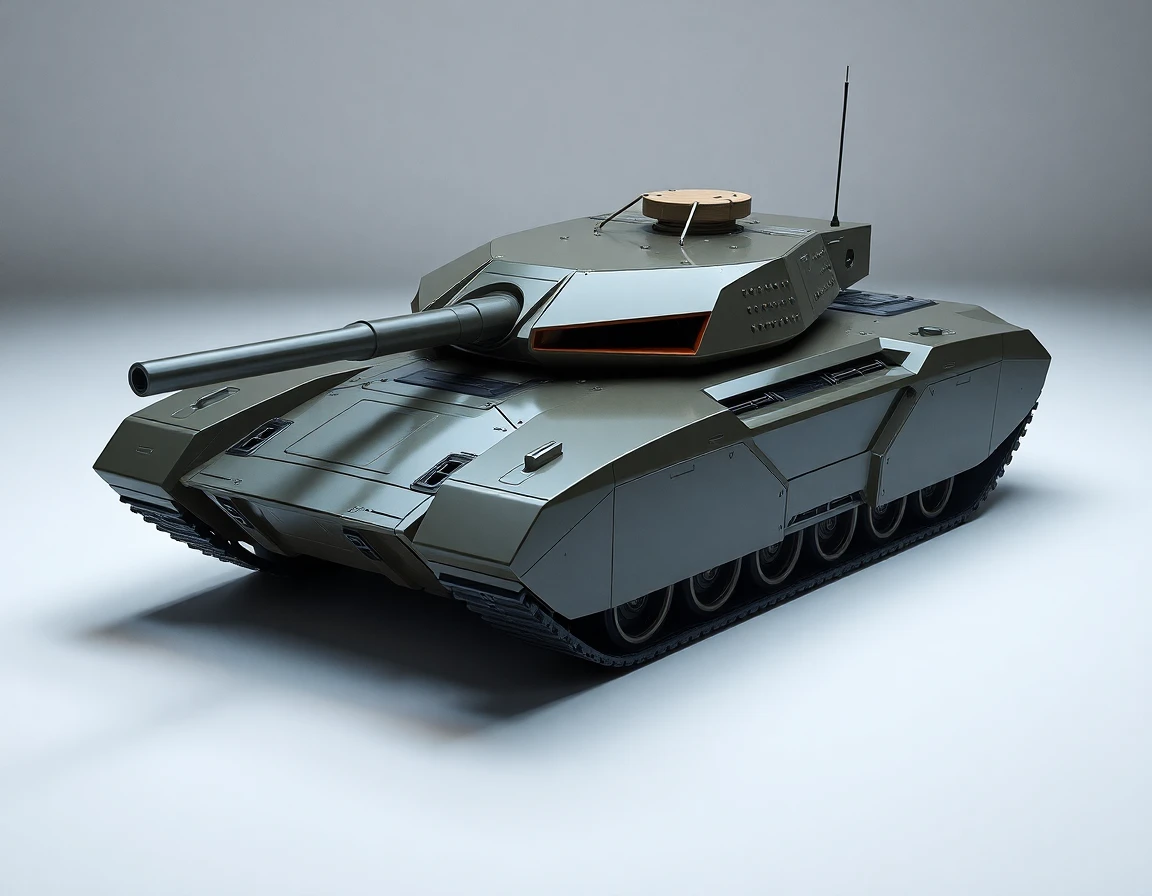
On April 30, the U.S. Department of Defense released a memorandum on “Army Transformation and Procurement Reform,” initiating a new round of “transformation” for the U.S. Army. Among the news, the cancellation of the M10 “Buker” light tank project, which had only been in service for one year, sparked widespread discussion.
Since the retirement of the M551 “Sheridan” light tank in the 1990s, the U.S. Army has not equipped itself with light tanks for a long time, relying mainly on air support for the maneuverable direct firepower of infantry units. In recent years, with the adjustment of U.S. military strategic focus, the U.S. Army introduced the “Multi-Domain Operations” concept, emphasizing rapid deployment capabilities and combat capabilities in complex environments. This led to the proposal of the “Maneuver Fire Protection” project, which plans to produce 504 light tanks by 2035 to equip 12 independent light tank battalions, enhancing the mobility and sustainability of ground support firepower for infantry brigades. In June 2023, the new generation of light tanks, designated M10 “Buker,” was unveiled. In June 2024, the first batch of 24 “Buker” light tanks officially entered service, delivered to the 82nd Airborne Division for combat testing.
As the main combat equipment of the U.S. Army infantry brigade, the design intent of the “Buker” light tank was to execute joint operations under multi-domain combat conditions. Therefore, strategic airlift capability is a crucial technical indicator. According to the initial design requirements, the combat weight of the vehicle should not exceed 35 tons, allowing a C-17 transport aircraft to carry two units simultaneously. However, during the development process, the U.S. Army repeatedly modified the technical specifications, ultimately resulting in a combat weight of up to 42 tons after the vehicle’s finalization, meaning a C-17 could only transport one unit, comparable to the airlift efficiency of the over 70-ton M1 main battle tank. U.S. Army officials pointed out that “this violates both airlift principles and light tank principles.” Additionally, the prototype’s power output was significantly below the design standards. To meet the design specifications, the vehicle had to be fitted with a more powerful engine, which reduced its maximum range from 480 kilometers to 305 kilometers. It can be said that the overweight “Buker” only has the name of a light tank but lacks its true capabilities, placing it in an awkward position on the battlefield of “not fast enough and not far enough.”
The main gun of the “Buker” light tank is the M35 type 105mm rifled gun, which has deficiencies such as weak armor penetration capability, limited compatible ammunition types, and low combat firing rate. This gun is only equipped with M900 series armor-piercing rounds and AMP multi-purpose rounds. When firing the M900A1 tail-stabilized armor-piercing round with a depleted uranium core, the armor penetration thickness at a distance of 2000 meters is approximately 450 to 500 millimeters, making it difficult to penetrate the frontal armor of currently active main battle tanks; its effectiveness is also insufficient against well-protected armored targets. The AMP multi-purpose round has capabilities for armor penetration, fragmentation, and anti-infantry roles, but its functions are “broad but not refined.” The U.S. Army has evaluated it as “not sufficient to destroy fortified targets and less effective against soft targets than a 30mm chain gun.” In summary, the outdated technical and tactical indicators of the main gun make it challenging to gain firepower advantages against advanced main battle tanks and light tanks on future battlefields, failing to provide reliable fire support for infantry.
The prototype of the “Buker” light tank weighs 38 tons. The U.S. military has taken measures such as reducing the number of road wheels and using hollow road wheels to decrease weight, but as a result, the vehicle can only withstand direct fire from 14.5mm armor-piercing rounds at a distance of 500 meters. Additionally, the vehicle has issues such as a short maximum range, high internal noise during off-road driving, a short average fault interval mileage, and smoke backflow after firing, all of which affect operational capabilities. Furthermore, due to weight limitations, the vehicle is not equipped with an active protection system, making it difficult to counter attacks from anti-tank missiles and drones.
The cancellation of the “Buker” light tank project has long been predictable. The prototype rolled off the assembly line in April 2020, and two years later, the Russia-Ukraine conflict broke out. During this period, various unmanned systems and advanced anti-armor weapons destroyed a large number of tanks and armored vehicles, including U.S. equipment such as the M1 main battle tank, M2 infantry fighting vehicle, and “Striker” armored vehicle. This regional conflict is considered to have “changed the nature of ground combat,” with counter-drone strikes and enhanced active protection capabilities becoming pressing issues for armored vehicles. Against this backdrop, the “Buker” light tank struggles to meet battlefield demands in terms of firepower, protection, and mobility, facing the embarrassment of being “obsolete upon entry.” U.S. media even referred to it as a “lemon” that the U.S. Army did not need, and its project cancellation is viewed as a “damage control” measure in the U.S. Army’s strategic adjustments.
From weight control issues leading to deployment dilemmas, to the awkward balance of firepower, mobility, and protection; from the strategic environment’s drastic changes causing demand misalignment, to the timely cancellation for “damage control.” The “Buker” project has become a microcosm of the current state of the U.S. military, the nuances of which may be best understood by those in charge. (Yunshan, Ruishi)
Source: China National Defense News